
§Author· 2 books
Nella Larsen
Also known as Nellie Walker, Nellallitea Larsen, Nellye Larson, Nellie Larsen, Nella Larsen Imes
The literary movement of the Harlem Renaissance was profoundly shaped by pioneering novels exploring complex questions of race, class, and female identity in early twentieth-century America. Nella Larsen emerged as an essential voice of this era through her groundbreaking debut novel Quicksand, which drew directly upon her biracial background to examine the social isolation of mixed-race women.
Born Nellie Walker in Chicago on April 13, 1891, to a Danish mother and a Afro-Caribbean father, Larsen spent her early childhood navigating complicated family dynamics after her father's early death and her mother's remarriage to a white Danish man. She attended high school associated with Fisk University before auditing classes at the University of Copenhagen, eventually earning a nursing degree from Lincoln Hospital and a library science certificate from the New York Public Library.
Career & Background
After settling in New York City, Larsen worked as a nurse and librarian before turning her focus to fiction. Her entry into Harlem's literary circles gained rapid momentum in the late 1920s when she published short stories and her two celebrated novels, Quicksand in 1928 and Passing in 1929. Passing examined two light-skinned Black women whose diverging choices regarding racial identity highlighted the profound social and emotional consequences of crossing color lines in segregated America.
Despite earning critical praise and becoming the first African American woman awarded a Guggenheim Fellowship for creative writing in 1930, Larsen stepped away from public literary life following plagiaristic accusations surrounding a short story and the dissolution of her marriage to Elmer Imes. She returned to nursing in New York City hospitals, where she worked quietly until her death on March 30, 1964. Decades later, her works experienced a major critical revival as scholars reclaimed her pivotal contributions to modernist fiction.
Writing Style & Themes
Larsen's narrative approach is distinguished by psychological realism, emotional restraint, and acute observation of social mobility. Her stories center on biracial protagonists caught between white and Black worlds, detailing the marginalization and internal displacement resulting from rigid racial definitions. Rather than offering simplified resolutions, her work exposes the psychological pressure, desire, and anxiety experienced by middle-class Black women navigating early twentieth-century society.
Major Works
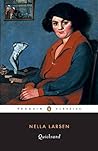
- Quicksand — Published in 1928, this semi-autobiographical debut novel follows Helga Crane, a biracial woman who travels between the American South, Harlem, and Copenhagen in a restless quest for personal autonomy and belonging.
- Passing — Published in 1929, this novel traces the reconnected lives of two childhood friends, Irene Redfield and Clare Kendry, whose contrasting relationships with their Black heritage lead to tragic tension in 1920s Harlem.

§ About Nella Larsen's books
- Books on SansFiction
- 2
- Published
- 1928–1929
- Average rating
- 4.0 / 5 across 143 ratings
- Genres
- African Americans, African American Women, General, Historical Fiction
Start here: Passing (1929)
A NETFLIX BOOK CLUB PICK Nella Larsen's powerful, thrilling, and tragic tale about the fluidity of racial identity that continues to resonate today. A New York Times Editors’ Choice. Now a major motion picture starring Tessa Thompson and Alexander Skarsgård Clare Kendry is living on the edge.
Common questions about Nella Larsen
- Who is Nella Larsen?
- After settling in New York City, Larsen worked as a nurse and librarian before turning her focus to fiction. Her entry into Harlem's literary circles gained rapid momentum in the late 1920s when she published short stories and her two celebrated novels, Quicksand in 1928 and Passing in 1929.
- What is Nella Larsen best known for?
- Nella Larsen is best known for Passing, published in 1929 with 131 ratings and a 4.0 average. It is the most-rated of Nella Larsen's books on SansFiction.
- How many books has Nella Larsen written?
- SansFiction lists 2 books by Nella Larsen, published between 1928 and 1929. The most popular are Passing and Quicksand.
- Which Nella Larsen book should I read first?
- Passing is the usual place to start: it is Nella Larsen's most-rated book here, with a 4.0 average.
- What genres does Nella Larsen write?
- Nella Larsen's books on SansFiction are tagged African Americans, African American Women, General and Historical Fiction.
Explore: African Americans · African American Women · General · Historical Fiction