MJ
§Author· 1 book
Min Jin Lee
Also known as 이민진
Multigenerational historical fiction and social realism detailing the Korean diaspora have reshaped contemporary literature about identity, exile, and immigration, most prominently through the saga Pachinko. Min Jin Lee writes expansive stories that examine how economic systems, cultural expectations, and political displacement impact individuals across generations. Her work spans historical fiction set in twentieth-century East Asia as well as contemporary narratives exploring class mobility and ambition among Korean Americans.
Career & Background
Born in Seoul, South Korea, in 1968, Min Jin Lee immigrated to the United States as a child and grew up in New York City. She completed her undergraduate studies at Yale University before earning a Juris Doctor degree from Georgetown University Law Center. After practicing law, Lee shifted her career to journalism and fiction writing, focusing her work on the experiences, social dynamics, and history of the Korean diaspora across different eras and continents. In 2019, she became a writer-in-residence at Amherst College in Massachusetts.
Lee's literary achievements have earned broad international recognition and prestigious honors. She served as the New York State Author Laureate for 2025–2027, receiving the Edith Wharton Citation of Merit. Her honors include the Manhae Grand Prize for Literature, the Bucheon Diaspora Literary Award, and the Samsung Happiness for Tomorrow Award for Creativity from South Korea, along with the Fitzgerald Prize for Literary Excellence in 2024. She has received fellowships from the Guggenheim Foundation, the Radcliffe Institute for Advanced Study at Harvard, and the New York Foundation for the Arts, and is an inductee of both the New York Foundation for the Arts Hall of Fame and the New York State Writers Hall of Fame.
Writing Style & Themes
Lee is known for her immersion-based research process, gathering interviews, primary material, and lived experiences to construct authentic social environments. Her research methods have included taking a millinery class at the Fashion Institute of Technology, observing Wall Street poker games, and interviewing dozens of Korean-Japanese residents. She organizes her collected research in detailed physical archives using Bankers Boxes. Drawing inspiration from novelist Willa Cather, Lee incorporates a disciplined daily writing ritual that includes reading a chapter of the Bible six days a week before writing.
Thematically, Lee's novels explore class strata, systemic discrimination, religious faith, family duty, and the search for belonging among displaced populations. Her narratives highlight how geopolitical forces and cultural pressures condition personal relationships, economic survival, and moral choices. Rather than presenting abstract social commentary, her prose grounds these themes in concrete details of domestic life, labor, and educational ambition.
Major Works
- Free Food for Millionaires — Published in 2007, Lee's debut novel explores the life of a young Korean American woman navigating social hierarchy, ambition, and family expectations in New York City following her graduation from Princeton University.
- Pachinko — Published in 2017, this epic historical novel follows four generations of an ethnic Korean family living in Japan throughout the twentieth century. The book was a finalist for the National Book Award, runner-up for the Dayton Literary Peace Prize, and was named one of The New York Times's 100 Best Books of the Century.
- American Hagwon — Announced as the third installment in her Korean trilogy, this novel focuses on the central role of education and academic pressure in Korean culture and society.
§All Books
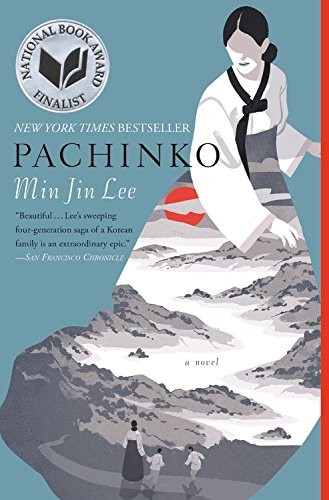
Pachinko
Min Jin Lee, 2017
593 ratings
§ About Min Jin Lee's books
- Books on SansFiction
- 1
- Published
- 2017
- Average rating
- 4.2 / 5 across 593 ratings
- Genres
- Classics, Family Saga, Fiction, Historical Fiction
The book: Pachinko (2017)
In this New York Times bestseller, four generations of a poor Korean immigrant family fight to control their destiny in 20th-century Japan–the inspiration for the television series on Apple TV+. In the early 1900s, teenaged Sunja, the adored daughter of a crippled fisherman, falls for a wealthy stranger.
Common questions about Min Jin Lee
- Who is Min Jin Lee?
- Born in Seoul, South Korea, in 1968, Min Jin Lee immigrated to the United States as a child and grew up in New York City. She completed her undergraduate studies at Yale University before earning a Juris Doctor degree from Georgetown University Law Center.
- What is Min Jin Lee best known for?
- Min Jin Lee is best known for Pachinko, published in 2017 with 593 ratings and a 4.2 average. It is the most-rated of Min Jin Lee's books on SansFiction.
- What genres does Min Jin Lee write?
- Min Jin Lee's books on SansFiction are tagged Classics, Family Saga, Fiction and Historical Fiction.
Explore: Classics · Family Saga · Fiction · Historical Fiction