
§Author· 4 books
Karl Marx
Also known as Karl Heinrich Marx
A foundational body of nineteenth-century political and economic critique transformed modern political theory through rigorous analyses of capital, labour, and historical class dynamics, epitomized by the radical text The Communist Manifesto. Karl Marx, a German philosopher, economist, sociologist, journalist, and revolutionary socialist, formulated the theory of historical materialism to explain how economic structures and class struggles shape human society and historical progress.
Career & Background
Born on May 5, 1818, in Trier in the Prussian Rhine province to a lawyer, Marx received a classical education before studying jurisprudence at Bonn and Berlin. His academic focus quickly shifted to philosophy and the ideas of G.W.F. Hegel and Ludwig Feuerbach, culminating in a doctorate in philosophy from the University of Jena in 1841. After serving briefly as the editor of a liberal newspaper in Cologne, he moved to Paris with his wife, Jenny, in 1843, immersing himself in revolutionary communist thought. Over the following decades, living in cities such as Brussels and London, he maintained a lifelong intellectual and political partnership with Friedrich Engels, with whom he produced seminal pamphlets and foundational theoretical texts.
Writing Style & Themes
Marx's writings combine philosophical critique, detailed historical analysis, and systematic economic theory. Central to his work is historical materialism, an analytical framework asserting that societal development and institutional forms are primarily driven by material conditions and class conflicts under capitalism. In works like Wage Labour and Capital and German Ideology, he examined the relationship between labor power, wage dynamics, and ideological structures. His prose ranges from sharp polemical agitation designed for working-class organization to meticulous economic investigation dissecting classical political economy and capital accumulation.
Major Works
- The Communist Manifesto — Co-authored with Friedrich Engels in 1848, this influential political pamphlet outlines the principles of modern communism, analyzing history through the lens of class struggle and calling for working-class solidarity.
- Capital: A Critique of Political Economy, Volume 1 — Published in 1867 as his major critique of classical political economy, this treatise analyzes the mechanisms of capitalism, commodities, surplus value, and the economic forces driving industrial society.
- German Ideology — Written alongside Engels, this critical work expounds the principles of historical materialism while critiquing contemporary German philosophy, particularly Hegelian idealism and Feuerbach's materialism.
- Wage Labour and Capital — Based on lectures delivered to working-class audiences, this treatise provides a clear analysis of economic relationships, explaining how wage labor functions within the capitalistic mode of production.
§All Books

The Communist Manifesto
Karl Marx, 1848
312 ratings
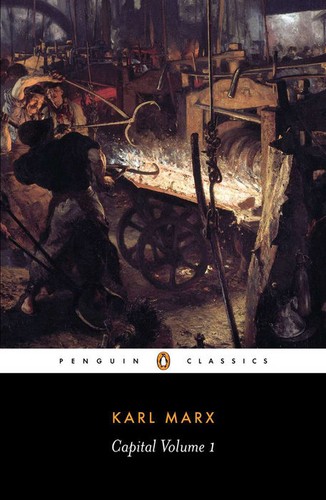
Capital: A Critique of Political Economy, Volume 1
Karl Marx, 1867
33 ratings

Wage Labour and Capital
Karl Marx, 1891
11 ratings

German Ideology
Karl Marx
3 ratings
§ About Karl Marx's books
- Books on SansFiction
- 4
- Published
- 1848–1891
- Average rating
- 3.6 / 5 across 359 ratings
- Genres
- General, History, Biography, Business & Economics
Start here: The Communist Manifesto (1848)
Available under a Creative Commons Attribution-ShareAlike License: http://www.marxists.org/archive/marx/works/1848/communist-manifesto/ One of the most influential political tracts ever published this short book succinctly explains the aims and purpose of the Communist League of the 19th century, giving the author’s theories of the class struggle which they…
Common questions about Karl Marx
- Who is Karl Marx?
- Born on May 5, 1818, in Trier in the Prussian Rhine province to a lawyer, Marx received a classical education before studying jurisprudence at Bonn and Berlin. His academic focus quickly shifted to philosophy and the ideas of G.W.F. Hegel and Ludwig Feuerbach, culminating in a doctorate in philosophy from the University of Jena in 1841.
- What is Karl Marx best known for?
- Karl Marx is best known for The Communist Manifesto, published in 1848 with 312 ratings and a 3.6 average. It is the most-rated of Karl Marx's books on SansFiction.
- How many books has Karl Marx written?
- SansFiction lists 4 books by Karl Marx, published between 1848 and 1891. The most popular are The Communist Manifesto, Capital: A Critique of Political Economy, Volume 1, Wage Labour and Capital and German Ideology.
- Which Karl Marx book should I read first?
- The Communist Manifesto is the usual place to start: it is Karl Marx's most-rated book here, with a 3.6 average.
- What genres does Karl Marx write?
- Karl Marx's books on SansFiction are tagged General, History, Biography and Business & Economics.
Explore: General · History · Biography · Business & Economics