
§Author· 3 books
Friedrich Engels
Also known as Friedrich Oswald
Co-authoring foundational texts of modern political economy and socialist theory provided a systematic critique of nineteenth-century industrial capitalism, most famously in the revolutionary pamphlet The Communist Manifesto. Friedrich Engels worked as a philosopher, social theorist, journalist, and businessman, combining direct observation of industrial working conditions with rigorous theoretical analysis alongside Karl Marx.
Career & Background
Born on 28 November 1820 in Barmen, Prussia, Friedrich Engels was the son of a prosperous cotton manufacturer. Sent to Manchester, England, to assist in managing the family textile firm, Engels directly observed the harsh social realities of industrialization and working-class poverty. He published radical political journalism, at times writing under the pseudonym Friedrich Oswald. In 1844, Engels met Karl Marx in Paris, establishing a lifelong intellectual and political alliance based on shared philosophical principles. Together they participated in radical revolutionary movements and the International Workingmen's Association. After Marx died, Engels spent his remaining years in London editing and completing the second and third volumes of Das Kapital, sustaining their shared intellectual legacy until his death on 5 August 1895.
Writing Style & Themes
Engels wrote with analytical clarity and empirical detail, bridging concrete sociological reportage with historical materialism and dialectical philosophy. His prose aimed to render complex economic theories accessible to broader radical political movements. Across collaborative works including German Ideology and Wage Labour and Capital, his writing consistently examined the dynamics of class struggle, industrial production, political economy, and the material conditions shaping human society.
Major Works
- The Communist Manifesto — Co-authored with Karl Marx and published in 1848, this seminal political work presents the core principles of scientific socialism and analyzes society through the lens of class struggle.
- German Ideology — A joint work with Karl Marx that formulated the foundations of historical materialism while critiquing Young Hegelian philosophy.
- Wage Labour and Capital — An influential economic work analyzing the material relations between workers, wages, and capitalist accumulation.
- Das Kapital — Engels organized, edited, and completed the second and third volumes of Marx's comprehensive critique of political economy after Marx's death.
§All Books
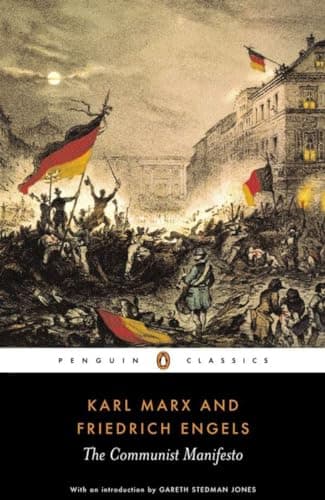
The Communist Manifesto
Karl Marx, 1848
312 ratings
Wage Labour and Capital
Karl Marx, 1891
11 ratings
German Ideology
Karl Marx
3 ratings