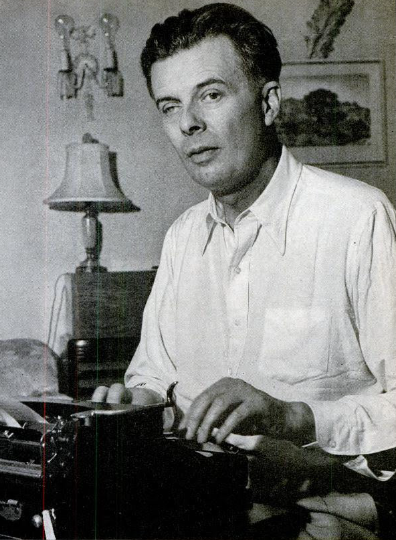
§Author· 4 books
Aldous Huxley
Also known as Aldous Leonard Huxley
Dystopian fiction reached a major milestone with Brave New World, a novel projecting a scientifically controlled future society stripped of emotional depth and personal freedom. Writing across nearly fifty books, Aldous Huxley established a lasting presence in twentieth-century literature through his sharp social satire and philosophical inquiry, probing the consequences of technological progress, political authoritarianism, and human vulnerabilities.
Career & Background
Born in Godalming, Surrey, England, on July 26, 1894, Aldous Leonard Huxley belonged to a prominent family of scientists and intellectuals. His grandfather was the biologist Thomas Henry Huxley, his father Leonard Huxley edited the Cornhill Magazine, and his mother Julia Arnold was the niece of poet Matthew Arnold. Although Huxley originally planned to pursue a career in science, a severe case of keratitis during his youth left him partially blind and altered his professional trajectory. Turning to literary study, he attended Balliol College, Oxford, and graduated with a degree in English literature in 1916.
Huxley began his literary career editing Oxford Poetry and publishing verse, followed by his debut novel Crome Yellow in 1921. Throughout the 1920s and 1930s, he produced a steady stream of satirical fiction, short stories, and critical essays while residing in Europe. In 1937, Huxley moved to the United States and settled in Los Angeles, California, where he lived for the remainder of his life. During his American years, he expanded his work to include screenwriting, historical biographies, and philosophical treatises on ethics and mysticism before his death on November 22, 1963.
Writing Style & Themes
Huxley's prose is characterized by erudite wit, conversational irony, and pessimistic satire. Drawing on his family's scientific tradition as well as humanistic scholarship, his narratives repeatedly examine the conflict between technological advances, individual autonomy, and moral responsibility.
A prominent feature of his approach is the 'novel of ideas,' a technique in which plot serves primarily as a framework for intellectual debate. His characters frequently represent contrasting philosophical stances, enabling Huxley to explore contemporary disillusionment, social cynicism, and the pursuit of spiritual meaning in a rapidly modernizing world.
Major Works
- Brave New World — Published in 1932, this dystopian novel depicts a future World State that utilizes genetic engineering, psychological conditioning, and drug consumption to enforce social stability at the expense of individuality.
- Point Counter Point — Published in 1928, this ambitious novel uses a complex, musicalized narrative structure to satirize the intellectual and artistic circles of late 1920s London.
- Antic Hay — Published in 1923, this early satirical novel depicts the aimless lives and moral confusion of post-World War I bohemian intellectuals in London.
- Eyeless in Gaza — Published in 1936, this novel employs a non-chronological timeline to chart a central character's journey from detached cynicism to active involvement in pacifism and spiritual self-discovery.
§All Books
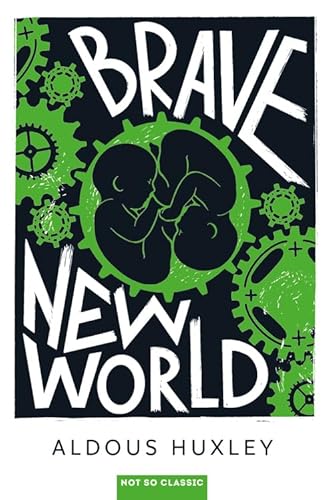
Brave New World
Aldous Huxley, 1930
2,804 ratings

Point Counter Point
Aldous Huxley, 1928
12 ratings

Antic Hay
Aldous Huxley, 1923
4 ratings

Eyeless in Gaza
Aldous Huxley, 1936
3 ratings
§ About Aldous Huxley's books
- Books on SansFiction
- 4
- Published
- 1923–1936
- Average rating
- 3.9 / 5 across 2,823 ratings
- Genres
- Classics, Fiction, Science Fiction, Dystopian
Start here: Brave New World (1930)
"Aldous Huxley's profoundly important classic of world literature, Brave New World is a searching vision of an unequal, technologically-advanced future where humans are genetically bred, socially indoctrinated, and pharmaceutically anesthetized to passively uphold an authoritarian ruling order–all at the cost of our freedom, full humanity, and perhaps also…
Common questions about Aldous Huxley
- Who is Aldous Huxley?
- Born in Godalming, Surrey, England, on July 26, 1894, Aldous Leonard Huxley belonged to a prominent family of scientists and intellectuals. His grandfather was the biologist Thomas Henry Huxley, his father Leonard Huxley edited the Cornhill Magazine, and his mother Julia Arnold was the niece of poet Matthew Arnold.
- What is Aldous Huxley best known for?
- Aldous Huxley is best known for Brave New World, published in 1930 with 2,804 ratings and a 3.9 average. It is the most-rated of Aldous Huxley's books on SansFiction.
- How many books has Aldous Huxley written?
- SansFiction lists 4 books by Aldous Huxley, published between 1923 and 1936. The most popular are Brave New World, Point Counter Point, Antic Hay and Eyeless in Gaza.
- Which Aldous Huxley book should I read first?
- Brave New World is the usual place to start: it is Aldous Huxley's most-rated book here, with a 3.9 average.
- What genres does Aldous Huxley write?
- Aldous Huxley's books on SansFiction are tagged Classics, Fiction, Science Fiction and Dystopian.
Explore: Classics · Fiction · Science Fiction · Dystopian