SSansFiction
The libraryCollectionsJournalStatsFor authors
Sign inJoin now
Sansfiction,

A digital library for books. Made by readers, for readers.

v 2.0 · 2026
The library
  • Discover
  • Collections
  • Book tracker
  • Journal
  • Stats
For authors
  • SF Links
  • Analytics
  • How it works
  • FAQ
Elsewhere
  • X / @sansfiction
  • Privacy
  • Terms
  • Contact
© 2026 SansFiction · Digital · GlobalA quiet room for your reading life.
The libraryCollectionsJournalStatsFor authors
Sign inJoin now →
Navigation
Library
Bookshelf
Journal
Discover
Collections
Tierlists
Stats
Profile
Author Page
Link Builder
Account
Sign in
S
G
Bookshealth & fitnessWhy We Sleep: Unlocking the Power of Sleep and Dreams
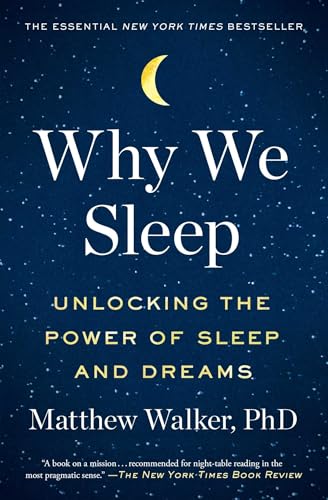
Cover of Why We Sleep: Unlocking the Power of Sleep and Dreams by Matthew Walker

Why We Sleep: Unlocking the Power of Sleep and Dreams,

by Matthew Walker

Ask AI
Rating4.4/ 5
Ratings477
Pages360
Reading Hours8h
Published2017
Language—

§Synopsis

01

“Why We Sleep is an important and fascinating book…Walker taught me a lot about this basic activity that every person on Earth needs. I suspect his book will do the same for you.” —Bill Gates A New York Times bestseller and international sensation, this “stimulating and important book” (Financial Times) is a fascinating dive into the purpose and power of slumber. With two appearances on CBS This Morning and Fresh Air's most popular interview of 2017, Matthew Walker has made abundantly clear that sleep is one of the most important but least understood aspects of our life. Until very recently, science had no answer to the question of why we sleep, or what good it served, or why we suffer such devastating health consequences when it is absent. Compared to the other basic drives in life—eating, drinking, and reproducing—the purpose of sleep remains more elusive. Within the brain, sleep enriches a diversity of functions, including our ability to learn, memorize, and make logical decisions. It recalibrates our emotions, restocks our immune system, fine-tunes our metabolism, and regulates our appetite. Dreaming creates a virtual reality space in which the brain melds past and present knowledge, inspiring creativity. In this “compelling and utterly convincing” (The Sunday Times) book, preeminent neuroscientist and sleep expert Matthew Walker provides a revolutionary exploration of sleep, examining how it affects every aspect of our physical and mental well-being. Charting the most cutting-edge scientific breakthroughs, and marshalling his decades of research and clinical practice, Walker explains how we can harness sleep to improve learning, mood and energy levels, regulate hormones, prevent cancer, Alzheimer’s and diabetes, slow the effects of aging, and increase longevity. He also provides actionable steps towards getting a better night’s sleep every night. Clear-eyed, fascinating, and accessible, Why We Sleep is a crucial and illuminating book. Written with the precision of Atul Gawande, Andrew Solomon, and Sherwin Nuland, it is “recommended for night-table reading in the most pragmatic sense” (The New York Times Book Review).

Track this book

Add to your library to track progress and write reviews

§Genres
health & fitness1nonfiction1psychology1science1
§Moods
challenging1hopeful1informative1reflective1relaxing1tense1

§About the Author

Matthew Walker
Matthew Walker

1 books in catalog

Scientific research into human sleep has revealed profound connections between rest, brain function, and systemic physical health. Through accessible popular science writing and decades of academic study, neuroscience research demonstrates how sleep deprivation affects memory, immune response, emotional regulation, and chronic disease. The international bestseller Why We Sleep: Unlocking the Power of Sleep and Dreams serves as a primary foundational text bringing these complex neurological and physiological insights into public health awareness.

Written by scientist Matthew Walker, this popular work translates complex laboratory discoveries into practical knowledge for everyday readers. By detailing the critical roles that Non-Rapid Eye Movement (NREM) and Rapid Eye Movement (REM) sleep play across the human lifespan, the work examines the hidden costs of sleep loss on cardiovascular health, cognitive preservation, and metabolic stability.

Career & Background

Born in Liverpool, England, Walker earned his Bachelor of Science from the University of Nottingham and completed his Ph.D. at Newcastle University. He began his academic career in psychiatry as a professor at Harvard Medical School before transitioning to the University of California, Berkeley. At UC Berkeley, where he served as a professor of neuroscience and psychology for seventeen years, he established the Center for Human Sleep Science to investigate the mechanisms governing sleep architecture.

Walker later joined the University of Texas at Dallas as a professor of neuroscience and biomedical engineering, founding and directing the Sleep Innovation Laboratories at the Center for BrainHealth. Over his research career, he has authored more than 100 peer-reviewed scientific studies supported by the National Institutes of Health and the National Science Foundation. His contributions to science communication and research earned him recognition as a Kavli Fellow of the National Academy of Sciences and recipient of the 2020 Carl Sagan Prize for Science Achievement. Beyond academic publishing, he has discussed sleep science on broadcasts such as 60 Minutes, NOVA, NPR's Science Friday, and BBC News, alongside a widely viewed main-stage TED Talk.

Writing Style & Themes

Walker's writing bridges rigorous clinical research with accessible public health guidance. In examining sleep, his work combines high-density electroencephalography, magnetic resonance imaging, positron emission tomography, and cognitive testing to illustrate neurological processes. A recurring theme in his work is the broad physiological impact of sleep architecture, highlighting how distinct sleep stages mitigate risks for neurodegenerative conditions such as Alzheimer's disease and Parkinson's disease, as well as cardiovascular illness, diabetes, and mood disorders.

Rather than treating sleep as a passive state of rest, his analysis frames it as an active biological necessity vital for memory consolidation, immune defence, emotional equilibrium, and metabolic function. By detailing the acute consequences of sleep deprivation—such as compromised immune response, mood instability, and cognitive deficits—he advocates for structural changes in societal attitudes toward sleep hygiene and public health policies.

Major Works

  • Why We Sleep: Unlocking the Power of Sleep and Dreams — Published in 2017, this New York Times and international bestseller represents Walker's first work of popular science. Drawing on over two decades of research and more than a hundred scientific studies, the book examines the critical importance of sleep, explaining how sleep loss contributes to major diseases and offering evidence-based strategies for improving sleep quality and overall health.

§Editions

Cover of Why We Sleep: Unlocking the Power of Sleep and Dreams

Why We Sleep: Unlocking the Power of Sleep and Dreams

Hardcover368 pgs
Scribner2017
§Genres
health & fitness1nonfiction1psychology1science1
§Moods
challenging1hopeful1informative1reflective1relaxing1tense1

Featured In Lists

Book cover from this collectionBook cover from this collectionBook cover from this collectionBook cover from this collection
Book cover from this collection

Intelligence

68 books
Book cover from this collectionBook cover from this collectionBook cover from this collectionBook cover from this collection
Book cover from this collection

Non-fiction books that expanded your understanding of the world

100 books