The intersection of semi-autobiographical fiction, religious upbringing, and queer identity shaped one of the most distinctive debut novels of the late twentieth century, Oranges Are Not The Only Fruit. Jeanette Winterson gained immediate literary prominence with this 1985 novel, which won the Whitbread Award for Best First Novel and was subsequently adapted into a BAFTA-winning BBC television drama.
Career & Background
Born in Manchester, England, on August 27, 1959, Winterson was adopted in infancy by Pentecostal evangelists John and Constance Winterson and raised in Accrington, Lancashire. Her evangelical upbringing was marked by strict religious discipline and limited access to secular literature, creating early tensions between her family environment and her ambition to read and write. She left home during her teenage years and earned an English Literature degree from St Catherine's College, Oxford. Following university, she worked in various roles, including as an assistant at the Roundhouse theatre and as an assistant editor at Pandora Press while writing her early fiction.
Following the publication of Oranges Are Not The Only Fruit, Winterson developed a wide-ranging body of work that spans novels, short story collections, journalism, and personal non-fiction. Beyond writing, she has written regular columns for The Guardian, broadcasted for television and radio, and held a position as Professor of New Writing at the Centre for New Writing at the University of Manchester. Her contributions to literature have been recognized with election as a Fellow of the Royal Society of Literature and appointment as a Commander of the Order of the British Empire (CBE).
Writing Style & Themes
Winterson's narrative style frequently blends elements of autofiction, historical fantasy, magical realism, and mythic storytelling. Her early works explored the conflict between religious orthodoxy and lesbian self-discovery, while subsequent novels expanded into experiments with non-linear time, shifting perspectives, and non-gendered narration. Her writing consistently investigates sexual identity, physical passion, obsession, and the boundaries of love. In later projects, her themes expanded to examine the intersection of human emotion, artificial intelligence, and emerging technologies.
Major Works
- Oranges Are Not The Only Fruit — Published in 1985, this semi-autobiographical debut novel depicts a young lesbian girl growing up within an intense Pentecostal evangelist family in Lancashire, winning the Whitbread Award for Best First Novel.
- The Passion — First published in 1987, this picaresque historical novel set during the Napoleonic Wars follows Henri, a young French soldier serving as Napoleon's chicken chef, and Villanelle, a cross-dressing Venetian woman with webbed feet.
- Sexing the Cherry — Released in 1989, this novel uses magical realism and postmodern narrative techniques set in seventeenth-century London to explore themes of time, physical space, and non-conforming gender identities.
- Written on the Body — Published in 1992, this novel features a narrator whose name and gender are deliberately left unspecified, focusing on an intense affair and the physical realities of love and illness.
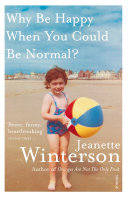
- Why Be Happy When You Could Be Normal? — This 2011 memoir details Winterson's childhood, her adoption by strict Pentecostal parents, her early literary awakening, and her adult journey to locate her biological mother.