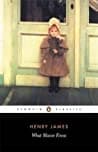
In the aftermath of an acrimonious divorce, young Maisie Farange finds herself shuttled back and forth between her father and mother, both of them amoral and monstrously self-involved. After her parents find new spouses -- and after the new spouses find themselves drawn to each other, as much for Maisie's sake as their own -- Maisie feels even more misplaced. As she observes the world of adults and their adulteries, and finds herself in the position to decide her own fate, Henry James's rendering of her child's-eye view -- his depiction of what precisely Maisie knows -- draws the reader into this scathing satire of social mores and insightful meditation on familial dependence.
Add to your library to track progress and write reviews
Find What Maisie Knew Henry James in PDF, EPUB, ebook, audiobook, print, or library editions.

9 books in catalog
Transatlantic literature and psychological realism reached a defining threshold through novels exploring the cultural collisions between European society and American individualism, most notably in The Portrait of a Lady. Henry James created a vast body of work spanning twenty novels, over one hundred short stories, plays, and extensive literary criticism that bridged nineteenth-century realism and twentieth-century modernism.
Born in New York City on April 15, 1843, James was raised in an intellectual family as the son of theologian Henry James Sr. and the brother of philosopher William James and diarist Alice James. His family crossed the Atlantic Ocean repeatedly before 1860, providing an international education in Geneva, Paris, London, and New England. Before committing entirely to writing, James briefly attended law school, but soon began publishing critical essays and fiction in periodicals such as The Atlantic Monthly. He relocated to Europe in his thirties and eventually settled in England, where he lived for decades and became a British citizen in 1915 before his death on February 28, 1916.
Renowned for his intricate sentence structures and precise psychological insight, James developed narrative techniques that prioritized central character consciousness over external plot mechanisms. His fiction frequently examines the international theme, contrasting the earnest morality of American travelers with the dense social traditions of European aristocracy. Beyond narrative prose, James authored groundbreaking critical studies, including The Art of Fiction, which championed the novel as a serious art form. His major themes centered on personal freedom, social compromise, feminism, and moral autonomy.