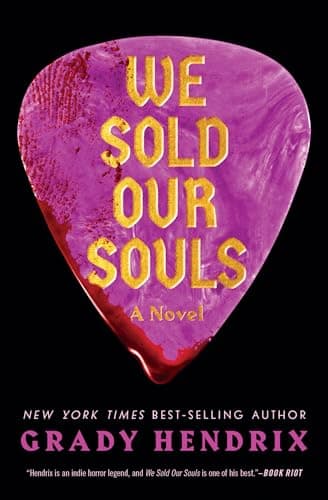
Kris Pulaski’s metal band was about to break big in the Nineties when their lead singer sold them out and went off to become a solo act sensation, leaving his old friends behind to rot in rural Pennsylvania. Decades later, Kris has hung up her Gibson and finally gotten used to being a footnote in someone else’s success story when she learns the secret to their former lead singer’s success: he didn’t sell his soul to dark forces for fame and glory, he sold Kris’s.
They told Kris not to be angry, they told her to be a good girl and not cause trouble, but now she’s pissed off and hitting the road one last time to find her old bandmates and confront the man who ruined her life. It’s a journey through an America darker than any Mordor Tolkien could devise and along the way she’ll learn that the occult forces that bought her soul aren’t corny devils carrying pitchforks, but the conspiracy behind the conspiracy, the shadowy men who rule our lives, the secret committees who put sedatives in our water and watch us from satellites, who've transformed our world into a vast feeding pen where the struggle, sweat, and fear of the 99% provides sustenance for the 1% who keep us asleep.
Sometimes it’s not what you’re fighting for that matters, it’s the fact that you’re still fighting at all, and Kris Pulaski has never walked away from a fight in her life. A furious power ballad about never giving up, even in the face of overwhelming odds, We Sold Our Souls is an epic journey into the heart of a surveillance mad, prescription popping, paranoid country where only a girl with a guitar can save us from eternal damnation. After all, there has to be something in this world that's not for sale.
Kris Pulaski’s metal band was about to break big in the Nineties when their lead singer sold them out and went off to become a solo act sensation, leaving his old friends behind to rot in rural Pennsylvania. Decades later, Kris has hung up her Gibson and finally gotten used to being a footnote in someone else’s success story when she learns the secret to their former lead singer’s success: he didn’t sell his soul to dark forces for fame and glory, he sold Kris’s.
They told Kris not to be angry, they told her to be a good girl and not cause trouble, but now she’s pissed off and hitting the road one last time to find her old bandmates and confront the man who ruined her life. It’s a journey through an America darker than any Mordor Tolkien could devise and along the way she’ll learn that the occult forces that bought her soul aren’t corny devils carrying pitchforks, but the conspiracy behind the conspiracy, the shadowy men who rule our lives, the secret committees who put sedatives in our water and watch us from satellites, who've transformed our world into a vast feeding pen where the struggle, sweat, and fear of the 99% provides sustenance for the 1% who keep us asleep.
Sometimes it’s not what you’re fighting for that matters, it’s the fact that you’re still fighting at all, and Kris Pulaski has never walked away from a fight in her life. A furious power ballad about never giving up, even in the face of overwhelming odds, We Sold Our Souls is an epic journey into the heart of a surveillance mad, prescription popping, paranoid country where only a girl with a guitar can save us from eternal damnation. After all, there has to be something in this world that's not for sale.
Add to your library to track progress and write reviews
Add to your library to track progress and write reviews
Find We Sold Our Souls Grady Hendrix in PDF, EPUB, ebook, audiobook, print, or library editions.
Find We Sold Our Souls Grady Hendrix in PDF, EPUB, ebook, audiobook, print, or library editions.

8 books in catalog
Blending satirical humor with genuine horror, contemporary fiction has found a distinctive voice in stories that juxtapose domestic routines and pop culture with supernatural dread. Grady Hendrix made a notable impact on the horror genre with his 2014 debut novel Horrorstör, set inside a haunted Swedish flat-pack furniture superstore, and has since written multiple bestselling novels that re-examine classic horror tropes through relatable social settings.
From suburban book clubs confronting undead threats to teenage friendships tested by demonic possession, his stories ground terrifying scenarios in detailed, humorous, and emotionally resonant realities. His work spans bestselling fiction, award-winning nonfiction on horror literature history, and feature film screenplays.
Born in 1972 in Charleston, South Carolina, Grady Hendrix eventually relocated to New York City, where he established a career as a New York Times bestselling novelist and screenwriter. Before achieving wide recognition for his fiction, he developed a deep knowledge of genre history, which later informed his Bram Stoker Award-winning nonfiction history of the 1970s and 1980s horror paperback boom, Paperbacks from Hell: The Twisted History of '70s and '80s Horror Fiction. In addition to his novels, Hendrix expanded his creative work into film, writing the screenplays for the horror film Mohawk, set during the War of 1812, and Satanic Panic, which follows a pizza delivery worker confronting wealthy cultists.
His fiction career expanded rapidly as several of his titles were optioned and adapted for screen media, including feature film and television development for My Best Friend's Exorcism, The Southern Book Club's Guide to Slaying Vampires, and How to Sell a Haunted House. By pairing sharp narrative pacing with research-backed subgenre tropes, Hendrix has published a diverse bibliography that includes the heavy metal horror story We Sold Our Souls and the slasher homage The Final Girl Support Group, published on July 13, 2021. His books have reached broad international audiences, selling millions of copies and appearing in over twenty translations.
Hendrix's writing style is characterized by a balance of absurdist wit, nostalgic detail, and intense emotional warmth mixed with body horror. He frequently places ordinary people—such as retail employees, suburban mothers, or teenage best friends—into extraordinary supernatural danger, exploring how personal relationships, grief, and institutional pressures shape human resilience. Whether examining suburban domesticity or corporate consumerism, his narratives treat characters' emotional bonds with sincere gravity while maintaining an irreverent, fast-paced comic tone.
8 books in catalog
Blending satirical humor with genuine horror, contemporary fiction has found a distinctive voice in stories that juxtapose domestic routines and pop culture with supernatural dread. Grady Hendrix made a notable impact on the horror genre with his 2014 debut novel Horrorstör, set inside a haunted Swedish flat-pack furniture superstore, and has since written multiple bestselling novels that re-examine classic horror tropes through relatable social settings.
From suburban book clubs confronting undead threats to teenage friendships tested by demonic possession, his stories ground terrifying scenarios in detailed, humorous, and emotionally resonant realities. His work spans bestselling fiction, award-winning nonfiction on horror literature history, and feature film screenplays.
Born in 1972 in Charleston, South Carolina, Grady Hendrix eventually relocated to New York City, where he established a career as a New York Times bestselling novelist and screenwriter. Before achieving wide recognition for his fiction, he developed a deep knowledge of genre history, which later informed his Bram Stoker Award-winning nonfiction history of the 1970s and 1980s horror paperback boom, Paperbacks from Hell: The Twisted History of '70s and '80s Horror Fiction. In addition to his novels, Hendrix expanded his creative work into film, writing the screenplays for the horror film Mohawk, set during the War of 1812, and Satanic Panic, which follows a pizza delivery worker confronting wealthy cultists.
His fiction career expanded rapidly as several of his titles were optioned and adapted for screen media, including feature film and television development for My Best Friend's Exorcism, The Southern Book Club's Guide to Slaying Vampires, and How to Sell a Haunted House. By pairing sharp narrative pacing with research-backed subgenre tropes, Hendrix has published a diverse bibliography that includes the heavy metal horror story We Sold Our Souls and the slasher homage The Final Girl Support Group, published on July 13, 2021. His books have reached broad international audiences, selling millions of copies and appearing in over twenty translations.
Hendrix's writing style is characterized by a balance of absurdist wit, nostalgic detail, and intense emotional warmth mixed with body horror. He frequently places ordinary people—such as retail employees, suburban mothers, or teenage best friends—into extraordinary supernatural danger, exploring how personal relationships, grief, and institutional pressures shape human resilience. Whether examining suburban domesticity or corporate consumerism, his narratives treat characters' emotional bonds with sincere gravity while maintaining an irreverent, fast-paced comic tone.