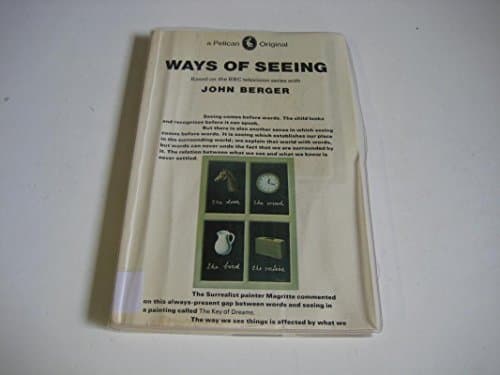
How do we see the world around us? The Penguin on Design series includes the works of creative thinkers whose writings on art, design and the media have changed our vision forever."Seeing comes before words. The child looks and recognizes before it can speak.""But there is also another sense in which seeing comes before words. It is seeing which establishes our place in the surrounding world; we explain that world with words, but word can never undo the fact that we are surrounded by it. The relation between what we see and what we know is never settled."John Berger's Ways of Seeing is one of the most stimulating and influential books on art in any language. First published in 1972, it was based on the BBC television series about which the (London) Sunday Times critic commented: "This is an eye-opener in more ways than one: by concentrating on how we look at paintings . . . he will almost certainly change the way you look at pictures." By now he has.
How do we see the world around us? The Penguin on Design series includes the works of creative thinkers whose writings on art, design and the media have changed our vision forever."Seeing comes before words. The child looks and recognizes before it can speak.""But there is also another sense in which seeing comes before words. It is seeing which establishes our place in the surrounding world; we explain that world with words, but word can never undo the fact that we are surrounded by it. The relation between what we see and what we know is never settled."John Berger's Ways of Seeing is one of the most stimulating and influential books on art in any language. First published in 1972, it was based on the BBC television series about which the (London) Sunday Times critic commented: "This is an eye-opener in more ways than one: by concentrating on how we look at paintings . . . he will almost certainly change the way you look at pictures." By now he has.
Add to your library to track progress and write reviews
Add to your library to track progress and write reviews
Find Ways of seeing John Berger in PDF, EPUB, ebook, audiobook, print, or library editions.
Find Ways of seeing John Berger in PDF, EPUB, ebook, audiobook, print, or library editions.

3 books in catalog
Art criticism and fiction underwent a major shift when television essays and experimental novels began demystifying traditional visual culture and social hierarchies. John Peter Berger, born in 1926 and dying in 2017, was an English art critic, novelist, painter, and poet who reshaped how audiences analyze images and storytelling. His essay on art criticism Ways of Seeing, created alongside the groundbreaking BBC television series of the same name, demystified art history and remains a standard university text on visual culture.
Born John Peter Berger in London in 1926, he trained as a painter at the Central School of Art and Chelsea School of Art after serving in the British Army from 1944 to 1946. During the 1950s, he taught drawing, exhibited his artwork in London galleries, and began writing regular art criticism for publications such as the New Statesman and Tribune. Believing that writing offered a more direct medium for expressing his Marxist political views and social critique, he shifted his primary focus from painting to literature. He later left England and lived in France for over fifty years, spending decades in the rural peasant community of Quincy before passing away in 2017 in the Paris suburb of Antony.
Berger's literary and critical approach merged rigorous social analysis, historical context, and formal experimentation across more than thirty published works. In critical collections like About Looking and Ways of Seeing, he exposed how ideology, class, and gender influence visual perception and artistic appreciation. His fiction incorporated modernist techniques, political commentary, and intimate observational detail to examine human labor, migration, and power dynamics. By collaborating with photographers, filmmakers, and translators, Berger constantly pushed the boundaries of multi-disciplinary storytelling while maintaining a steadfast commitment to political engagement and the dignity of everyday life.
3 books in catalog
Art criticism and fiction underwent a major shift when television essays and experimental novels began demystifying traditional visual culture and social hierarchies. John Peter Berger, born in 1926 and dying in 2017, was an English art critic, novelist, painter, and poet who reshaped how audiences analyze images and storytelling. His essay on art criticism Ways of Seeing, created alongside the groundbreaking BBC television series of the same name, demystified art history and remains a standard university text on visual culture.
Born John Peter Berger in London in 1926, he trained as a painter at the Central School of Art and Chelsea School of Art after serving in the British Army from 1944 to 1946. During the 1950s, he taught drawing, exhibited his artwork in London galleries, and began writing regular art criticism for publications such as the New Statesman and Tribune. Believing that writing offered a more direct medium for expressing his Marxist political views and social critique, he shifted his primary focus from painting to literature. He later left England and lived in France for over fifty years, spending decades in the rural peasant community of Quincy before passing away in 2017 in the Paris suburb of Antony.
Berger's literary and critical approach merged rigorous social analysis, historical context, and formal experimentation across more than thirty published works. In critical collections like About Looking and Ways of Seeing, he exposed how ideology, class, and gender influence visual perception and artistic appreciation. His fiction incorporated modernist techniques, political commentary, and intimate observational detail to examine human labor, migration, and power dynamics. By collaborating with photographers, filmmakers, and translators, Berger constantly pushed the boundaries of multi-disciplinary storytelling while maintaining a steadfast commitment to political engagement and the dignity of everyday life.