BooksTribe of Mentors: Short Life Advice from the Best in the World
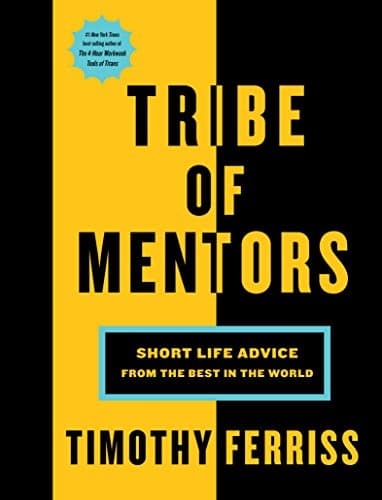
Tribe of Mentors: Short Life Advice from the Best in the World,
by Timothy Ferriss, Kaleo Griffith, Ray Porter, Samin Nosrat, Steven Pressfield, Kyle Maynard, Terry Crews,
by Timothy Ferriss, Kaleo Griffith, Ray Porter, Samin Nosrat, Steven Pressfield, Kyle Maynard, Terry Crews,
When high-level success no longer provides a clear map for the future, the only remaining strategy is to look outward at those who have navigated similar voids. This narrative of intellectual discovery begins with a crisis of direction. Facing a milestone age and a series of personal losses, the seeker realizes that the tactics that brought him past victories are insufficient for the next stage of his life. He is stuck in the friction between what worked before and the unknown requirements of what comes next.
To solve this, a mental roundtable is constructed, composed of the world's most effective individuals across every conceivable discipline. By posing a standardized set of eleven deep-probing questions to these "titans," a laboratory of human experience is established. The text explores the initial tension of seeking wisdom from people who are notoriously difficult to reach, testing whether the habits of a chess grandmaster or a legendary artist can truly translate to the life of a weary professional or a creative at a crossroads.
The world of this book is governed by a rigid, almost ritualistic set of constraints: eleven specific questions designed to bypass superficial small talk and strike at the mechanics of a life well-lived. This setting is not a physical location but a psychological landscape where the "rules" of success are interrogated. The atmosphere is one of focused curiosity, where the barrier between the amateur and the master is dissolved through the Socratic method. Each contributor operates within this framework, providing a sense of consistency that allows the reader to compare how diverse minds—ranging from elite athletes to reclusive authors—handle the same existential pressures.
In the opening chapters, the narrator undergoes a shift from a state of scattered "decision fatigue" to a state of deliberate receptivity. Initially, the protagonist is overwhelmed by the sheer volume of choices and the weight of mid-life transitions. As the first few mentors respond, the arc moves from an external search for "hacks" to an internal realization that wisdom is often found in the things these experts chose to stop doing. The relationship between the narrator and his "tribe" is one of apprentice to masters, though the apprentice quickly learns that even the masters are often just as perplexed by life's complexities as he is.
The book utilizes the "Wise Mentor" trope but frequently subverts it by showcasing the vulnerability and unconventional failures of its subjects. Instead of presenting a singular, god-like figure with all the answers, it provides a fragmented, democratic collection of perspectives that often contradict one another. This mirrors the "Council of Elders" trope found in epic fantasy, yet it strips away the mysticism to focus on tactical habits—such as meditation, morning routines, and the rejection of expert advice—thereby making the "magic" of high performance accessible and grounded in mundane discipline.
Add to your library to track progress and write reviews
Find Tribe of Mentors: Short Life Advice from the Best in the World Steven Pressfield in PDF, EPUB, ebook, audiobook, print, or library editions.

2 books in catalog
Practical advice on personal efficiency, lifestyle design, and rapid skill acquisition forms the core of modern self-improvement literature, epitomized by The 4-Hour Workweek: Escape 9-5, Live Anywhere, and Join the New Rich. Timothy Ferriss established his position in non-fiction literature by detailing structured methodologies for time management, remote working, and accelerated learning that encourage readers to challenge traditional employment structures.
Born on July 20, 1977, in East Hampton, New York, Timothy Ferriss attended Princeton University, receiving his Bachelor of Arts in 2000. Before achieving widespread recognition as an author, he built a career as an entrepreneur and early-stage technology investor, providing early funding and advisory support to major companies including Uber, Facebook, Shopify, Duolingo, and Alibaba. In addition to his business ventures, he became a public speaker and launched The Tim Ferriss Show, an influential interview podcast that crossed 200 million downloads. Recognized on industry lists such as Fast Company's Most Innovative Business People and Fortune's 40 under 40, Ferriss has also directed support toward scientific research regarding psychedelic medical treatments.
The writing style of Timothy Ferriss centers on systematic experimentation, high-density informational interviewing, and practical step-by-step frameworks. His early self-help books focus on lifestyle optimization, applying principles of efficiency to career management, physical fitness, and culinary arts. In later works, his focus shifted toward curated wisdom and interviews with high achievers, distilling actionable daily routines, mental models, and life advice from experts across diverse fields.