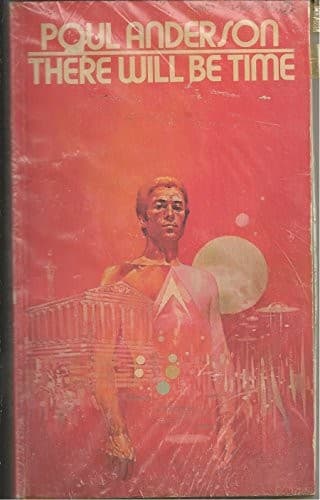
A time traveler stumbles upon a horrific plot to alter the future in this adventure from “one of science fiction’s most revered writers” (USA Today). Born with a strange genetic mutation, Jack Havig can travel backward and forward in time at will. His unique gift enables him to visit ancient Rome, the Byzantine Empire, and the Wild West. He’s even seen the far future, when the ecology-minded Maurai Federation dominates a world nearly obliterated by nuclear war. Jack undertakes these voyages with one objective in mind: to find others who share his remarkable abilities. In the shadow of the Crucifixion, Jack finally achieves his goal. But a terrible darkness clouds his admission into the secretive, time-traveling organization called Eyrie when the group’s true intentions become clear. For Eyrie’s plans include an unthinkable genocide designed to irrevocably alter the destiny of humankind—and Jack is the only one who can stop it. But he won’t be able to do it alone. The prolific and remarkable Poul Anderson dazzles once again with a humanistic science fiction adventure that races across the boundaries of time. Lightning-paced and marvelously inventive, There Will Be Time is an unforgettable journey through the ages from one of the greats of twentieth-century science fiction. This ebook includes the bonus stories “Progress” and “Windmill.”
A time traveler stumbles upon a horrific plot to alter the future in this adventure from “one of science fiction’s most revered writers” (USA Today). Born with a strange genetic mutation, Jack Havig can travel backward and forward in time at will. His unique gift enables him to visit ancient Rome, the Byzantine Empire, and the Wild West. He’s even seen the far future, when the ecology-minded Maurai Federation dominates a world nearly obliterated by nuclear war. Jack undertakes these voyages with one objective in mind: to find others who share his remarkable abilities. In the shadow of the Crucifixion, Jack finally achieves his goal. But a terrible darkness clouds his admission into the secretive, time-traveling organization called Eyrie when the group’s true intentions become clear. For Eyrie’s plans include an unthinkable genocide designed to irrevocably alter the destiny of humankind—and Jack is the only one who can stop it. But he won’t be able to do it alone. The prolific and remarkable Poul Anderson dazzles once again with a humanistic science fiction adventure that races across the boundaries of time. Lightning-paced and marvelously inventive, There Will Be Time is an unforgettable journey through the ages from one of the greats of twentieth-century science fiction. This ebook includes the bonus stories “Progress” and “Windmill.”
Add to your library to track progress and write reviews
Add to your library to track progress and write reviews
Find There Will Be Time Poul Anderson in PDF, EPUB, ebook, audiobook, print, or library editions.
Find There Will Be Time Poul Anderson in PDF, EPUB, ebook, audiobook, print, or library editions.

7 books in catalog
Rigorous physics principles and deep historical lore shaped hard science fiction and speculative fantasy across six decades of publishing, producing celebrated novels such as Tau Zero and The High Crusade. Poul William Anderson entered the field during the Golden Age of science fiction and maintained an active publishing career into the twenty-first century, earning seven Hugo Awards and three Nebula Awards alongside the SFWA Grand Master Award.
His vast bibliography spans hard science fiction, space opera, alternate history, historical fantasy, and short stories, demonstrating a rare combination of scientific literacy and mythic storytelling.
Born to Danish parents in Pennsylvania in 1926, Anderson spent parts of his childhood in Texas and Denmark before returning to the United States around the onset of World War II. He earned a degree in physics from the University of Minnesota in 1948, publishing his first science fiction story while still an undergraduate and becoming a full-time freelance writer upon graduation. In 1953, he married Karen Kruse, with whom he shared a lifelong literary partnership; their daughter, Astrid, later married science fiction author Greg Bear. Anderson took on leadership roles within the speculative fiction community, serving as the sixth president of the Science Fiction and Fantasy Writers of America in 1972. He was also a founding member of the Society for Creative Anachronism and belonged to the Swordsmen and Sorcerers' Guild of America, a loose-knit group of heroic fantasy authors founded in the 1960s whose works featured in Lin Carter's Flashing Swords! anthologies. Additionally, his advocacy for space exploration led Robert A. Heinlein to dedicate his 1985 novel The Cat Who Walks Through Walls to Anderson and eight other members of the Citizens' Advisory Council on National Space Policy. Anderson continued writing until his death from cancer on July 31, 2001, after a month in the hospital, with several of his novels published posthumously.
Anderson's fiction is distinguished by scrupulous attention to physical details and astronomical logic, informed by his degree in physics and his deep knowledge of Scandinavian history and languages. He frequently explored complex political systems, long-term societal changes, and galactic expansion, while simultaneously contributing foundational works to high fantasy and heroic fantasy. His novels and short stories frequently examined individual liberty versus organizational power, as reflected in his contributions to shared universes like Foundation's Friends and standalone science fiction novels including The Enemy Stars, There Will Be Time, Fire Time, and The People of the Wind.
7 books in catalog
Rigorous physics principles and deep historical lore shaped hard science fiction and speculative fantasy across six decades of publishing, producing celebrated novels such as Tau Zero and The High Crusade. Poul William Anderson entered the field during the Golden Age of science fiction and maintained an active publishing career into the twenty-first century, earning seven Hugo Awards and three Nebula Awards alongside the SFWA Grand Master Award.
His vast bibliography spans hard science fiction, space opera, alternate history, historical fantasy, and short stories, demonstrating a rare combination of scientific literacy and mythic storytelling.
Born to Danish parents in Pennsylvania in 1926, Anderson spent parts of his childhood in Texas and Denmark before returning to the United States around the onset of World War II. He earned a degree in physics from the University of Minnesota in 1948, publishing his first science fiction story while still an undergraduate and becoming a full-time freelance writer upon graduation. In 1953, he married Karen Kruse, with whom he shared a lifelong literary partnership; their daughter, Astrid, later married science fiction author Greg Bear. Anderson took on leadership roles within the speculative fiction community, serving as the sixth president of the Science Fiction and Fantasy Writers of America in 1972. He was also a founding member of the Society for Creative Anachronism and belonged to the Swordsmen and Sorcerers' Guild of America, a loose-knit group of heroic fantasy authors founded in the 1960s whose works featured in Lin Carter's Flashing Swords! anthologies. Additionally, his advocacy for space exploration led Robert A. Heinlein to dedicate his 1985 novel The Cat Who Walks Through Walls to Anderson and eight other members of the Citizens' Advisory Council on National Space Policy. Anderson continued writing until his death from cancer on July 31, 2001, after a month in the hospital, with several of his novels published posthumously.
Anderson's fiction is distinguished by scrupulous attention to physical details and astronomical logic, informed by his degree in physics and his deep knowledge of Scandinavian history and languages. He frequently explored complex political systems, long-term societal changes, and galactic expansion, while simultaneously contributing foundational works to high fantasy and heroic fantasy. His novels and short stories frequently examined individual liberty versus organizational power, as reflected in his contributions to shared universes like Foundation's Friends and standalone science fiction novels including The Enemy Stars, There Will Be Time, Fire Time, and The People of the Wind.
Maurai
Maurai