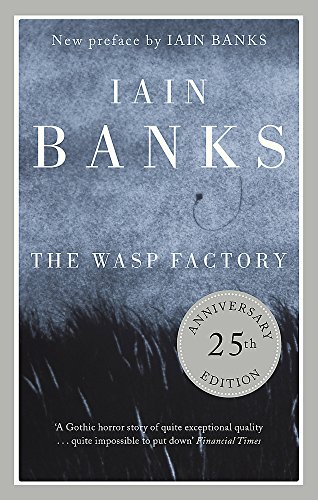
Frank, no ordinary sixteen-year-old, lives with his father outsIde a remote Scottish village. Their life is, to say the least, unconventional. Frank's mother abandoned them years ago: his elder brother Eric is confined to a psychiatric hospital; and his father measures out his eccentricities on an imperial scale. Frank has turned to strange acts of violence to vent his frustrations. In the bizarre daily rituals there is some solace. But when news comes of Eric's escape from the hospital Frank has to prepare the ground for his brother's inevitable return - an event that explodes the mysteries of the past and changes Frank utterly. Iain Banks' celebrated first novel is a work of extraordinary originality, imagination and horrifying compulsion: horrifying, because it enters a mind whose realities are not our own, whose values of life and death are alien to our society; and compulsive, because the humour and compassion of that mind reach out to us all.
Add to your library to track progress and write reviews
Find The Wasp Factory Iain Banks in PDF, EPUB, ebook, audiobook, print, or library editions.

4 books in catalog
Contemporary Scottish literature and speculative fiction were fundamentally reshaped by a distinct dual-career output that spanned twenty-nine books published over nearly three decades. Iain Banks achieved immediate public attention with his controversial 1984 debut novel The Wasp Factory, establishing a career that alternated between mainstream fiction and expansive science fiction space opera.
Writing non-genre novels under his birth name and published science fiction under the pen name Iain M. Banks—adding the initial of his middle name Menzies—the author built a vast bibliography before his death in 2013. His narratives earned critical acclaim and popular success, leading to numerous adaptations for theatre, radio, and television.
Born in Dunfermline, Fife, in 1954, Banks spent his early childhood in North Queensferry before moving to Gourock on the Clyde estuary. He attended Stirling University to read English literature alongside philosophy and psychology, graduating in 1975. During his university years, he appeared as an uncredited extra in the final scene of Monty Python and the Holy Grail, which was filmed nearby.
The publication of The Wasp Factory in 1984 provoked intense public debate, receiving fierce reactions from reviewers—such as being labeled 'a repulsive piece of work' by the Evening Standard and 'a work of unparalleled depravity' by the Irish Times—while rapidly becoming a cult classic. The success of this debut allowed Banks to become a full-time writer. He expanded into science fiction with his 1987 novel Consider Phlebas, initiating a celebrated body of speculative work alongside mainstream Scottish contemporary novels like The Crow Road and Complicity.
In April 2013, Banks announced publicly that he had been diagnosed with inoperable cancer and was unlikely to survive beyond a year. He completed his final novel, The Quarry, shortly before his death on 9 June 2013. Posthumous publications later included a joint poetry collection, Poems, co-authored with Ken MacLeod in 2015, and The Culture: The Drawings in 2023, leaving his official archive preserved at Stirling University.
Banks was notable for bridging the divide between literary fiction and genre science fiction, maintaining that the distinction between his two publishing names was largely a matter of marketing register rather than artistic separation. His mainstream novels, including Dead Air and Complicity, often feature intricate plot structures, dark humor, intense psychological scrutiny, and sharp social commentary on contemporary society.
Across both his general fiction and space opera, Banks explored themes of mortality, power, political philosophy, morality, and technological transformation. His works frequently juxtaposed visceral personal trauma with grand structural or galactic backgrounds, combining stylistic audacity with deeply human character studies.

4 books in catalog
Contemporary Scottish literature and speculative fiction were fundamentally reshaped by a distinct dual-career output that spanned twenty-nine books published over nearly three decades. Iain Banks achieved immediate public attention with his controversial 1984 debut novel The Wasp Factory, establishing a career that alternated between mainstream fiction and expansive science fiction space opera.
Writing non-genre novels under his birth name and published science fiction under the pen name Iain M. Banks—adding the initial of his middle name Menzies—the author built a vast bibliography before his death in 2013. His narratives earned critical acclaim and popular success, leading to numerous adaptations for theatre, radio, and television.
Born in Dunfermline, Fife, in 1954, Banks spent his early childhood in North Queensferry before moving to Gourock on the Clyde estuary. He attended Stirling University to read English literature alongside philosophy and psychology, graduating in 1975. During his university years, he appeared as an uncredited extra in the final scene of Monty Python and the Holy Grail, which was filmed nearby.
The publication of The Wasp Factory in 1984 provoked intense public debate, receiving fierce reactions from reviewers—such as being labeled 'a repulsive piece of work' by the Evening Standard and 'a work of unparalleled depravity' by the Irish Times—while rapidly becoming a cult classic. The success of this debut allowed Banks to become a full-time writer. He expanded into science fiction with his 1987 novel Consider Phlebas, initiating a celebrated body of speculative work alongside mainstream Scottish contemporary novels like The Crow Road and Complicity.
In April 2013, Banks announced publicly that he had been diagnosed with inoperable cancer and was unlikely to survive beyond a year. He completed his final novel, The Quarry, shortly before his death on 9 June 2013. Posthumous publications later included a joint poetry collection, Poems, co-authored with Ken MacLeod in 2015, and The Culture: The Drawings in 2023, leaving his official archive preserved at Stirling University.
Banks was notable for bridging the divide between literary fiction and genre science fiction, maintaining that the distinction between his two publishing names was largely a matter of marketing register rather than artistic separation. His mainstream novels, including Dead Air and Complicity, often feature intricate plot structures, dark humor, intense psychological scrutiny, and sharp social commentary on contemporary society.
Across both his general fiction and space opera, Banks explored themes of mortality, power, political philosophy, morality, and technological transformation. His works frequently juxtaposed visceral personal trauma with grand structural or galactic backgrounds, combining stylistic audacity with deeply human character studies.