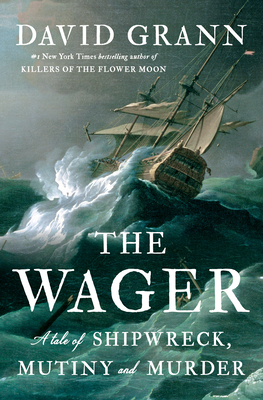

From the #1 New York Times bestselling author of Killers of the Flower Moon, a page-turning story of shipwreck, survival, and savagery, culminating in a court martial that reveals a shocking truth. The powerful narrative reveals the deeper meaning of the events on the Wager, showing that it was not only the captain and crew who ended up on trial, but the very idea of empire.
On January 28, 1742, a ramshackle vessel of patched-together wood and cloth washed up on the coast of Brazil. Inside were thirty emaciated men, barely alive, and they had an extraordinary tale to tell. They were survivors of His Majesty's Ship the Wager, a British vessel that had left England in 1740 on a secret mission during an imperial war with Spain. While the Wager had been chasing a Spanish treasure-filled galleon known as "the prize of all the oceans," it had wrecked on a desolate island off the coast of Patagonia. The men, after being marooned for months and facing starvation, built the flimsy craft and sailed for more than a hundred days, traversing nearly 3,000 miles of storm-wracked seas. They were greeted as heroes.
But then . . . six months later, another, even more decrepit craft landed on the coast of Chile. This boat contained just three castaways, and they told a very different story. The thirty sailors who landed in Brazil were not heroes - they were mutineers. The first group responded with countercharges of their own, of a tyrannical and murderous senior officer and his henchmen. It became clear that while stranded on the island the crew had fallen into anarchy, with warring factions fighting for dominion over the barren wilderness. As accusations of treachery and murder flew, the Admiralty convened a court martial to determine who was telling the truth. The stakes were life-and-death--for whomever the court found guilty could hang.
The Wager is a grand tale of human behavior at the extremes told by one of our greatest nonfiction writers. Grann's recreation of the hidden world on a British warship rivals the work of Patrick O'Brian, his portrayal of the castaways' desperate straits stands up to the classics of survival writing such as The Endurance, and his account of the court martial has the savvy of a Scott Turow thriller. As always with Grann's work, the incredible twists of the narrative hold the reader spellbound.
From the #1 New York Times bestselling author of Killers of the Flower Moon, a page-turning story of shipwreck, survival, and savagery, culminating in a court martial that reveals a shocking truth. The powerful narrative reveals the deeper meaning of the events on the Wager, showing that it was not only the captain and crew who ended up on trial, but the very idea of empire.
On January 28, 1742, a ramshackle vessel of patched-together wood and cloth washed up on the coast of Brazil. Inside were thirty emaciated men, barely alive, and they had an extraordinary tale to tell. They were survivors of His Majesty's Ship the Wager, a British vessel that had left England in 1740 on a secret mission during an imperial war with Spain. While the Wager had been chasing a Spanish treasure-filled galleon known as "the prize of all the oceans," it had wrecked on a desolate island off the coast of Patagonia. The men, after being marooned for months and facing starvation, built the flimsy craft and sailed for more than a hundred days, traversing nearly 3,000 miles of storm-wracked seas. They were greeted as heroes.
But then . . . six months later, another, even more decrepit craft landed on the coast of Chile. This boat contained just three castaways, and they told a very different story. The thirty sailors who landed in Brazil were not heroes - they were mutineers. The first group responded with countercharges of their own, of a tyrannical and murderous senior officer and his henchmen. It became clear that while stranded on the island the crew had fallen into anarchy, with warring factions fighting for dominion over the barren wilderness. As accusations of treachery and murder flew, the Admiralty convened a court martial to determine who was telling the truth. The stakes were life-and-death--for whomever the court found guilty could hang.
The Wager is a grand tale of human behavior at the extremes told by one of our greatest nonfiction writers. Grann's recreation of the hidden world on a British warship rivals the work of Patrick O'Brian, his portrayal of the castaways' desperate straits stands up to the classics of survival writing such as The Endurance, and his account of the court martial has the savvy of a Scott Turow thriller. As always with Grann's work, the incredible twists of the narrative hold the reader spellbound.
Add to your library to track progress and write reviews
Find The Wager: A Tale of Shipwreck, Mutiny and Murder David Grann in PDF, EPUB, ebook, audiobook, print, or library editions.
2 books in catalog
Investigative narrative nonfiction often reconstructs forgotten historical tragedies and complex real-life mysteries through exhaustive archival research and field reporting. David Grann, a #1 New York Times bestselling author and award-winning staff writer at The New Yorker magazine, has earned wide recognition for turning historical investigations into rigorous non-fiction narratives, most notably with Killers of the Flower Moon: The Osage Murders and the Birth of the FBI.
Born David Elliot Grann on March 10, 1967, he earned a bachelor's degree from Connecticut College and a master's degree from The Fletcher School at Tufts University in 1992. Before becoming a full-time author and long-form magazine journalist, Grann contributed articles to several national publications, including The New York Times Magazine and The Atlantic. In 2003, he joined the staff of The New Yorker, where his complex investigative reporting earned accolades such as the George Polk Award.
Grann's non-fiction is defined by painstaking archival research, forensic attention to historical records, and a recurring focus on human obsession, true crime, and survival under extreme conditions. His work frequently uncovers systemic injustice and cold cases where greed or extreme ambition led to tragic consequences. Despite a degenerative eye condition that severely limits his eyesight, Grann conducts immersive field research, traveling to remote settings like the South American rainforest to verify historical details firsthand.
2 books in catalog
Investigative narrative nonfiction often reconstructs forgotten historical tragedies and complex real-life mysteries through exhaustive archival research and field reporting. David Grann, a #1 New York Times bestselling author and award-winning staff writer at The New Yorker magazine, has earned wide recognition for turning historical investigations into rigorous non-fiction narratives, most notably with Killers of the Flower Moon: The Osage Murders and the Birth of the FBI.
Born David Elliot Grann on March 10, 1967, he earned a bachelor's degree from Connecticut College and a master's degree from The Fletcher School at Tufts University in 1992. Before becoming a full-time author and long-form magazine journalist, Grann contributed articles to several national publications, including The New York Times Magazine and The Atlantic. In 2003, he joined the staff of The New Yorker, where his complex investigative reporting earned accolades such as the George Polk Award.
Grann's non-fiction is defined by painstaking archival research, forensic attention to historical records, and a recurring focus on human obsession, true crime, and survival under extreme conditions. His work frequently uncovers systemic injustice and cold cases where greed or extreme ambition led to tragic consequences. Despite a degenerative eye condition that severely limits his eyesight, Grann conducts immersive field research, traveling to remote settings like the South American rainforest to verify historical details firsthand.