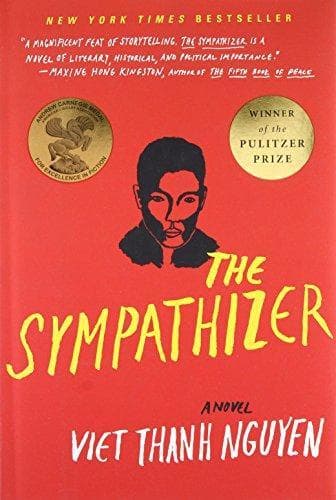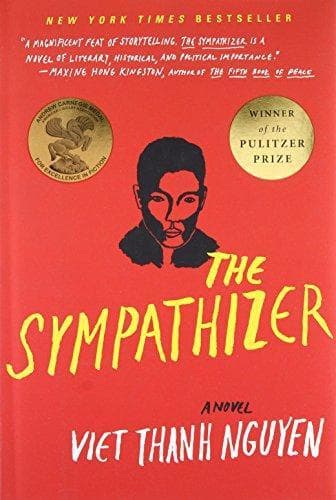
The novel, The Sympathizer, begins in April 1975, as Saigon is about to fall to communist invasion. Soon enough it does, and the war is over. Or is it?
Black comedy, historical novel, and literary thriller, The Sympathizer follows a nameless spy who has infiltrated the South Vietnamese army and flees with its remnants to America. His mission: report on their efforts to continue their lost war. As the aide to a general who refuses to admit defeat, he observes the struggles of the Vietnamese refugees to survive in a melancholic Los Angeles. Among them, the general believes, are communist agents. So our spy’s double life continues, hunting communists while helping the general organize a covert army. Their mission: to invade Vietnam and take it back.
Neither America nor a double life is new to our narrator. He is Eurasian, his father a French priest, his mother Vietnamese. He has been a double agent since his teenage years, and in his college years, he studied in California, the better to learn American culture. His war is a psychological one, but as he slowly realizes, much of that war is fought within himself, a man in between races and countries. As he tells us from the beginning: I am a spy, a sleeper, a spook, a man of two faces. Perhaps not surprisingly, I am also a man of two minds.
Add to your library to track progress and write reviews
Find The Sympathizer Viet Thanh Nguyen in PDF, EPUB, ebook, audiobook, print, or library editions.

2 books in catalog
Explorations of war, memory, displacement, and political identity form the core of modern fiction addressing the aftermath of the Vietnam War and its global diaspora. Viet Thanh Nguyen gained widespread recognition with his debut novel, The Sympathizer, which offers a dual-agent perspective on the fall of Saigon and the complexities of refugee identity in the United States. His writing combines satirical espionage fiction, historical analysis, and personal reflection to reframe how historical conflicts and displaced populations are represented in contemporary literature.
Born in South Vietnam on March 13, 1971, Nguyen fled to the United States as a child refugee with his family in 1975 following the fall of Saigon. After living in San Jose, California, he pursued higher education in the University of California system, completing his undergraduate and doctorate degrees at the University of California, Berkeley. Nguyen established his academic career at the University of Southern California, where he serves as the Aerol Arnold Chair of English and Professor of English, American Studies and Ethnicity, and Comparative Literature. In addition to his academic appointments, he became a Fellow of the American Academy of Arts and Sciences and was named a MacArthur Foundation Fellow and a Guggenheim Fellow in 2017. Beyond academia and fiction, he works as a regular contributor and op-ed columnist for The New York Times, writing extensively on immigration, refugees, politics, culture, and South East Asia.
Nguyen's literary and critical work frequently interrogates the politics of memory, imperial violence, and the lived experience of forced migration. His prose often utilizes satire, irony, and double consciousness to challenge dominant American narratives regarding the Vietnam War and Asian American identity. By centering voices that exist between competing political allegiances and cultural expectations, his narratives critique both Western power structures and ideological dogmatism. In his editorial projects, including the essay collection The Displaced: Refugee Writers on Refugee Lives, Nguyen brings together international writers to examine displacement as a central global condition rather than a temporary crisis.
The Sympathizer