§About the Author

T. H. White
2 books in catalog
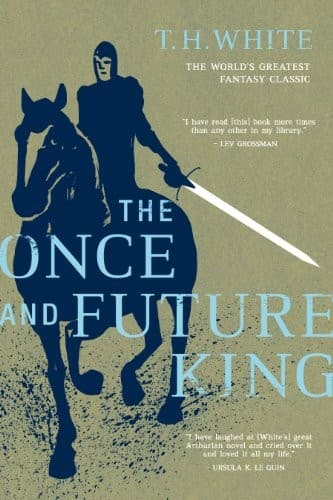
The reimagining of Arthurian mythology gained one of its most influential interpretations through a multi-volume saga that blended medieval lore, satire, and deep human affection. T. H. White transformed Sir Thomas Malory's 15th-century Morte Darthur into the classic fantasy fantasy collection The Once and Future King, recasting King Arthur's boyhood and reign into a narrative exploring governance, education, and human folly.
Career & Background
Born Terence Hanbury White in Bombay, British India, in 1906, he spent his early childhood in India before being raised by relatives in the United Kingdom from the age of five. He was educated at Cheltenham College and Queen's College, Cambridge, before taking a position as an English master at Stowe School from 1930 to 1936. During his time teaching at Stowe, White achieved his first major critical success with England Have My Bones (1936), an autobiographical record of his rural country pursuits.
Following the success of his memoir, White resigned from teaching to devote himself entirely to writing and research. He immersed himself in medieval literature, social history, and traditional country sports like hawking and fishing. He lived in relative isolation for much of his adult life, spending years in Ireland and later the Channel Islands, continuing his literary work until his death in 1964 in Piraeus, Greece.
Writing Style & Themes
White's writing is characterized by a distinct blend of medieval scholarship, gentle irony, and tragicomic reflection. His Arthurian works feature anachronistic humor alongside meticulous detail regarding medieval falconry, hunting, armor, and chivalric customs, bringing ancient legend into dialogue with modern sensibilities. A deep nostalgia for England's historical and natural past remains a prominent motif across both his fiction and non-fiction, such as Farewell Victoria (1933).
At the core of his Arthurian cycle is a sustained examination of power, justice, and political philosophy. By depicting Merlyn teaching young Arthur through transformations into various animals, White explored themes of anti-militarism, tyranny, and moral education, reflecting the geopolitical anxieties and societal changes of the mid-20th century.
Major Works
- The Once and Future King — Published together in 1958, this sequence brings together White's Arthurian fiction into a single comprehensive narrative detailing Arthur's life from childhood through the downfall of Camelot.
- The Sword in the Stone / by T. H. White — First published as an independent novel in 1938, this story introduces Arthur, known as Wart, and his magical education under the wizard Merlyn.
- England Have My Bones — A 1936 autobiographical volume documenting White's experiences with country life, which established his reputation as a writer prior to his Arthurian works.