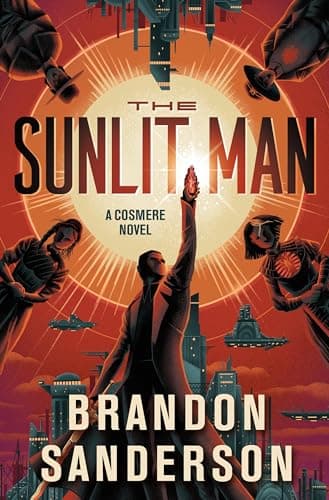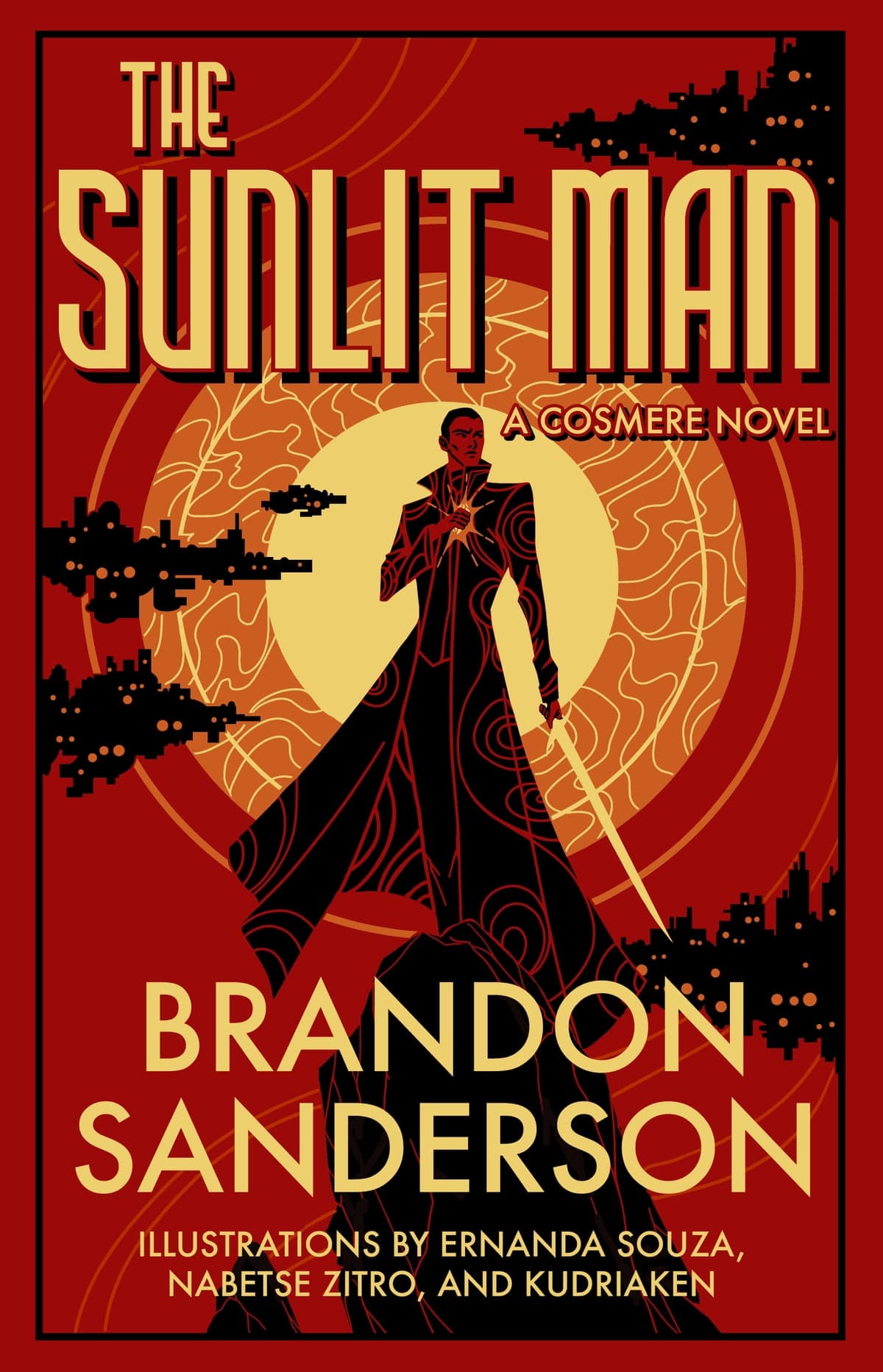
A man known only as Nomad has spent years fleeing across the Cosmere, pursued by a relentless organization called the Night Brigade. He is a planetary wanderer, not by choice, but by a survival instinct honed through countless narrow escapes. When he unexpectedly "skips" to a new world called Canticle, he arrives physically exhausted and spiritually depleted, only to find himself in a setting where the environment itself is a predator. On Canticle, the sun does not merely provide light; it is a localized apocalypse that melts stone and incinerates anything caught in its path, forcing the entire population to live in a state of perpetual, high-speed migration.
Nomad’s struggle is defined by a unique and debilitating condition known as his "Torment," a magical scarring that prevents him from causing physical harm to others. This creates a high-stakes moral and tactical dilemma: he is a warrior who cannot fight, landing in the middle of a civil war between a tyrannical regime and a group of desperate refugees. To survive long enough to recharge his abilities and leave the planet, Nomad must navigate a society that harvests sunlight as a literal currency of power, all while deciding if his own survival is worth the cost of ignoring the plight of those around him.
The world-building of Canticle centers on the "Sunlight" as both the primary threat and the ultimate resource. Because the planet rotates slowly and the sun is unnervingly close, the surface is subjected to temperatures that liquefy the crust. The inhabitants live on massive, hovering floating ships and cities that must stay on the "day side" long enough to harvest energy but move fast enough to stay ahead of the lethal dawn. This creates a "thermal economy" where solidified sunlight, known as Sunhearts, serves as the battery for all technology, medicine, and heat. The atmosphere is one of frantic, industrial survival, where every second of delay is a step toward extinction.
The protagonist’s development is rooted in the "Torment," a mechanical manifestation of his past choices. Unlike traditional fantasy heroes who gain power as the story progresses, Nomad begins the narrative with immense knowledge but extreme physical limitations. His arc focuses on the transition from a purely reactive survivalist to a man who must find creative, non-violent ways to exert influence. His relationship with Auxiliary highlights a deep-seated exhaustion; their dynamic is less about a hero and his sidekick and more about two veterans of a cosmic war trying to find a reason to keep moving when their resources—and their hope—are nearly at zero.
The Sunlit Man utilizes the "Stranger in a Strange Land" trope but strips away the usual advantages of the archetype. While Nomad possesses advanced technological and magical knowledge, he lacks the basic linguistic and biological requirements to survive Canticle’s atmosphere without help. The book also leans heavily into "Science-Fantasy" tropes, where the magic system is treated with the rigor of thermodynamics. It subverts the "invincible wanderer" trope by making the protagonist's greatest asset—his connection to the broader universe—the very thing that makes him a target for the Night Brigade, ensuring that every moment he spends helping others increases the risk of his own capture.
Add to your library to track progress and write reviews

37 books in catalog
The creation of the Cosmere, a vast interconnected universe where magic systems are governed by distinct physical laws, has redefined the scope of modern epic fantasy. Brandon Sanderson established this shared setting through a series of novels that began with the publication of Elantris and expanded into the multi-volume saga The Stormlight Archive.
His work is characterized by intricate world-building and a commitment to "hard magic," where the limitations of supernatural abilities are as important as the powers themselves. This approach has made his books, such as Mistborn: The Final Empire and The Way of Kings, central to contemporary discussions of genre construction and narrative consistency.
Born on December 19, 1975, in Lincoln, Nebraska, Brandon Winn Sanderson was the eldest of four children born to Barbara and Winn Sanderson. Although he was a reluctant reader in his early youth, his perspective changed in the eighth grade when his teacher, Mrs. Reeder, gave him a copy of Dragonsbane by Barbara Hambly. This encounter led him to explore the works of Robert Jordan, Melanie Rawn, David Eddings, Anne McCaffrey, and Orson Scott Card, eventually inspiring his own early attempts at fiction. In 1994, he enrolled at Brigham Young University (BYU) as a biochemistry major. However, a two-year hiatus from 1995 to 1997 to serve as a missionary for the Church of Jesus Christ of Latter-day Saints in Seoul, South Korea, shifted his focus. During this time, he realized he missed writing more than chemistry. Upon returning to BYU, he changed his major to English, much to the dismay of his mother, who had hoped he would become a doctor.
To support his education while maximizing his writing time, Sanderson worked as a night desk clerk at a local hotel, writing between midnight and 5:00 AM. By the time he finished his undergraduate degree, he had completed seven novels, though he faced a steady stream of rejections from publishers. He also volunteered for The Leading Edge, BYU’s science fiction and fantasy magazine, where he served as Editor in Chief during his senior year. This role allowed him to read many submissions and form lifelong friendships within the industry. He learned about the business side of writing by taking a class from David Farland, author of the Runelords series, who advised him to attend conventions like WorldCon and World Fantasy to connect with professionals. He eventually met his current agent and one of his editors at these events.
His persistence paid off in 2003 when editor Moshe Feder at Tor Books discovered the manuscript for Elantris in a slush pile. The novel was published in May 2005, marking the official start of his professional career. Shortly after, he launched the Mistborn trilogy, which includes Mistborn: The Final Empire (2006), The Well of Ascension (2007), and The Hero of Ages. In 2004, after graduating with his Master’s degree in creative writing from BYU, he was asked to teach the same genre-focused writing class he had once taken as an undergraduate. He continues to teach this section because he enjoys helping aspiring writers. In July 2006, he married Emily Bushman, a fellow English major from BYU. Emily began working as his business manager following the birth of their first child in October 2007.
A significant turning point occurred in December 2007 when Harriet McDougal Rigney selected Sanderson to complete Robert Jordan’s The Wheel of Time series following Jordan's death. This massive undertaking resulted in three volumes: The Gathering Storm (2009), Towers of Midnight (2010), and A Memory of Light (2013). During this same period, Sanderson began his own magnum opus, The Stormlight Archive, starting with The Way of Kings in 2010. He has since balanced these epic projects with middle-grade series like Alcatraz Versus the Evil Librarians (2007) and young adult science fiction such as Skyward. His novella The Emperor’s Soul won the Hugo Award in 2013, and he has been a judge for Writers of the Future since 2016. He also co-hosts the podcast Writing Excuses, which has won multiple awards for its writing advice.
Sanderson is widely recognized for his development of "Sanderson’s Laws of Magic," a set of guidelines for authors to create consistent and logical magic systems. His approach emphasizes that an author's ability to solve problems with magic is directly proportional to how well the reader understands said magic. This philosophy is evident in the "Allomancy" of the Mistborn series, where characters ingest and "burn" metals to gain specific abilities, and the "Surgebinding" found in The Stormlight Archive. By establishing clear costs and limitations, he ensures that magical resolutions feel earned rather than arbitrary. This dedication to internal logic has influenced a generation of fantasy writers seeking to move away from "soft" magic systems where powers are ill-defined.
His world-building often incorporates unique geological and ecological elements that directly influence the cultures and technologies of his characters. For instance, the landscape of Roshar in The Stormlight Archive features a rocky terrain and flora that retracts into the ground, a design inspired by the sandstone buttes and slot canyons of southeastern Utah. Similarly, the world of Scadrial in Mistborn is defined by falling ash and a red sun, environmental factors that shape the social hierarchy and survival strategies of its inhabitants. His background in linguistics, influenced by his time in Korea, often informs the naming conventions and structural logic of his fictional languages, adding a layer of authenticity to his diverse civilizations.
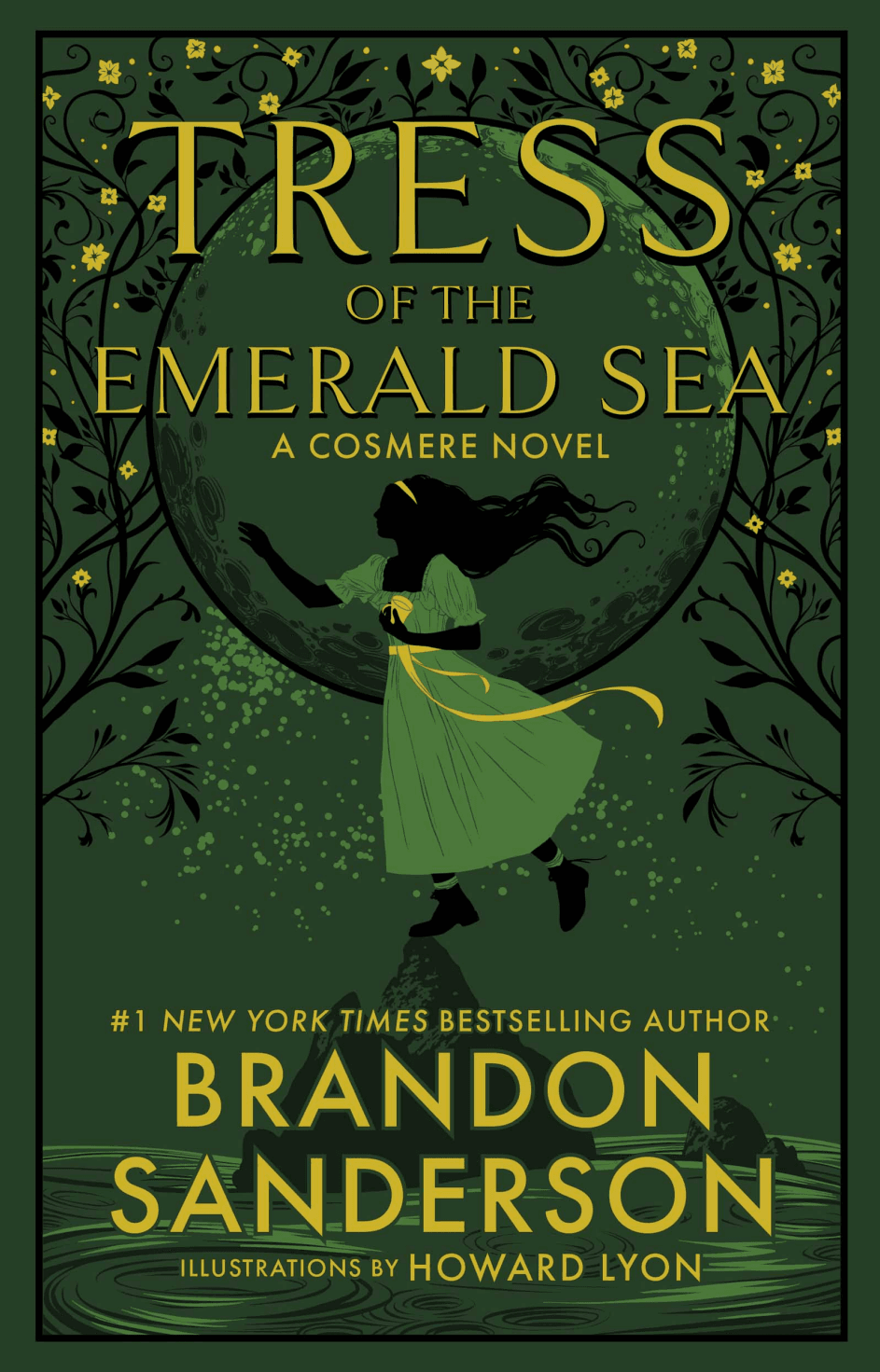
Thematic depth in his work often explores the intersection of leadership, morality, and mental health. Characters in The Stormlight Archive frequently struggle with depression, post-traumatic stress, or identity crises, reflecting a nuanced approach to heroism that acknowledges human vulnerability. The "Cosmere" framework allows for subtle cross-over elements, where characters known as "Worldhoppers" appear in different series, rewarding observant readers with a deeper layer of narrative connectivity. This interconnectedness is further explored in his "Secret Projects," such as Tress of the Emerald Sea and The Sunlit Man, which expand the boundaries of his shared universe into new genres and planetary systems, including the transition into a space age as seen in Wind and Truth.
Secret Projects