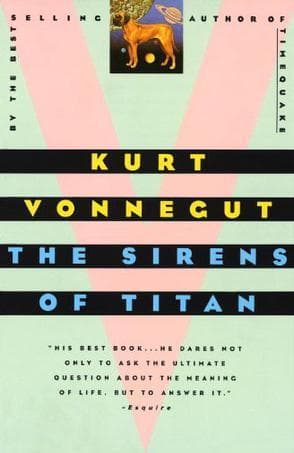
"His best book," Esquire wrote of Kurt Vonnegut's 1959 novel The Sirens of Titan, adding, "he dares not only to ask the ultimate question about the meaning of life, but to answer it." This novel fits into that aspect of the Vonnegut canon that might be classified as science fiction, a quality that once led Time to describe Vonnegut as "George Orwell, Dr. Caligari and Flash Gordon compounded into one writer ... a zany but moral mad scientist."
The Sirens of Titan was perhaps the novel that began the Vonnegut phenomenon with readers. The story is a fabulous trip, spinning madly through space and time in pursuit of nothing less than a fundamental understanding of the meaning of life. It takes place at a time in the future, when "only the human soul remained terra incognita ... the Nightmare Ages, falling roughly, give or take a few years, between the Second World War and the Third Great Depression."
The villainous and super rich Malachi Constant is offered a chance to journey into the far reaches of outer space, to eventually live on the planet Titan surrounded by three beautiful sirens. There is the proverbial "small print" with this incredible offer, which Constant turns down, setting in motion a fantastic chain of events that only Vonnegut could imagine. The result is an uproarious, freewheeling inquiry into the very reason we exist and about how we participate and matter in the scheme of the universe.
The Sirens of Titan is essential, fundamental Vonnegut, as entertaining as it is questing in search of answers to the mysteries of life. As a work of fiction, it is a sure leap, in terms of craft, over his first novel, Player Piano. His writing here is pared down, more concentrated and graceful, richly in the service of his remarkable ideas. Vonnegut summons greatness for the first time in The Sirens of Titan, where the search for the meaning of existence looks and sounds like a kaleidoscopic dream but leaves the reader with a clear and challenging answer.
Add to your library to track progress and write reviews
Find The Sirens of Titan Kurt Vonnegut in PDF, EPUB, ebook, audiobook, print, or library editions.

8 books in catalog
Blending satirical social commentary, dark comedy, and speculative elements, the groundbreaking 1969 novel Slaughterhouse-Five transformed modern American fiction by confronting war through a disjointed, non-linear lens. Its creator, Kurt Vonnegut, produced fourteen novels, short story collections, plays, and works of nonfiction across a career spanning more than five decades. His writing frequently used absurdist science fiction tropes to examine human cruelty, morality, and social inequality.
Born on November 11, 1922, in Indianapolis, Indiana, Kurt Vonnegut Jr. developed his early writing skills through student journalism, serving on the staff of Shortridge High School's paper, The Echo, and later working as managing editor for Cornell University's The Sun. The straightforward rules of reporting—focusing on facts and clear declarative sentences—permanently shaped his literary style. During World War II, Vonnegut served in the U.S. Army, was captured by German forces, and survived the 1945 Allied firebombing of Dresden as a prisoner of war. This horrific firsthand experience provided the core foundation for Slaughterhouse-Five (1969), which brought him widespread critical and commercial acclaim. He also served as honorary president of the American Humanist Association, reflecting his lifelong commitment to humanist principles until his death on April 11, 2007, in New York City.
Vonnegut's signature style relies on economical prose, short chapters, dark humor, and a skeptic's eye toward modern technology and institutional authority. His work frequently features recurring characters, such as the fictional science fiction writer Kilgore Trout, and fuses philosophical queries with surreal storytelling. In works like Cat's Cradle (1963) and Breakfast of Champions (1973), he satirized scientific arrogance, religious dogma, and economic disparity. By pairing bleak themes of destruction and human frailty with offbeat absurdity, Vonnegut offered a distinctly humanist critique of twentieth-century society.