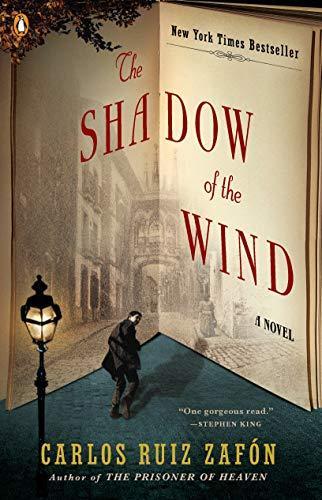
№ 1 · The Cemetery of Forgotten Books
The Shadow of the Wind,
§Synopsis
01Barcelona, 1945: A city slowly heals in the aftermath of the Spanish Civil War, and Daniel, an antiquarian book dealer’s son who mourns the loss of his mother, finds solace in a mysterious book entitled The Shadow of the Wind, by one Julián Carax. But when he sets out to find the author’s other works, he makes a shocking discovery: someone has been systematically destroying every copy of every book Carax has written. In fact, Daniel may have the last of Carax’s books in existence. Soon Daniel’s seemingly innocent quest opens a door into one of Barcelona’s darkest secrets—an epic story of murder, madness, and doomed love.
Un amanecer de 1945, un muchacho es conducido por su padre a un misterioso lugar oculto en el corazón de la ciudad vieja: el Cementerio de los Libros Olvidados. Allí, Daniel Sempere encuentra un libro maldito que cambia el rumbo de su vida y le arrastra a un laberinto de intrigas y secretos enterrados en el alma oscura de la ciudad. La Sombra del Viento es un misterio literario ambientado en la Barcelona de la primera mitad del siglo xx, desde los últimos esplendores del Modernismo hasta las tinieblas de la posguerra.
Aunando las técnicas del relato de intriga y suspense, la novela histórica y la comedia de costumbres, La Sombra del Viento es sobre todo una trágica historia de amor cuyo eco se proyecta a través del tiempo. Con gran fuerza narrativa, el autor entrelaza tramas y enigmas a modo de muñecas rusas en un inolvidable relato sobre los secretos del corazón y el embrujo de los libros cuya intriga se mantiene hasta la última página.
Todavía recuerdo aquel amanecer en que mi padre me llevó por primera vez a visitar El Cementerio de los Libros Olvidados.
§Our take
Zafón's novel rewards you more as accumulated atmosphere than as polished prose. Daniel’s search for Julián Carax begins as a rare-book treasure hunt, then becomes a layered inquiry assembled from other people’s testimony. That nested structure gives the book the pleasing shape of a secret passed hand to hand, though the middle wanders and later revelations lean heavily on letters and explanation.
The real argument is about excess. Zafón makes books feel alive and endangered, then leaves critics divided over whether the literary machinery is sublime or silly. Kirkus loved the layered mystery and supporting cast; Publishers Weekly found nearly every scene strained by flashy comparisons. Readers tend to praise the lyrical prose, Fermín and Daniel’s bond with his father, while objecting to melodrama, coincidence and the bleak treatment of women. Both camps have a point. Read it for atmosphere and devotion, not immaculate plotting.
§Themes
- Books under threat
- The Cemetery of Forgotten Books makes reading a rescue mission, while the systematic destruction of Carax’s work makes every volume part of the danger.
- Truth in nested voices
- Daniel’s first-person account frames other people’s stories, so the mystery takes shape as assembled testimony.
- Barcelona after the war
- A city healing after the Spanish Civil War carries censorship, violence and memory into Daniel’s search.
- Gothic romance under pressure
- Doomed love and obsessive revenge push the novel toward melodrama, which some readers relish and others find exhausting.
- Women through a male gaze
- Daniel’s young male viewpoint colors the book, but readers still fault the sexualized, one-dimensional portrayals of women.
§How it was received
Kirkus was warmly enthusiastic, praising the layered mystery, young narrator and lively supporting cast. Publishers Weekly found the story overwrought and more a Hollywood imitation than a real nineteenth-century novel, while The Telegraph and Washington Post were strongly positive and German critics more reserved. Readers commonly single out the lyrical prose, Fermín and Daniel’s bond with his father, while objecting to melodrama, shifting perspectives and the bleak portrayal of women.
§Read it if
- You love books about books, rare-book shops and libraries with a darker purpose
- You enjoy a gothic mystery that trades strict plotting for atmosphere and layered testimony
- You’re willing to forgive florid prose if the setting and supporting cast are magnetic
§Skip it if
- Telenovela-style melodrama, florid prose and late explanatory monologues are likely to grate
- Female characters defined mainly by the men around them are a deal-breaker; readers make that complaint often
§Before you start
- Reading experience
- A long, dense novel with shifting narrators, several subplots and a digressive middle, so patience is the price of the atmospheric payoff.
- Reading order
- Book 1 of the Cemetery of Forgotten Books in publication order. The Angel’s Game (2008) is set earlier and often read as a prequel or companion; The Prisoner of Heaven (2011) continues from The Shadow of the Wind, followed by The Labyrinth of the Spirits (2016). The books are linked but can be read separately, and this is the consensus starting point.
- Content notes
- Violence, including murder, torture and wartime brutality; Imprisonment and depictions of madness; Sexual violence and sexual content, including rape and beatings; Book burning, doomed love, jealousy and revenge.
§Common questions
- Is The Shadow of the Wind part of a series?
- Yes. It’s book 1 of the Cemetery of Forgotten Books, though the linked novels can be read separately.
- Do I need to read the other books in order?
- No. Start here. The Angel’s Game is set earlier, The Prisoner of Heaven continues from this story, and The Labyrinth of the Spirits follows.
- Is it suitable for children?
- It isn’t a children’s book. It includes murder, torture, rape and other sexual violence, plus bleak treatment of women.
§If you liked this
- The Name of the Rose by Umberto Eco — A bookish mystery in which a library and forbidden texts drive the plot, making it the natural companion for readers who like their puzzles surrounded by books.
- Foucault's Pendulum by Umberto Eco — Publishers Weekly linked the novel’s bookish intrigue to Eco’s novel, so it belongs on the same shelf for readers who gravitate to literary riddles.
- One Hundred Years of Solitude by Gabriel García Márquez — Bookreporter compared the book’s magical-realism touches to García Márquez, though here the supernatural remains faint and the gothic mystery stays in charge.
- Great Expectations by Charles Dickens — Kirkus called The Shadow of the Wind a Dickensian romance; Great Expectations offers the same mix of romance, mystery and melodrama at its source.
- The Historian by Elizabeth Kostova — A contemporary bookish hunt for a hidden past across several timelines, for readers who want another library-and-archive mystery.
Track this book
Add to your library to track progress and write reviews