SSansFiction
The libraryCollectionsJournalStatsFor authors
Sign inJoin now
Sansfiction,

A digital library for books. Made by readers, for readers.

v 2.0 · 2026
The library
  • Discover
  • Collections
  • Book tracker
  • Journal
  • Stats
For authors
  • SF Links
  • Analytics
  • How it works
  • FAQ
Elsewhere
  • X / @sansfiction
  • Privacy
  • Terms
  • Contact
© 2026 SansFiction · Digital · GlobalA quiet room for your reading life.
The libraryCollectionsJournalStatsFor authors
Sign inJoin now →
Navigation
Library
Bookshelf
Journal
Discover
Collections
Tierlists
Stats
Profile
Author Page
Link Builder
Account
Sign in
S
G
BooksadventureThe Road
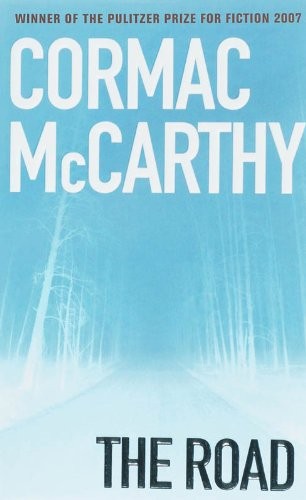
Cover of The Road by Cormac McCarthy

The Road,

by Cormac McCarthy

Ask AI
Rating4.0/ 5
Ratings1,781
Pages287
Reading Hours6h
Published2006
LanguageEnglish

§Synopsis

01

A father and his son walk alone through burned America. Nothing moves in the ravaged landscape save the ash on the wind. It is cold enough to crack stones, and when the snow falls it is gray. The sky is dark. Their destination is the coast, although they don’t know what, if anything, awaits them there. They have nothing; just a pistol to defend themselves against the lawless bands that stalk the road, the clothes they are wearing, a cart of scavenged food—and each other.

§Our take

The catastrophe is never named, and that silence is the book's engine. Critics have called it parable, climate warning, religious allegory, genre horror; Michael Chabon argues that 'parable' is the label critics reach for to avoid saying 'genre,' and that the novel works best as a Crusoe-style quest with Gothic teeth. The prose strips down to short clauses and no quotation marks, which Chabon reads as preservation rather than denial — naming things even as the world burns them away. James Wood, the main skeptic among major reviewers, found the treatment of belief a little showy and wanted the ending to carry more philosophical weight; Chabon, a fan, felt the closing note sat uneasily with the rest of the book. Unlike Blood Meridian's slow climb to the canon, The Road was celebrated and prized within months, and Oprah picked it for her club. Readers split on whether the sparse style is hypnotic or a pose, and on whether the ending fits what came before. The father-son bond carries it either way.

§Themes

Carrying the fire
The father's shorthand for goodness and humanity, literal and figurative, that the boy must inherit.
A parent's fear made messianic
The father's devotion shades into near-religious sacrifice while the boy questions the survivalist code.
Belief as stubborn will
No doctrine confirms they're the good ones; the father's conviction is the only proof, and critics disagree whether that's strength or evasion.
The rhythm of walking and waiting
Unnumbered sections cycle through scavenging, sheltering, dreaming — rhythm replaces plot.
Prose that preserves by burning
The stripped style omits quotation marks and apostrophes, naming the world even as it erases it.

§How it was received

Reviews at publication were overwhelmingly admiring, with Kirkus calling it a radical achievement and The Guardian naming it a very great novel; James Wood stood out as the main dissenter, finding the handling of belief showy and the ending philosophically light. The book kept climbing retrospective best-of lists for years afterward, and the 2009 film drew cooler but still positive notices.

§Read it if

  • You want a post-apocalypse story that ignores the cause and focuses on a father and son
  • You admire prose that strips to the bone — no quotation marks, parataxis, repeated gray imagery — and call it hypnotic
  • You're drawn to the long-running argument over whether the ending fits the book

§Skip it if

  • You need plot momentum; the episodic walk-scavenge-shelter cycle reads as monotonous to some
  • You can't take unrelenting emotional pressure; one reader called the father-son bond an 'emotional sledgehammer'

§Before you start

Reading experience
Short unnumbered sections, close third person, no quotation marks — readers adjust within pages because only two voices carry most dialogue, but the emotional weight makes it a slow fast read.
Content notes
Cannibalism and predatory human violence are central threats; the book is graphic enough that sources advise against younger readers; A child is in constant danger; the father keeps a pistol with the option of killing his son rather than letting him be captured; Suicide of the boy's mother is discussed and shown in flashback.

§Common questions

Is The Road part of a series?
No, it's a standalone novel.
Why are there no quotation marks?
McCarthy omits them and most apostrophes; readers report adjusting within pages since only the father and son speak most dialogue.
Is the book more hopeful or bleak?
It is unrelentingly bleak for most of its length, and readers and critics split on whether the ending fits the rest of the book; Chabon found it moving but at odds with what came before.

§If you liked this

  • Blood Meridian by Cormac McCarthy — Same author, same biblical cadence and bare punctuation, but a dense historical Western instead of an intimate father-son story.
  • Station Eleven by Emily St. John Mandel — Another literary post-collapse novel, but nonlinear, built around art and community, and more consolatory in tone.
  • Earth Abides by George R. Stewart — A 1949 classic where plague ends civilization, told in restrained objective tone over generations rather than one desperate walk.
  • Robinson Crusoe by Daniel Defoe — Chabon points to Crusoe-style survival and scavenging as one of the book's models.
Sources
  • Wikipedia
  • Literary Hub
  • The New York Review of Books (Michael Chabon)
  • Book Marks (Literary Hub), reproducing Alan Warner in The Guardian
  • Book Marks (Literary Hub)
  • Kirkus Reviews
  • Publishers Weekly
  • Virginia Quarterly Review
  • Writers Write
  • LitCharts
  • Common Sense Media
  • Wikipedia
  • Wikipedia
  • Wikipedia
  • Wikipedia

Track this book

Add to your library to track progress and write reviews

§Genres
adventure1cannibalism1classics1dystopian1fantasy1fathers and sons1fiction1
§Content Warnings
§Moods
adventurous1challenging1dark1emotional1hopeful1inspiring1mysterious1
§Tags
#fire/fire injury1#loveable characters1#not diverse characters1#plot driven1#strong character development1#unloveable characters1

§About the Author

Cormac McCarthy
Cormac McCarthy

6 books in catalog

American literature of the South, West, and post-apocalyptic settings is deeply shaped by dark, visceral narratives exploring morality and human nature in harsh environments. Cormac McCarthy (born Charles Joseph McCarthy Jr.; July 20, 1933 – June 13, 2023) authored twelve novels, two plays, five screenplays, and three short stories over a literary career that spanned nearly six decades.

His fiction reinterprets frontier myths and apocalyptic survival, bringing intense focus to characters grappling with violence, fate, and evil across classic works such as Blood Meridian and The Road.

Career & Background

Born in Providence, Rhode Island, McCarthy moved with his family to Knoxville, Tennessee in 1937, where his father worked as a lawyer for the Tennessee Valley Authority. He attended the University of Tennessee from 1951 to 1953 before dropping out to serve in the U.S. Air Force, returning to his studies from 1957 to 1959. His debut novel, The Orchard Keeper, was published in 1965 and received the William Faulkner Foundation Award.

For decades, McCarthy lived quietly and wrote in relative obscurity, eschewing media interviews and publicity while producing Southern Gothic fiction including Suttree. His scope shifted to the American Southwest with Blood Meridian in 1985 and The Border Trilogy, inaugurated by All The Pretty Horses, which earned both the National Book Award and the National Book Critics Circle Award. His subsequent novels, including No Country for Old Men and the Pulitzer Prize-winning The Road, reached wide audiences, followed decades later by The Passenger Box Set: The Passenger, Stella Maris. McCarthy died of natural causes at his home in Santa Fe, New Mexico, on June 13, 2023, at the age of eighty-nine.

Writing Style & Themes

McCarthy's work spans the Southern Gothic, Western, and post-apocalyptic genres, featuring graphic depictions of violence to examine human existence and evil. His prose is marked by a sparse use of punctuation, omitted quotation marks, and minimal attribution tags, creating a distinct rhythmic quality. Across his bibliography, his narratives consistently follow men facing unyielding landscapes and severe moral and physical trials.

Major Works

  • The Orchard Keeper — Published in 1965, McCarthy's debut novel won the William Faulkner Foundation Award and established his early Southern Gothic setting.
  • Suttree — Drawing on McCarthy's time living near Knoxville, this 1979 novel presents an atmospheric exploration of life along the Tennessee River.
  • Blood Meridian — First published in 1985, this acclaimed frontier novel examines violence and morality along the nineteenth-century American borderlands.
  • All The Pretty Horses — Published in 1992 as the opening volume of The Border Trilogy, this novel won the National Book Award and the National Book Critics Circle Award.
  • No Country for Old Men — Set in the modern Southwest along the Texas-Mexico border, this 2005 crime novel explores lawlessness and fate.
  • The Road — This 2006 post-apocalyptic story of a father and son traveling through a destroyed landscape won the Pulitzer Prize for Fiction in 2007.
  • The Passenger Box Set: The Passenger, Stella Maris — Published in 2022, this paired set of late-career novels delves into grief, physics, and human consciousness.

§Other Editions

Showing 2 of 80 editions
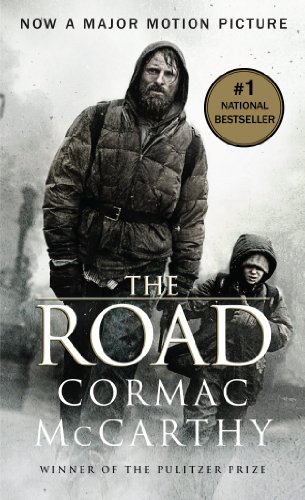
Cover of The Road

The Road

engMass Market PaperbackMovie Tie-In Edition (US/CAN)
Vintage Books20069780307476319
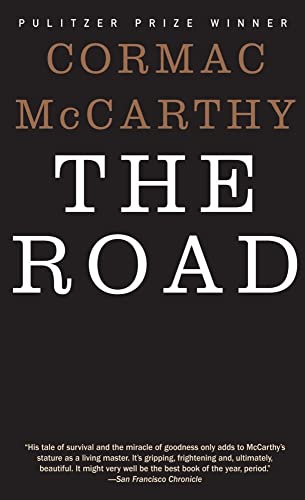
Cover of The Road

The Road

engPaperbackOpen-Market Edition
Vintage Books20069780307386458
§Genres
adventure1cannibalism1classics1dystopian1fantasy1fathers and sons1fiction1
§Content Warnings
§Moods
adventurous1challenging1dark1emotional1hopeful1inspiring1mysterious1
§Tags
#fire/fire injury1#loveable characters1#not diverse characters1#plot driven1#strong character development1#unloveable characters1

Metadata

ISBN-139780330448628
ISBN-100330448625

Editions and availability

Find The Road Cormac McCarthy in PDF, EPUB, ebook, audiobook, print, or library editions.

Bookshop.orgGoogle Play BooksBarnes & NobleOpen Library

Featured In Lists

Book cover from this collectionBook cover from this collectionBook cover from this collectionBook cover from this collection
Book cover from this collection

NPRs Top 100 Science-Fiction and Fantasy Books of All Time

100 books
Book cover from this collectionBook cover from this collectionBook cover from this collectionBook cover from this collection
Book cover from this collection

100 New York Times Best Books of the 21st Century

100 books
Book cover from this collectionBook cover from this collectionBook cover from this collectionBook cover from this collection
Book cover from this collection

Pulitzer Prize-winning Fiction

66 books
Book cover from this collectionBook cover from this collectionBook cover from this collectionBook cover from this collection
Book cover from this collection

Readers Pick Their 100 Best Books of the 21st Century

100 books
Book cover from this collectionBook cover from this collectionBook cover from this collectionBook cover from this collection
Book cover from this collection

Mother Horror's 101 Horror Books to Read Before You're Murdered

239 books
Book cover from this collectionBook cover from this collectionBook cover from this collectionBook cover from this collection
Book cover from this collection

TrueLit’s 100 Best Books of the Quarter Century

99 books
Book cover from this collectionBook cover from this collectionBook cover from this collectionBook cover from this collection
Book cover from this collection

4lit

96 books
Book cover from this collectionBook cover from this collectionBook cover from this collectionBook cover from this collection
Book cover from this collection

NPR Top 100 Science Fiction Fantasy

68 books