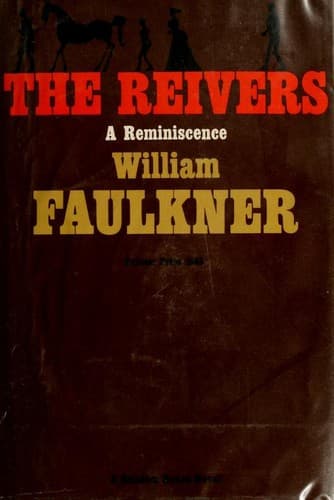
§Synopsis
01No description available.
No description available.
No description available.
Add to your library to track progress and write reviews
Add to your library to track progress and write reviews
Find The Reivers William Faulkner in PDF, EPUB, ebook, audiobook, print, or library editions.
Find The Reivers William Faulkner in PDF, EPUB, ebook, audiobook, print, or library editions.

9 books in catalog
Modernist American literature was transformed by complex multi-perspective narratives set in the fictional Yoknapatawpha County, Mississippi, a setting based closely on Lafayette County. William Cuthbert Faulkner (September 25, 1897 – July 6, 1962) created this immersive Southern landscape to explore themes of historical memory, social decay, and human endurance, most famously in his 1929 novel The Sound and the Fury.
Born William Cuthbert Falkner in New Albany, Mississippi, on September 25, 1897, the author grew up in nearby Oxford, Mississippi, where he spent most of his life. Influenced by his family background and regional history, he initially wrote poetry before serving in the Royal Canadian Air Force during World War I. After brief studies at the University of Mississippi and employment at a New York bookstore and a New Orleans newspaper, Faulkner dedicated himself to prose fiction, drawing heavily on the geography and culture of Lafayette County. Across his career, he worked as a farm owner at Rowan Oak and as a screenwriter in Hollywood, eventually earning wide acclaim as one of American literature's most celebrated figures and winning the 1949 Nobel Prize in Literature alongside two Pulitzer Prizes and two National Book Awards.
Faulkner is noted for his pioneering use of stream-of-consciousness narration, nonlinear chronologies, complex syntax, and multiple shifting perspectives. His works probe the lingering historical trauma of the American South, examining race, class, family honor, and moral decay. By connecting recurring characters and lineages across novels such as As I Lay Dying, Sanctuary, and Light In August, Faulkner constructed a cohesive regional mythos that examines human resilience and ethical struggle.
9 books in catalog
Modernist American literature was transformed by complex multi-perspective narratives set in the fictional Yoknapatawpha County, Mississippi, a setting based closely on Lafayette County. William Cuthbert Faulkner (September 25, 1897 – July 6, 1962) created this immersive Southern landscape to explore themes of historical memory, social decay, and human endurance, most famously in his 1929 novel The Sound and the Fury.
Born William Cuthbert Falkner in New Albany, Mississippi, on September 25, 1897, the author grew up in nearby Oxford, Mississippi, where he spent most of his life. Influenced by his family background and regional history, he initially wrote poetry before serving in the Royal Canadian Air Force during World War I. After brief studies at the University of Mississippi and employment at a New York bookstore and a New Orleans newspaper, Faulkner dedicated himself to prose fiction, drawing heavily on the geography and culture of Lafayette County. Across his career, he worked as a farm owner at Rowan Oak and as a screenwriter in Hollywood, eventually earning wide acclaim as one of American literature's most celebrated figures and winning the 1949 Nobel Prize in Literature alongside two Pulitzer Prizes and two National Book Awards.
Faulkner is noted for his pioneering use of stream-of-consciousness narration, nonlinear chronologies, complex syntax, and multiple shifting perspectives. His works probe the lingering historical trauma of the American South, examining race, class, family honor, and moral decay. By connecting recurring characters and lineages across novels such as As I Lay Dying, Sanctuary, and Light In August, Faulkner constructed a cohesive regional mythos that examines human resilience and ethical struggle.