Add to your library to track progress and write reviews
Find The pump house gang Tom Wolfe in PDF, EPUB, ebook, audiobook, print, or library editions.
3 books in catalog
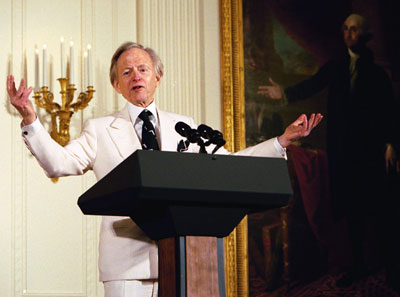
Pioneering a style of reportage that brought fictional narrative techniques to non-fiction journalism, literary reporting of the 1960s and 1970s transformed how writers documented American society. Tom Wolfe emerged as a central figure in this movement, known as New Journalism, capturing cultural shifts, class tensions, and subcultures with meticulous detail and vivid satire. His influential bibliography spans groundbreaking nonfiction accounts such as The Electric Kool-Aid Acid Test alongside major satirical novels like The Bonfire of the Vanities. By combining immersion reporting with scene-by-scene construction and distinctive punctuation, his work analyzed everything from Wall Street ambition and California counterculture to the early American space program.
Tom Wolfe was born and raised in Richmond, Virginia, where his father was an agricultural scientist and editor, and his mother designed gardens. He attended Washington and Lee University, graduating with a B.A. in 1951, and was also a talented baseball pitcher who tried out for the New York Giants. Pursuing advanced academic work, he earned a Ph.D. in American Studies from Yale University in 1957. In December 1956, before completing his doctorate, he took his first newspaper job as a reporter for the Springfield (Massachusetts) Union. This launched a ten-year career in daily journalism, primarily spent working as a general assignment reporter. For six months in 1960, he served as The Washington Post's Latin American correspondent, earning the Washington Newspaper Guild's foreign news prize for his reporting on Cuba. In 1962, he moved to New York City to become a reporter for the New York Herald-Tribune and joined Jimmy Breslin as one of the two main staff writers for New York magazine, which originated as the paper's Sunday supplement.
While working as a daily newspaper reporter for the New York Herald-Tribune, Wolfe assembled his first book from articles written about the flamboyant culture of the 1960s for New York and Esquire. Published in 1965 by Farrar, Straus, and Giroux under the title The Kandy-Kolored Tangerine-Flake Streamline Baby, the collection became an immediate bestseller and established him at the forefront of New Journalism. On a single day in 1968, he published two landmark bestsellers simultaneously: The Pump House Gang, which examined mid-1960s pop culture and California youth lifestyle, and The Electric Kool-Aid Acid Test, a full-length nonfiction narrative detailing Ken Kesey and the Merry Pranksters during the peak of the hippie era. In 1970, he published Radical Chic & Mau-Mauing the Flak Catchers, a controversial examination of racial friction and class politics in the United States. Its first section detailed a fundraising party hosted by conductor Leonard Bernstein for the Black Panthers at his Park Avenue duplex, while its second section exposed the bureaucratic inner workings of government anti-poverty programs. In 1979, after more than six years of research and writing, Wolfe completed The Right Stuff, an exhaustive account of post-World War II military rocket airplane experiments and Project Mercury. The book explored the psychological drive of test pilots and astronauts, examining the fierce competition among them. The Right Stuff became a major bestseller and earned the American Book Award for nonfiction, the National Institute of Arts and Letters Harold Vursell Award for prose style, and the Columbia Journalism Award.
Wolfe's writing style is defined by extensive on-the-scene reporting combined with literary devices such as third-person limited point of view, scene-by-scene reconstruction, realistic dialogue, and detailed catalogs of social status indicators. He frequently analyzed how individuals navigate class structures, social prestige, and group identity within American culture. Beyond his full-length books, he introduced several lasting cultural idioms into the public lexicon, including "the right stuff," "radical chic," and "the Me Decade" (also rendered as "the Me Generation"). However, Wolfe expressed particular pride in introducing the term "good ol' boy" to written language in a 1964 Esquire profile of North Carolina stock car racing driver Junior Johnson, titled "The Last American Hero." In his later career, he applied his observational reporting techniques to fiction, writing bestselling social novels including The Bonfire of the Vanities, which skewered 1980s New York City high finance, race relations, and criminal justice.

3 books in catalog
Pioneering a style of reportage that brought fictional narrative techniques to non-fiction journalism, literary reporting of the 1960s and 1970s transformed how writers documented American society. Tom Wolfe emerged as a central figure in this movement, known as New Journalism, capturing cultural shifts, class tensions, and subcultures with meticulous detail and vivid satire. His influential bibliography spans groundbreaking nonfiction accounts such as The Electric Kool-Aid Acid Test alongside major satirical novels like The Bonfire of the Vanities. By combining immersion reporting with scene-by-scene construction and distinctive punctuation, his work analyzed everything from Wall Street ambition and California counterculture to the early American space program.
Tom Wolfe was born and raised in Richmond, Virginia, where his father was an agricultural scientist and editor, and his mother designed gardens. He attended Washington and Lee University, graduating with a B.A. in 1951, and was also a talented baseball pitcher who tried out for the New York Giants. Pursuing advanced academic work, he earned a Ph.D. in American Studies from Yale University in 1957. In December 1956, before completing his doctorate, he took his first newspaper job as a reporter for the Springfield (Massachusetts) Union. This launched a ten-year career in daily journalism, primarily spent working as a general assignment reporter. For six months in 1960, he served as The Washington Post's Latin American correspondent, earning the Washington Newspaper Guild's foreign news prize for his reporting on Cuba. In 1962, he moved to New York City to become a reporter for the New York Herald-Tribune and joined Jimmy Breslin as one of the two main staff writers for New York magazine, which originated as the paper's Sunday supplement.
While working as a daily newspaper reporter for the New York Herald-Tribune, Wolfe assembled his first book from articles written about the flamboyant culture of the 1960s for New York and Esquire. Published in 1965 by Farrar, Straus, and Giroux under the title The Kandy-Kolored Tangerine-Flake Streamline Baby, the collection became an immediate bestseller and established him at the forefront of New Journalism. On a single day in 1968, he published two landmark bestsellers simultaneously: The Pump House Gang, which examined mid-1960s pop culture and California youth lifestyle, and The Electric Kool-Aid Acid Test, a full-length nonfiction narrative detailing Ken Kesey and the Merry Pranksters during the peak of the hippie era. In 1970, he published Radical Chic & Mau-Mauing the Flak Catchers, a controversial examination of racial friction and class politics in the United States. Its first section detailed a fundraising party hosted by conductor Leonard Bernstein for the Black Panthers at his Park Avenue duplex, while its second section exposed the bureaucratic inner workings of government anti-poverty programs. In 1979, after more than six years of research and writing, Wolfe completed The Right Stuff, an exhaustive account of post-World War II military rocket airplane experiments and Project Mercury. The book explored the psychological drive of test pilots and astronauts, examining the fierce competition among them. The Right Stuff became a major bestseller and earned the American Book Award for nonfiction, the National Institute of Arts and Letters Harold Vursell Award for prose style, and the Columbia Journalism Award.
Wolfe's writing style is defined by extensive on-the-scene reporting combined with literary devices such as third-person limited point of view, scene-by-scene reconstruction, realistic dialogue, and detailed catalogs of social status indicators. He frequently analyzed how individuals navigate class structures, social prestige, and group identity within American culture. Beyond his full-length books, he introduced several lasting cultural idioms into the public lexicon, including "the right stuff," "radical chic," and "the Me Decade" (also rendered as "the Me Generation"). However, Wolfe expressed particular pride in introducing the term "good ol' boy" to written language in a 1964 Esquire profile of North Carolina stock car racing driver Junior Johnson, titled "The Last American Hero." In his later career, he applied his observational reporting techniques to fiction, writing bestselling social novels including The Bonfire of the Vanities, which skewered 1980s New York City high finance, race relations, and criminal justice.