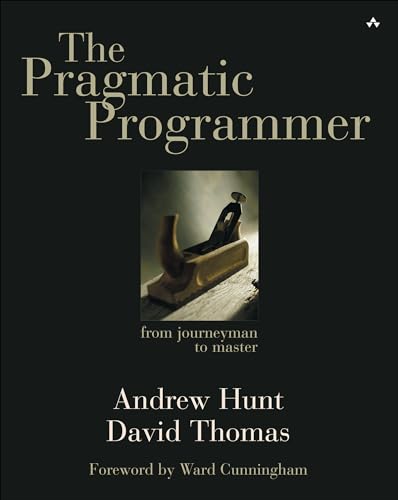
The Pragmatic Programmer is one of those rare tech books you’ll read, re-read, and read again over the years. Whether you’re new to the field or an experienced practitioner, you’ll come away with fresh insights each and every time.
Dave Thomas and Andy Hunt wrote the first edition of this influential book in 1999 to help their clients create better software and rediscover the joy of coding. These lessons have helped a generation of programmers examine the very essence of software development, independent of any particular language, framework, or methodology, and the Pragmatic philosophy has spawned hundreds of books, screencasts, and audio books, as well as thousands of careers and success stories.
Now, twenty years later, this new edition re-examines what it means to be a modern programmer. Topics range from personal responsibility and career development to architectural techniques for keeping your code flexible and easy to adapt and reuse. Read this book, and you’ll learn how to:
Fight software rot Learn continuously Avoid the trap of duplicating knowledge Write flexible, dynamic, and adaptable code Harness the power of basic tools Avoid programming by coincidence Learn real requirements Solve the underlying problems of concurrent code Guard against security vulnerabilities Build teams of Pragmatic Programmers Take responsibility for your work and career Test ruthlessly and effectively, including property-based testing Implement the Pragmatic Starter Kit Delight your users
Written as a series of self-contained sections and filled with classic and fresh anecdotes, thoughtful examples, and interesting analogies, The Pragmatic Programmer illustrates the best approaches and major pitfalls of many different aspects of software development. Whether you’re a new coder, an experienced programmer, or a manager responsible for software projects, use these lessons daily, and you’ll quickly see improvements in personal productivity, accuracy, and job satisfaction. You’ll learn skills and develop habits and attitudes that form the foundation for long-term success in your career.
You’ll become a Pragmatic Programmer.
The Pragmatic Programmer is one of those rare tech books you’ll read, re-read, and read again over the years. Whether you’re new to the field or an experienced practitioner, you’ll come away with fresh insights each and every time.
Dave Thomas and Andy Hunt wrote the first edition of this influential book in 1999 to help their clients create better software and rediscover the joy of coding. These lessons have helped a generation of programmers examine the very essence of software development, independent of any particular language, framework, or methodology, and the Pragmatic philosophy has spawned hundreds of books, screencasts, and audio books, as well as thousands of careers and success stories.
Now, twenty years later, this new edition re-examines what it means to be a modern programmer. Topics range from personal responsibility and career development to architectural techniques for keeping your code flexible and easy to adapt and reuse. Read this book, and you’ll learn how to:
Fight software rot Learn continuously Avoid the trap of duplicating knowledge Write flexible, dynamic, and adaptable code Harness the power of basic tools Avoid programming by coincidence Learn real requirements Solve the underlying problems of concurrent code Guard against security vulnerabilities Build teams of Pragmatic Programmers Take responsibility for your work and career Test ruthlessly and effectively, including property-based testing Implement the Pragmatic Starter Kit Delight your users
Written as a series of self-contained sections and filled with classic and fresh anecdotes, thoughtful examples, and interesting analogies, The Pragmatic Programmer illustrates the best approaches and major pitfalls of many different aspects of software development. Whether you’re a new coder, an experienced programmer, or a manager responsible for software projects, use these lessons daily, and you’ll quickly see improvements in personal productivity, accuracy, and job satisfaction. You’ll learn skills and develop habits and attitudes that form the foundation for long-term success in your career.
You’ll become a Pragmatic Programmer.
Add to your library to track progress and write reviews
Find The Pragmatic Programmer: Your Journey to Mastery, 20th Anniversary Edition Andrew Hunt in PDF, EPUB, ebook, audiobook, print, or library editions.
1 books in catalog
Software architecture and developer methodology were reshaped by the practical software development advice introduced in The Pragmatic Programmer. Co-author Andrew Hunt, a programmer turned consultant, author, and publisher, helped establish foundational practices for software engineering by focusing on craft, adaptability, and continuous personal growth.
Born in 1964 in Raleigh, North Carolina, Andrew Hunt (frequently published as Andy Hunt) began his career in computer science and software development. He built a consulting business in Raleigh, delivering technical solutions across telecommunications, banking, financial services, utilities, medical imaging, graphic arts, and internet services. In 2001, Hunt served as one of the 17 original authors of the Agile Manifesto and was a founding participant in the Agile Alliance to advance flexible software engineering methodologies.
Beyond consulting and writing, Hunt co-founded the Pragmatic Bookshelf publishing company alongside David Thomas, releasing critically acclaimed and award-winning books for software craftspeople. He is also a woodworker, musician, and audio producer who plays trumpet, flugelhorn, and keyboards at Strange & Special Air Productions. In addition to his technical guides, Hunt writes science fiction titles such as Conglommora, Conglommora Found, and Weatherly Hall, while actively experimenting with software development methodologies through The GROWS Method®.
Hunt's technical writing concentrates on practical application, cognitive reflection, and habit refinement over rigid adherence to theoretical frameworks. Across his technical publications, he blends established practices with modern tools, encouraging software developers to refine their cognitive processes, maintain curiosity, and take a pragmatic approach to complex software architectures.
1 books in catalog
Software architecture and developer methodology were reshaped by the practical software development advice introduced in The Pragmatic Programmer. Co-author Andrew Hunt, a programmer turned consultant, author, and publisher, helped establish foundational practices for software engineering by focusing on craft, adaptability, and continuous personal growth.
Born in 1964 in Raleigh, North Carolina, Andrew Hunt (frequently published as Andy Hunt) began his career in computer science and software development. He built a consulting business in Raleigh, delivering technical solutions across telecommunications, banking, financial services, utilities, medical imaging, graphic arts, and internet services. In 2001, Hunt served as one of the 17 original authors of the Agile Manifesto and was a founding participant in the Agile Alliance to advance flexible software engineering methodologies.
Beyond consulting and writing, Hunt co-founded the Pragmatic Bookshelf publishing company alongside David Thomas, releasing critically acclaimed and award-winning books for software craftspeople. He is also a woodworker, musician, and audio producer who plays trumpet, flugelhorn, and keyboards at Strange & Special Air Productions. In addition to his technical guides, Hunt writes science fiction titles such as Conglommora, Conglommora Found, and Weatherly Hall, while actively experimenting with software development methodologies through The GROWS Method®.
Hunt's technical writing concentrates on practical application, cognitive reflection, and habit refinement over rigid adherence to theoretical frameworks. Across his technical publications, he blends established practices with modern tools, encouraging software developers to refine their cognitive processes, maintain curiosity, and take a pragmatic approach to complex software architectures.