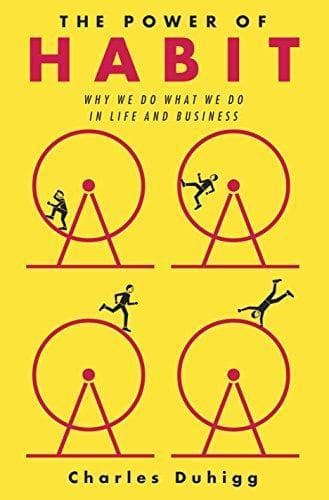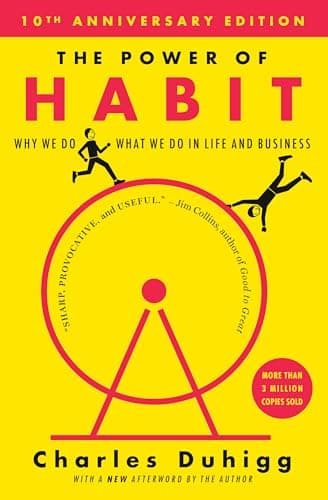
Groundbreaking new research shows that by grabbing hold of the three-step "loop" all habits form in our brains—cue, routine, reward—we can change them, giving us the power to take control over our lives. "We are what we repeatedly do," said Aristotle. "Excellence, then, is not an act, but a habit." On the most basic level, a habit is a simple neurological loop: there is a cue (my mouth feels gross), a routine (hello, Crest), and a reward (ahhh, minty fresh). Understanding this loop is the key to exercising regularly or becoming more productive at work or tapping into reserves of creativity. Marketers, too, are learning how to exploit these loops to boost sales; CEOs and coaches are using them to change how employees work and athletes compete. As this book shows, tweaking even one habit, as long as it's the right one, can have staggering effects. In The Power of Habit, award-winning New York Times business reporter Charles Duhigg takes readers inside labs where brain scans record habits as they flourish and die; classrooms in which students learn to boost their willpower; and boardrooms where executives dream up products that tug on our deepest habitual urges. Full of compelling narratives that will appeal to fans of Michael Lewis, Jonah Lehrer, and Chip and Dan Heath, The Power of Habit contains an exhilarating argument: our most basic actions are not the product of well-considered decision making, but of habits we often do not realize exist. By harnessing this new science, we can transform our lives.
Add to your library to track progress and write reviews
Find The Power of Habit: Why We Do What We Do in Life and Business Charles Duhigg in PDF, EPUB, ebook, audiobook, print, or library editions.

3 books in catalog
Investigative journalism and social science research meet in non-fiction works that examine human psychology, habit formation, productivity, and interpersonal dynamics. Charles Duhigg has authored several high-profile books in this space, most notably The Power of Habit: Why We Do What We Do in Life and Business, which spent over three years on bestseller lists and was translated into 40 languages.
Through deep reporting and concrete case studies of individuals and organizations, his work translates behavioral research into practical insights about how people work, communicate, and change daily routines.
Born in New Mexico in 1974, Charles Duhigg completed his undergraduate studies at Yale University before earning a Master of Business Administration from Harvard Business School in 2003. He began his journalism career as a staff writer for the Los Angeles Times before joining The New York Times in 2006, where he worked as a reporter and senior editor until 2017. Later in his career, he became a staff writer and contributor for The New Yorker magazine.
In 2013, Duhigg was part of a reporting team at The New York Times that was awarded the Pulitzer Prize for Explanatory Reporting for 'The iEconomy,' a ten-part series detailing the business practices of Apple and other technology companies. His investigative journalism has also earned the George Polk Award, the Gerald Loeb Award, the Investigative Reporters and Editors Medal, the Scripps Howard National Journalism Award, and recognition from the National Academies of Sciences. In addition to print reporting, he has appeared on broadcast outlets including NPR, PBS's NewsHour, Frontline, This American Life, and The Colbert Report.
Combining the analytical rigor of an investigative journalist with insights informed by business education, Duhigg connects scientific research with real-world narratives. His writing frequently pairs behavioral psychology, neuroscience, and organizational science with memorable real-life case studies. Rather than offering abstract self-help techniques, he focuses on how systems, routines, and environmental structures shape human behavior.
A central theme across his books is the mechanics of behavioral change and effective communication. He explores how habit loops operate in individuals and corporations, how high-performing groups structure their decision-making processes, and how conversations can be navigated by recognizing underlying emotional, practical, and social layers.