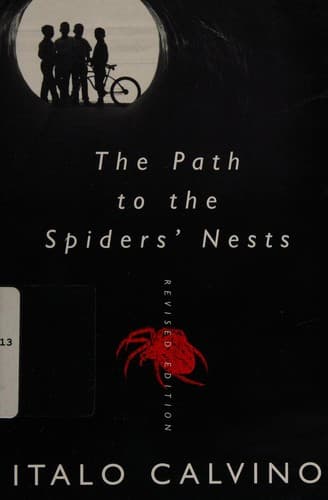
"Italo Calvino was only twenty-three when he first published this bold and imaginative novel. It tells the story of Pin, a cobbler's apprentice in a town on the Ligurian coast during World War II. He lives with his sister, a prostitute and spends as much time as he can at a seedy bar where he amuses the adult patrons. After a mishap with a Nazi soldier, Pin becomes involved with a band of partisans.
Calvino's portrayal of these characters, seen through the eyes of a child, is not only a revealing commentary on the Italian resistance but an insightful coming-of-age story.
Updated to include changes from Calvino's definitive Italian edition, previously censored passages, and his newly translated, unabridged preface - in which Calvino brilliantly critiques and places into historical context his own youthful work - The Path to the Spiders' Nests is animated by the formidable imagination that has made Italo Calvino one of the most respected writers of our time."--BOOK JACKET.
Add to your library to track progress and write reviews
Find The Path to the Spiders' Nests Italo Calvino in PDF, EPUB, ebook, audiobook, print, or library editions.

6 books in catalog
Imaginary urban landscapes described by Marco Polo to Kublai Khan form the backbone of the celebrated 1972 novel Invisible Cities. Italo Calvino, an Italian journalist, novelist, and short story writer born in 1923 and deceased in 1985, established himself among the most translated contemporary Italian authors of his generation.
Born on October 15, 1923, in Santiago de Las Vegas, Cuba, Calvino moved as a young child with his Italian parents to Sanremo on the Italian Riviera. During World War II, he served in the Italian Resistance between 1943 and 1945. After graduating from the University of Turin in 1947, he worked on the editorial staff of the publishing house Giulio Einaudi Editore until 1983. His early literary career was marked by neorealist prose, beginning with his debut novel The Path to the Spiders' Nests, which drew directly from his wartime experiences in the Resistance.
From the 1950s onward, his career transitioned into fabulist, allegorical, and combinatorial fiction. He gained wide international renown in Britain and the United States as well as becoming a noted contender for the Nobel Prize for Literature. In his later years, he joined Oulipo (Ouvroir de littérature potentielle), a collective of writers and mathematicians exploring constrained writing techniques. Calvino died in Siena, Italy, on September 19, 1985, following a cerebral hemorrhage.
Calvino's prose is characterized by analytical clarity paired with irony and lyrical reflection. His literary output spans neorealist war narrative, allegorical folk fantasy, scientific mythmaking, and self-referential metafiction. A major recurring technique involves structural constraints and mathematical frameworks, reflecting his work with Oulipo and his fascination with combinatorial narrative structures.
Themes in his work range from human identity and isolation to the nature of storytelling and perception. In works like The Castle of Crossed Destinies, story threads are constructed around tarot cards, whereas Cosmicomics (1965) uses mathematical and scientific concepts to create imaginative origins for the universe. His fiction consistently invites readers to examine how narratives shape human understanding.