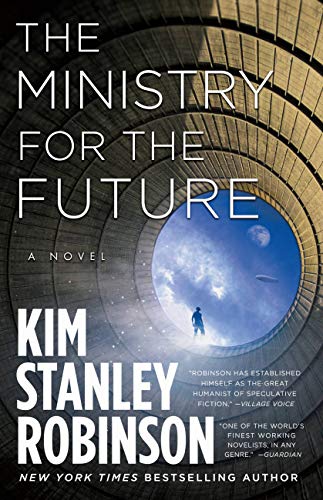

The Ministry for the Future is a masterpiece of the imagination, using fictional eyewitness accounts to tell the story of how climate change will affect us all. Its setting is not a desolate, post-apocalyptic world, but a future that is almost upon us. Chosen by Barack Obama as one of his favorite books of the year, this extraordinary novel from visionary science fiction writer Kim Stanley Robinson will change the way you think about the climate crisis.
ONE OF BARACK OBAMA’S FAVORITE BOOKS OF THE YEAR
“The best science-fiction nonfiction novel I’ve ever read.” —Jonathan Lethem
"If I could get policymakers, and citizens, everywhere to read just one book this year, it would be Kim Stanley Robinson’s The Ministry for the Future." —Ezra Klein (Vox)
"One hopes that this book is read widely—that Robinson’s audience, already large, grows by an order of magnitude. Because the point of his books is to fire the imagination."―New York Review of Books
"If there’s any book that hit me hard this year, it was Kim Stanley Robinson’s The Ministry for the Future, a sweeping epic about climate change and humanity’s efforts to try and turn the tide before it’s too late." ―Polygon (Best of the Year)
"Masterly." —New Yorker
"[The Ministry for the Future] struck like a mallet hitting a gong, reverberating through the year ... it’s terrifying, unrelenting, but ultimately hopeful. Robinson is the SF writer of my lifetime, and this stands as some of his best work. It’s my book of the year." —Locus
"Science-fiction visionary Kim Stanley Robinson makes the case for quantitative easing our way out of planetary doom." ―Bloomberg Green
Source: Publisher
The Ministry for the Future is a masterpiece of the imagination, using fictional eyewitness accounts to tell the story of how climate change will affect us all. Its setting is not a desolate, post-apocalyptic world, but a future that is almost upon us. Chosen by Barack Obama as one of his favorite books of the year, this extraordinary novel from visionary science fiction writer Kim Stanley Robinson will change the way you think about the climate crisis.
ONE OF BARACK OBAMA’S FAVORITE BOOKS OF THE YEAR
“The best science-fiction nonfiction novel I’ve ever read.” —Jonathan Lethem
"If I could get policymakers, and citizens, everywhere to read just one book this year, it would be Kim Stanley Robinson’s The Ministry for the Future." —Ezra Klein (Vox)
"One hopes that this book is read widely—that Robinson’s audience, already large, grows by an order of magnitude. Because the point of his books is to fire the imagination."―New York Review of Books
"If there’s any book that hit me hard this year, it was Kim Stanley Robinson’s The Ministry for the Future, a sweeping epic about climate change and humanity’s efforts to try and turn the tide before it’s too late." ―Polygon (Best of the Year)
"Masterly." —New Yorker
"[The Ministry for the Future] struck like a mallet hitting a gong, reverberating through the year ... it’s terrifying, unrelenting, but ultimately hopeful. Robinson is the SF writer of my lifetime, and this stands as some of his best work. It’s my book of the year." —Locus
"Science-fiction visionary Kim Stanley Robinson makes the case for quantitative easing our way out of planetary doom." ―Bloomberg Green
Source: Publisher
Add to your library to track progress and write reviews
13 books in catalog
Hard science fiction exploring terraforming, climate ecology, and socio-political systems reaches one of its most detailed expressions in the Mars trilogy. Kim Stanley Robinson, an American science fiction writer born on March 23, 1952, earned international recognition for depicting human colonization and ecological transformation on Mars through novels such as Red Mars, Green Mars, and Blue Mars.
Robinson earned his doctorate with a study on the fiction of Philip K. Dick, published as The Novels of Philip K. Dick in 1984. That same year, he published his debut novel, The Wild Shore, which launched his Three Californias trilogy—comprising The Wild Shore, The Gold Coast, and Pacific Edge—and inaugurated Ace Books' revived Science Fiction Specials line. Over a career encompassing more than twenty books, he has worked with institutions such as the Sierra Nevada Research Institute, the Clarion Writers' Workshop, and UC San Diego's Arthur C. Clarke Center for Human Imagination. In 2008, Time magazine named him a Hero of the Environment for his persistent ecological focus.
Ecological, cultural, and political systems form the core of Robinson's narrative architecture, with practicing scientists frequently serving as protagonists. His realistic approach to speculative fiction combines rigorous scientific detail with political economy, examining how human institutions adapt to environmental crises and technological change. His major honors include the Hugo Award for Best Novel, the Nebula Award for Best Novel, and the World Fantasy Award.
13 books in catalog
Hard science fiction exploring terraforming, climate ecology, and socio-political systems reaches one of its most detailed expressions in the Mars trilogy. Kim Stanley Robinson, an American science fiction writer born on March 23, 1952, earned international recognition for depicting human colonization and ecological transformation on Mars through novels such as Red Mars, Green Mars, and Blue Mars.
Robinson earned his doctorate with a study on the fiction of Philip K. Dick, published as The Novels of Philip K. Dick in 1984. That same year, he published his debut novel, The Wild Shore, which launched his Three Californias trilogy—comprising The Wild Shore, The Gold Coast, and Pacific Edge—and inaugurated Ace Books' revived Science Fiction Specials line. Over a career encompassing more than twenty books, he has worked with institutions such as the Sierra Nevada Research Institute, the Clarion Writers' Workshop, and UC San Diego's Arthur C. Clarke Center for Human Imagination. In 2008, Time magazine named him a Hero of the Environment for his persistent ecological focus.
Ecological, cultural, and political systems form the core of Robinson's narrative architecture, with practicing scientists frequently serving as protagonists. His realistic approach to speculative fiction combines rigorous scientific detail with political economy, examining how human institutions adapt to environmental crises and technological change. His major honors include the Hugo Award for Best Novel, the Nebula Award for Best Novel, and the World Fantasy Award.