The Lusiads,
by Luís de Camões, Landeg White, Lucas Pozzi de Souza, Isabel Burton, Filipe Rocha Garcia, Richard Francis Burton
by Luís de Camões, Landeg White, Lucas Pozzi de Souza, Isabel Burton, Filipe Rocha Garcia, Richard Francis Burton
by Luís de Camões, Landeg White, Lucas Pozzi de Souza, Isabel Burton, Filipe Rocha Garcia, Richard Francis Burton
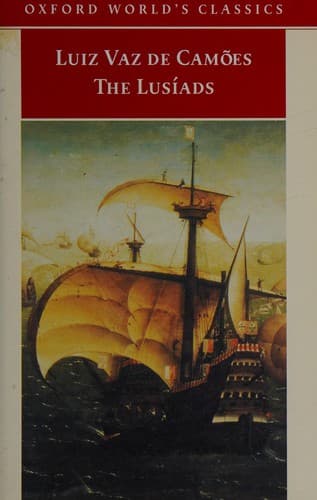
Os Lusíadas, usually translated as The Lusiads, is a Portuguese epic poem written by Luís de Camões and first published in 1572. It is widely regarded as the most important work of Portuguese-language literature and is frequently compared to Virgil's Aeneid. The work celebrates the discovery of a sea route to India by the Portuguese explorer Vasco da Gama (1469–1524). The ten cantos of the poem are in ottava rima and total 1,102 stanzas.
Os Lusíadas é uma obra poética do escritor Luís Vaz de Camões, considerada a epopeia portuguesa por excelência. Provavelmente concluída em 1556, foi publicada pela primeira vez em 1572 no período literário do classicismo, três anos após o regresso do autor do Oriente. A obra é composta de dez cantos, 1102 estrofes que são oitavas decassílabas, sujeitas ao esquema rímico fixo AB AB AB CC – oitava rima camoniana. A acção central é a descoberta do caminho marítimo para a Índia por Vasco da Gama, à volta da qual se vão descrevendo outros episódios da história de Portugal, glorificando o povo português.
Os Lusíadas, usually translated as The Lusiads, is a Portuguese epic poem written by Luís de Camões and first published in 1572. It is widely regarded as the most important work of Portuguese-language literature and is frequently compared to Virgil's Aeneid. The work celebrates the discovery of a sea route to India by the Portuguese explorer Vasco da Gama (1469–1524). The ten cantos of the poem are in ottava rima and total 1,102 stanzas.
Os Lusíadas é uma obra poética do escritor Luís Vaz de Camões, considerada a epopeia portuguesa por excelência. Provavelmente concluída em 1556, foi publicada pela primeira vez em 1572 no período literário do classicismo, três anos após o regresso do autor do Oriente. A obra é composta de dez cantos, 1102 estrofes que são oitavas decassílabas, sujeitas ao esquema rímico fixo AB AB AB CC – oitava rima camoniana. A acção central é a descoberta do caminho marítimo para a Índia por Vasco da Gama, à volta da qual se vão descrevendo outros episódios da história de Portugal, glorificando o povo português.
Add to your library to track progress and write reviews
Add to your library to track progress and write reviews
Find The Lusiads Luís de Camões in PDF, EPUB, ebook, audiobook, print, or library editions.
Find The Lusiads Luís de Camões in PDF, EPUB, ebook, audiobook, print, or library editions.
1 books in catalog
Luís Vaz de Camões (Portuguese pronunciation: [luˈiʃ vaʃ dɨ kaˈmõȷ̃ʃ]; sometimes rendered in English as Camoens; c. 1524 – June 10, 1580) is considered Portugal's, and the Portuguese language's, greatest poet. His mastery of verse has been compared to that of Shakespeare, Vondel, Homer, Virgil, and Dante. He wrote a considerable amount of lyrical poetry (in Portuguese and in Spanish) and drama but is best remembered for his epic work Os Lusíadas (The Lusiads). His recollection of poetry The Parnasum of Luís de Camões was lost in his lifetime.
1 books in catalog
Luís Vaz de Camões (Portuguese pronunciation: [luˈiʃ vaʃ dɨ kaˈmõȷ̃ʃ]; sometimes rendered in English as Camoens; c. 1524 – June 10, 1580) is considered Portugal's, and the Portuguese language's, greatest poet. His mastery of verse has been compared to that of Shakespeare, Vondel, Homer, Virgil, and Dante. He wrote a considerable amount of lyrical poetry (in Portuguese and in Spanish) and drama but is best remembered for his epic work Os Lusíadas (The Lusiads). His recollection of poetry The Parnasum of Luís de Camões was lost in his lifetime.