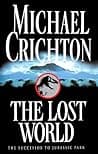
Six years after the death of John Hammond and the mysterious destruction of his Jurassic Park island of Isla Nubla, mathematician Ian Malcolm discovers a second island off Costa Rica, where Hammond created his genetically bred dinosaurs. He travels there with a scientific research team including paleobiologist Richard Levine, Sarah Harding, and two stowaway kids, Kelly and Arby, both 11 years old.
Once on the island, they find themselves on the run for their lives from some of the killer dinosaurs with whom Ian has already crossed paths, along with some new killers. The group not only has to contend with the dinosaurs, but with murderous rival scientist Lewis Dodgson and his cronies, who are out to steal the dinosaur eggs for themselves, as well. (source)
Also contained in: Michael Crichton's Jurassic World
Add to your library to track progress and write reviews
Find The Lost World Michael Crichton in PDF, EPUB, ebook, audiobook, print, or library editions.

4 books in catalog
Groundbreaking techno-thrillers that blend hard scientific research with high-stakes suspense have shaped modern science fiction and medical fiction. Author John Michael Crichton crafted speculative stories about biotechnology, computer systems, and zoological phenomena that questioned humanity's control over nature. His landmark novel Jurassic Park demonstrated how rapidly expanding scientific capabilities could lead to unforeseen ecological and technological crises.
Over the course of his career, Crichton sold more than 200 million copies of his books worldwide, with over a dozen of his works adapted into major motion pictures. In addition to his best-selling fiction, he worked as a screenwriter and director, and created the hit medical drama television series ER.
Born John Michael Crichton on October 23, 1942, in Chicago, Illinois, he spent his early childhood in Fort Morgan, Colorado, before growing up in Roslyn, Long Island. Raised by a father who worked as a journalist, Crichton developed an early interest in writing. He attended Harvard College, graduating summa cum laude, and went on to earn an MD from Harvard Medical School. To help fund his medical education, he published early novels under pseudonyms including John Lange, Jeffery Hudson, and Michael Douglas.
After completing his medical degree, Crichton chose not to practice clinical medicine, instead pursuing research as a postdoctoral fellow at the Salk Institute for Biological Studies alongside Jacob Bronowski. He also taught anthropology at Cambridge University and writing at the Massachusetts Institute of Technology. Crichton gained widespread literary recognition with science-focused thrillers such as The Terminal Man and continued to write, direct, and produce across film and television until his death on November 4, 2008, in Los Angeles.
Crichton's narrative approach relied heavily on technical detail, scientific reports, and procedural realism to make speculative scenarios feel believable. His novels frequently fall into the techno-thriller, science fiction, and medical fiction genres, exploring topics such as genetic modification, hybridization, zoology, and paleontology. A recurring central theme throughout his work is the danger of human hubris when attempting to dominate or manipulate complex natural systems.
While many of his stories served as cautionary tales regarding biotechnology and technological advancement, Crichton also addressed contemporary scientific debates in his fiction. In his 2004 novel State of Fear, he acknowledged global warming while challenging extreme anthropogenic warming scenarios. Across his bibliography, his prose remains grounded in scientific concepts, medical procedures, and systemic failure modes.
Jurassic Park