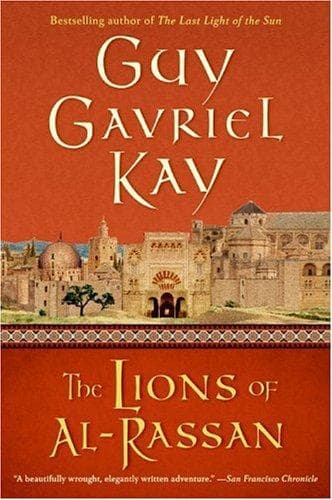
The ruling Asharites have come from the desert sands, worshipping the stars, their warrior blood fierce and pure. But over centuries, seduced by the sensuous pleasures of their new land, that stern piety has eroded. The Asharies empire has splintered into decadent city-states lead by warring petty kinds.
King Almalik of Cartada is on the ascendancy, adding city after city to his realm, even though Cartada is threatened by forces both within and without. Almalik is aided by his friend and advisor, the notorious Ammar ibn Khairan -- poet, diplomat, soldier -- until a summer afternoon of savage brutality changes their relationship forever.
Meanwhile, in the north, the Jaddite’s most celebrated -- and feared -- military leader, Rodrigo Belmonte, is driven into exile in the wake of events following the death of the king he loved. Rodrigo leads his mercenary company south, to the dangerous lands of Al-Rassan.
In the exquisite lakeside city of Ragosa, Rodrigo Belmonte and Ammar ibn Kharian meet and serve -- for a time -- the same master. Sharing the interwoven fate of these two men from different worlds -- and increasingly torn in her feelings -- is Jehane, the beautiful, accomplished court physician, whose own skills play an increasing role as Al-Rassan is swept to the brink of holy war, and beyond.
The ruling Asharites have come from the desert sands, worshipping the stars, their warrior blood fierce and pure. But over centuries, seduced by the sensuous pleasures of their new land, that stern piety has eroded. The Asharies empire has splintered into decadent city-states lead by warring petty kinds.
King Almalik of Cartada is on the ascendancy, adding city after city to his realm, even though Cartada is threatened by forces both within and without. Almalik is aided by his friend and advisor, the notorious Ammar ibn Khairan -- poet, diplomat, soldier -- until a summer afternoon of savage brutality changes their relationship forever.
Meanwhile, in the north, the Jaddite’s most celebrated -- and feared -- military leader, Rodrigo Belmonte, is driven into exile in the wake of events following the death of the king he loved. Rodrigo leads his mercenary company south, to the dangerous lands of Al-Rassan.
In the exquisite lakeside city of Ragosa, Rodrigo Belmonte and Ammar ibn Kharian meet and serve -- for a time -- the same master. Sharing the interwoven fate of these two men from different worlds -- and increasingly torn in her feelings -- is Jehane, the beautiful, accomplished court physician, whose own skills play an increasing role as Al-Rassan is swept to the brink of holy war, and beyond.
Add to your library to track progress and write reviews
Add to your library to track progress and write reviews
Find The Lions of Al-Rassan Guy Gavriel Kay in PDF, EPUB, ebook, audiobook, print, or library editions.
Find The Lions of Al-Rassan Guy Gavriel Kay in PDF, EPUB, ebook, audiobook, print, or library editions.

2 books in catalog
Fictional worlds meticulously modeled after actual historical eras—from Byzantine Constantinople to medieval Spain—define a distinct strand of epic fantasy literature. Guy Gavriel Kay introduced readers to this style through works that reimagine real-world cultural and political conflicts, beginning with his early trilogy The Fionavar Tapestry and expanding into acclaimed standalone novels such as Tigana.
Born on November 7, 1954, in Weyburn, Saskatchewan, Kay grew up in Winnipeg, where childhood reading of Greek mythology and fairy tales shaped his early literary interests. He pursued a bachelor's degree in philosophy at the University of Manitoba before moving to Oxford, England, where he assisted Christopher Tolkien in editing J.R.R. Tolkien's posthumously published manuscript The Silmarillion. Returning to Canada, Kay earned a law degree from the University of Toronto and qualified as a lawyer, but ultimately chose a career as a full-time novelist. His debut novel, The Summer Tree, appeared in 1984 as the first volume of The Fionavar Tapestry. In 2014, he was appointed to the Order of Canada in recognition of his literary contributions.
Kay's novels frequently feature fictional realms closely structured on historical locations and eras, including Constantinople during the reign of Justinian I and Spain during the time of El Cid. While these books are published and marketed as historical fantasy, Kay himself has expressed a preference to avoid genre categorization when possible. His narratives regularly explore themes of power, ambition, destiny, deceit, and the human consequences of political upheaval. Across sixteen novels and a collection of poetry, his work has been translated into dozens of languages, blending rigorous historical research with controlled fantastical elements.
2 books in catalog
Fictional worlds meticulously modeled after actual historical eras—from Byzantine Constantinople to medieval Spain—define a distinct strand of epic fantasy literature. Guy Gavriel Kay introduced readers to this style through works that reimagine real-world cultural and political conflicts, beginning with his early trilogy The Fionavar Tapestry and expanding into acclaimed standalone novels such as Tigana.
Born on November 7, 1954, in Weyburn, Saskatchewan, Kay grew up in Winnipeg, where childhood reading of Greek mythology and fairy tales shaped his early literary interests. He pursued a bachelor's degree in philosophy at the University of Manitoba before moving to Oxford, England, where he assisted Christopher Tolkien in editing J.R.R. Tolkien's posthumously published manuscript The Silmarillion. Returning to Canada, Kay earned a law degree from the University of Toronto and qualified as a lawyer, but ultimately chose a career as a full-time novelist. His debut novel, The Summer Tree, appeared in 1984 as the first volume of The Fionavar Tapestry. In 2014, he was appointed to the Order of Canada in recognition of his literary contributions.
Kay's novels frequently feature fictional realms closely structured on historical locations and eras, including Constantinople during the reign of Justinian I and Spain during the time of El Cid. While these books are published and marketed as historical fantasy, Kay himself has expressed a preference to avoid genre categorization when possible. His narratives regularly explore themes of power, ambition, destiny, deceit, and the human consequences of political upheaval. Across sixteen novels and a collection of poetry, his work has been translated into dozens of languages, blending rigorous historical research with controlled fantastical elements.