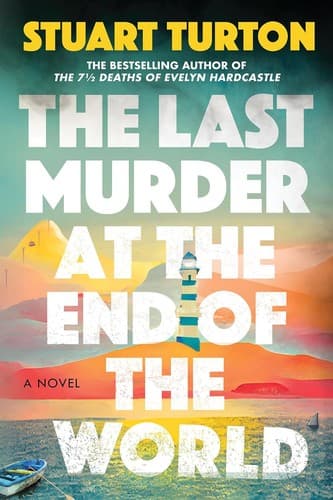
From the bestselling author of The 7 1/2 Deaths of Evelyn Hardcastle and The Devil and the Dark Water comes an inventive, high-concept murder mystery: an ingenious puzzle, an extraordinary backdrop, and an audacious solution.
Solve the murder to save what's left of the world.
Outside the island there is nothing: the world was destroyed by a fog that swept the planet, killing anyone it touched.
On the island: it is idyllic. One hundred and twenty-two villagers and three scientists, living in peaceful harmony. The villagers are content to fish, farm and feast, to obey their nightly curfew, to do what they're told by the scientists.
Until, to the horror of the islanders, one of their beloved scientists is found brutally stabbed to death. And then they learn that the murder has triggered a lowering of the security system around the island, the only thing that was keeping the fog at bay. If the murder isn't solved within 107 hours, the fog will smother the island―and everyone on it.
But the security system has also wiped everyone's memories of exactly what happened the night before, which means that someone on the island is a murderer―and they don't even know it.
And the clock is ticking.
From the bestselling author of The 7 1/2 Deaths of Evelyn Hardcastle and The Devil and the Dark Water comes an inventive, high-concept murder mystery: an ingenious puzzle, an extraordinary backdrop, and an audacious solution.
Solve the murder to save what's left of the world.
Outside the island there is nothing: the world was destroyed by a fog that swept the planet, killing anyone it touched.
On the island: it is idyllic. One hundred and twenty-two villagers and three scientists, living in peaceful harmony. The villagers are content to fish, farm and feast, to obey their nightly curfew, to do what they're told by the scientists.
Until, to the horror of the islanders, one of their beloved scientists is found brutally stabbed to death. And then they learn that the murder has triggered a lowering of the security system around the island, the only thing that was keeping the fog at bay. If the murder isn't solved within 107 hours, the fog will smother the island―and everyone on it.
But the security system has also wiped everyone's memories of exactly what happened the night before, which means that someone on the island is a murderer―and they don't even know it.
And the clock is ticking.
Add to your library to track progress and write reviews
Add to your library to track progress and write reviews
2 books in catalog
Combining classic whodunit puzzles with high-concept speculative fiction, intricate murder mysteries have captured international readership through high-stakes, locked-location settings. English journalist and novelist Stuart Turton made a striking entry into fiction with his bestselling novel The Seven Deaths of Evelyn Hardcastle, published in the United States as The 7 1/2 Deaths of Evelyn Hardcastle. His books have appeared on both the Sunday Times and USA Today bestseller lists, selling over one million copies worldwide.
Often referring to his first three standalone books as a 'not-a-trilogy' trilogy, his works have been translated into forty languages. By placing traditional detective puzzles inside extraordinary high-concept scenarios, his stories challenge readers to solve seemingly impossible crimes before time runs out.
Born in 1980 in Widnes, England, Stuart Turton spent years working as a journalist before turning to fiction writing. He later lived in West London with his wife, working as a freelance journalist while crafting his debut manuscript. His first novel, The Seven Deaths of Evelyn Hardcastle, was published in 2018 and achieved widespread critical acclaim. The novel won the 2018 Costa Book Award for First Novel as well as the Books Are My Bag Readers Award for Best Novel, while also securing shortlistings for the Specsavers National Book Awards and the British Book Awards Debut of the Year.
Following his debut success, Turton expanded his narrative repertoire with his second novel, The Devil and the Dark Water, and his post-apocalyptic mystery The Last Murder at the End of the World. The latter reached number one on the Sunday Times bestseller list. Across these works, Turton established a reputation as a friendly neighbourhood author who delights in subverting genre expectations, earning commercial and critical success across global markets.
Turton is widely recognized for fusing locked-room mystery structures with elements of literary fiction, science fiction, fantasy, and horror. A central motif in his storytelling is the execution of isolated, trap-like environments—progressing from a locked estate in his debut, to a locked boat on the high seas in his second book, and a locked island in his third. These contained environments create intense narrative pressure, trapping characters with a limited cast of suspects and forcing them to confront urgent timelines.
Beyond their mechanical intrigue, Turton's novels explore fundamental human questions about identity, morality, and survival under extreme conditions. He crafts intricate narrative structures featuring wild plot twists, time constraints, and layered puzzles that keep readers guessing until the climax. His inventive approach to mystery fiction allows each novel to function as an independent, high-concept narrative while maintaining a consistent commitment to clever puzzle-box plotting.
2 books in catalog
Combining classic whodunit puzzles with high-concept speculative fiction, intricate murder mysteries have captured international readership through high-stakes, locked-location settings. English journalist and novelist Stuart Turton made a striking entry into fiction with his bestselling novel The Seven Deaths of Evelyn Hardcastle, published in the United States as The 7 1/2 Deaths of Evelyn Hardcastle. His books have appeared on both the Sunday Times and USA Today bestseller lists, selling over one million copies worldwide.
Often referring to his first three standalone books as a 'not-a-trilogy' trilogy, his works have been translated into forty languages. By placing traditional detective puzzles inside extraordinary high-concept scenarios, his stories challenge readers to solve seemingly impossible crimes before time runs out.
Born in 1980 in Widnes, England, Stuart Turton spent years working as a journalist before turning to fiction writing. He later lived in West London with his wife, working as a freelance journalist while crafting his debut manuscript. His first novel, The Seven Deaths of Evelyn Hardcastle, was published in 2018 and achieved widespread critical acclaim. The novel won the 2018 Costa Book Award for First Novel as well as the Books Are My Bag Readers Award for Best Novel, while also securing shortlistings for the Specsavers National Book Awards and the British Book Awards Debut of the Year.
Following his debut success, Turton expanded his narrative repertoire with his second novel, The Devil and the Dark Water, and his post-apocalyptic mystery The Last Murder at the End of the World. The latter reached number one on the Sunday Times bestseller list. Across these works, Turton established a reputation as a friendly neighbourhood author who delights in subverting genre expectations, earning commercial and critical success across global markets.
Turton is widely recognized for fusing locked-room mystery structures with elements of literary fiction, science fiction, fantasy, and horror. A central motif in his storytelling is the execution of isolated, trap-like environments—progressing from a locked estate in his debut, to a locked boat on the high seas in his second book, and a locked island in his third. These contained environments create intense narrative pressure, trapping characters with a limited cast of suspects and forcing them to confront urgent timelines.
Beyond their mechanical intrigue, Turton's novels explore fundamental human questions about identity, morality, and survival under extreme conditions. He crafts intricate narrative structures featuring wild plot twists, time constraints, and layered puzzles that keep readers guessing until the climax. His inventive approach to mystery fiction allows each novel to function as an independent, high-concept narrative while maintaining a consistent commitment to clever puzzle-box plotting.