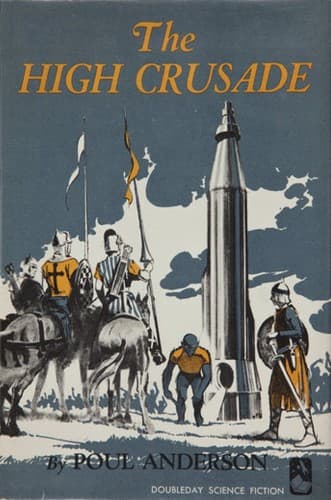
In the year of grace 1345, as Sir Roger Baron de Tourneville is gathering an army to join King Edward III in the war against France, a most astonishing event occurs: a huge silver ship descends through the sky and lands in a pasture beside the little village of Ansby in northeastern Lincolnshire. The Wersgorix, whose scouting ship it is, are quite expert at taking over planets, and having determined from orbit that this one was suitable, they initiate standard world-conquering procedure. Ah, but this time it's no mere primitives the Wersgorix seek to enslave—they've launched their invasion against free Englishmen! In the end, only one alien is left alive—and Sir Roger's grand vision is born. He intends for the creature to fly the ship first to France to aid his King, then on to the Holy Land to vanquish the infidel. Unfortunately, he has not allowed for the treachery of the alien pilot, who instead takes the craft to his home planet, where, he thinks, these upstart barbarians will have no choice but to surrender. But that knavish alien little understands the indomitable will and clever resourcefulness of Englishmen, no matter how great the odds against them...
In the year of grace 1345, as Sir Roger Baron de Tourneville is gathering an army to join King Edward III in the war against France, a most astonishing event occurs: a huge silver ship descends through the sky and lands in a pasture beside the little village of Ansby in northeastern Lincolnshire. The Wersgorix, whose scouting ship it is, are quite expert at taking over planets, and having determined from orbit that this one was suitable, they initiate standard world-conquering procedure. Ah, but this time it's no mere primitives the Wersgorix seek to enslave—they've launched their invasion against free Englishmen! In the end, only one alien is left alive—and Sir Roger's grand vision is born. He intends for the creature to fly the ship first to France to aid his King, then on to the Holy Land to vanquish the infidel. Unfortunately, he has not allowed for the treachery of the alien pilot, who instead takes the craft to his home planet, where, he thinks, these upstart barbarians will have no choice but to surrender. But that knavish alien little understands the indomitable will and clever resourcefulness of Englishmen, no matter how great the odds against them...
Add to your library to track progress and write reviews
Add to your library to track progress and write reviews
Find The High Crusade Poul Anderson in PDF, EPUB, ebook, audiobook, print, or library editions.
Find The High Crusade Poul Anderson in PDF, EPUB, ebook, audiobook, print, or library editions.

7 books in catalog
Rigorous physics principles and deep historical lore shaped hard science fiction and speculative fantasy across six decades of publishing, producing celebrated novels such as Tau Zero and The High Crusade. Poul William Anderson entered the field during the Golden Age of science fiction and maintained an active publishing career into the twenty-first century, earning seven Hugo Awards and three Nebula Awards alongside the SFWA Grand Master Award.
His vast bibliography spans hard science fiction, space opera, alternate history, historical fantasy, and short stories, demonstrating a rare combination of scientific literacy and mythic storytelling.
Born to Danish parents in Pennsylvania in 1926, Anderson spent parts of his childhood in Texas and Denmark before returning to the United States around the onset of World War II. He earned a degree in physics from the University of Minnesota in 1948, publishing his first science fiction story while still an undergraduate and becoming a full-time freelance writer upon graduation. In 1953, he married Karen Kruse, with whom he shared a lifelong literary partnership; their daughter, Astrid, later married science fiction author Greg Bear. Anderson took on leadership roles within the speculative fiction community, serving as the sixth president of the Science Fiction and Fantasy Writers of America in 1972. He was also a founding member of the Society for Creative Anachronism and belonged to the Swordsmen and Sorcerers' Guild of America, a loose-knit group of heroic fantasy authors founded in the 1960s whose works featured in Lin Carter's Flashing Swords! anthologies. Additionally, his advocacy for space exploration led Robert A. Heinlein to dedicate his 1985 novel The Cat Who Walks Through Walls to Anderson and eight other members of the Citizens' Advisory Council on National Space Policy. Anderson continued writing until his death from cancer on July 31, 2001, after a month in the hospital, with several of his novels published posthumously.
Anderson's fiction is distinguished by scrupulous attention to physical details and astronomical logic, informed by his degree in physics and his deep knowledge of Scandinavian history and languages. He frequently explored complex political systems, long-term societal changes, and galactic expansion, while simultaneously contributing foundational works to high fantasy and heroic fantasy. His novels and short stories frequently examined individual liberty versus organizational power, as reflected in his contributions to shared universes like Foundation's Friends and standalone science fiction novels including The Enemy Stars, There Will Be Time, Fire Time, and The People of the Wind.
7 books in catalog
Rigorous physics principles and deep historical lore shaped hard science fiction and speculative fantasy across six decades of publishing, producing celebrated novels such as Tau Zero and The High Crusade. Poul William Anderson entered the field during the Golden Age of science fiction and maintained an active publishing career into the twenty-first century, earning seven Hugo Awards and three Nebula Awards alongside the SFWA Grand Master Award.
His vast bibliography spans hard science fiction, space opera, alternate history, historical fantasy, and short stories, demonstrating a rare combination of scientific literacy and mythic storytelling.
Born to Danish parents in Pennsylvania in 1926, Anderson spent parts of his childhood in Texas and Denmark before returning to the United States around the onset of World War II. He earned a degree in physics from the University of Minnesota in 1948, publishing his first science fiction story while still an undergraduate and becoming a full-time freelance writer upon graduation. In 1953, he married Karen Kruse, with whom he shared a lifelong literary partnership; their daughter, Astrid, later married science fiction author Greg Bear. Anderson took on leadership roles within the speculative fiction community, serving as the sixth president of the Science Fiction and Fantasy Writers of America in 1972. He was also a founding member of the Society for Creative Anachronism and belonged to the Swordsmen and Sorcerers' Guild of America, a loose-knit group of heroic fantasy authors founded in the 1960s whose works featured in Lin Carter's Flashing Swords! anthologies. Additionally, his advocacy for space exploration led Robert A. Heinlein to dedicate his 1985 novel The Cat Who Walks Through Walls to Anderson and eight other members of the Citizens' Advisory Council on National Space Policy. Anderson continued writing until his death from cancer on July 31, 2001, after a month in the hospital, with several of his novels published posthumously.
Anderson's fiction is distinguished by scrupulous attention to physical details and astronomical logic, informed by his degree in physics and his deep knowledge of Scandinavian history and languages. He frequently explored complex political systems, long-term societal changes, and galactic expansion, while simultaneously contributing foundational works to high fantasy and heroic fantasy. His novels and short stories frequently examined individual liberty versus organizational power, as reflected in his contributions to shared universes like Foundation's Friends and standalone science fiction novels including The Enemy Stars, There Will Be Time, Fire Time, and The People of the Wind.