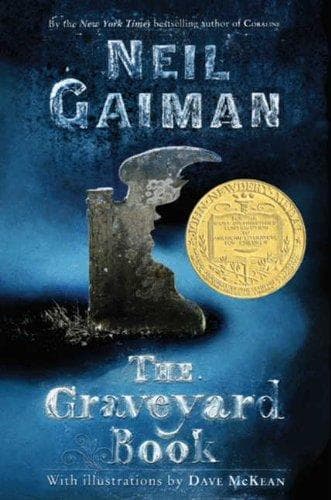
After a midnight tragedy leaves an orphaned toddler to wander into an ancient cemetery, the local residents—ranging from Roman centurions to Victorian gentlefolk—make the unconventional decision to raise him as one of their own. Granted the "Freedom of the Graveyard," the boy, renamed Nobody Owens, grows up in a world where the living are the outsiders and the dead are his neighbors, mentors, and protectors.
The central conflict rests on a delicate balance: while the graveyard offers a supernatural sanctuary, the man who murdered Nobody’s family remains in the world of the living, searching for the child who escaped him. As Nobody, or "Bod," navigates the transition from childhood to adolescence, he must master the skills of the dead—such as Fading and Haunting—to survive a world that he is not yet ready to join, all while a persistent shadow from his past draws closer to the graveyard gates.
The setting functions as a sovereign territory with its own distinct laws and physics. The "Freedom of the Graveyard" is a specific magical endowment that allows a living human to interact with the environment as if they were a spirit, granting the ability to see in total darkness and pass through solid gates. The atmosphere is heavily Gothic, moving between mossy tombs, ivy-choked chapels, and the ancient, terrifying depths of the Sleer’s barrow. Gaiman establishes a world where the dead are not malevolent, but rather a community bound by the history of the earth they occupy, creating a safe harbor that is paradoxically more nurturing than the town beyond the fence.
Bod’s development is defined by his attempt to reconcile his human nature with his ghostly upbringing. His early arc focuses on the acquisition of knowledge; he learns his alphabet from headstones and his history from those who lived it. However, as he matures, a fundamental tension arises: the graveyard provides safety but lacks the "life" Bod inherently craves. His relationship with Silas is one of mentorship and boundaries, as Silas tries to protect Bod from the "Man Jack" while preparing him for the inevitability that a living boy cannot stay in a tomb forever.
The book is a direct literary subversion of Rudyard Kipling’s The Jungle Book, replacing the wild animals of the Indian jungle with the spectral inhabitants of a British cemetery. By utilizing the "Feral Child" trope in a supernatural context, Gaiman flips the traditional horror of the graveyard on its head. Instead of the cemetery being a place of dread, it is a domestic space of community and learning. The real "horror" is found in the mundane world outside, represented by the clinical and persistent threat of the Man Jack, thereby subverting the trope that the supernatural is inherently more dangerous than the human.
Add to your library to track progress and write reviews
Find The Graveyard Book Neil Gaiman in PDF, EPUB, ebook, audiobook, print, or library editions.

44 books in catalog
Groundbreaking dark fantasy comic books and dark, whimsical prose fiction have reshaped speculative literature, most famously through the comic book series The Sandman. English author Neil Gaiman, born Neil Richard Gaiman on 10 November 1960, created this influential series before publishing widely acclaimed fantasy novels including Stardust, American Gods, Coraline, and The Graveyard Book.
Born Neil Richard Gaiman in Portchester, Hampshire, UK, he spent much of his childhood reading in public libraries, where he discovered the works of C.S. Lewis, J.R.R. Tolkien, Edgar Allan Poe, Ursula K. LeGuin, and G.K. Chesterton. He began his professional career in journalism before transitioning into comic book writing in the late 1980s, gaining prominence with Black Orchid in 1988 and launching The Sandman series for DC Comics' Vertigo imprint in 1989. Over the subsequent decades, he expanded into writing novels, short fiction, audio theatre, screenplays, and films, eventually taking up residence in the United States near Minneapolis.
His fiction has earned widespread critical recognition, receiving Hugo, Nebula, and Bram Stoker awards. In 2008, he published The Graveyard Book, becoming the first author to win both the American Newbery Medal and the British Carnegie Medal for the same work. In 2013, his novel The Ocean at the End of the Lane was voted Book of the Year in the British National Book Awards. His extensive bibliography and media adaptations continued to draw major critical attention through 2017 and beyond.
Gaiman's literary work is noted for combining imaginative fantasy with a darkly humorous tone, fusing modern settings with classical mythology, folklore, and fairy tale motifs. His stories frequently explore themes of memory, childhood innocence, ancient gods navigating contemporary society, and the fundamental power of stories. Across all age categories, his narratives balance gothic atmosphere with warm human empathy and sharp observational wit.