The Emperor of All Maladies is a magnificent, profoundly humane “biography” of cancer—from its first documented appearances thousands of years ago through the epic battles in the twentieth century to cure, control, and conquer it to a radical new understanding of its essence.
Physician, researcher, and award-winning science writer, Siddhartha Mukherjee examines cancer with a cellular biologist’s precision, a historian’s perspective, and a biographer’s passion. The result is an astonishingly lucid and eloquent chronicle of a disease humans have lived with—and perished from—for more than five thousand years.
The story of cancer is a story of human ingenuity, resilience, and perseverance, but also of hubris, paternalism, and misperception. Mukherjee recounts centuries of discoveries, setbacks, victories, and deaths, told through the eyes of his predecessors and peers, training their wits against an infinitely resourceful adversary that, just three decades ago, was thought to be easily vanquished in an all-out “war against cancer.”
The book reads like a literary thriller with cancer as the protagonist. From the Persian Queen Atossa, whose Greek slave cut off her malignant breast, to the nineteenth-century recipients of primitive radiation and chemotherapy to Mukherjee’s own leukemia patient, Carla, The Emperor of All Maladies is about the people who have soldiered through fiercely demanding regimens in order to survive—and to increase our understanding of this iconic disease.
Riveting, urgent, and surprising, The Emperor of All Maladies provides a fascinating glimpse into the future of cancer treatments. It is an illuminating book that provides hope and clarity to those seeking to demystify cancer.
--jacket flap
The Emperor of All Maladies is a magnificent, profoundly humane “biography” of cancer—from its first documented appearances thousands of years ago through the epic battles in the twentieth century to cure, control, and conquer it to a radical new understanding of its essence.
Physician, researcher, and award-winning science writer, Siddhartha Mukherjee examines cancer with a cellular biologist’s precision, a historian’s perspective, and a biographer’s passion. The result is an astonishingly lucid and eloquent chronicle of a disease humans have lived with—and perished from—for more than five thousand years.
The story of cancer is a story of human ingenuity, resilience, and perseverance, but also of hubris, paternalism, and misperception. Mukherjee recounts centuries of discoveries, setbacks, victories, and deaths, told through the eyes of his predecessors and peers, training their wits against an infinitely resourceful adversary that, just three decades ago, was thought to be easily vanquished in an all-out “war against cancer.”
The book reads like a literary thriller with cancer as the protagonist. From the Persian Queen Atossa, whose Greek slave cut off her malignant breast, to the nineteenth-century recipients of primitive radiation and chemotherapy to Mukherjee’s own leukemia patient, Carla, The Emperor of All Maladies is about the people who have soldiered through fiercely demanding regimens in order to survive—and to increase our understanding of this iconic disease.
Riveting, urgent, and surprising, The Emperor of All Maladies provides a fascinating glimpse into the future of cancer treatments. It is an illuminating book that provides hope and clarity to those seeking to demystify cancer.
--jacket flap
Add to your library to track progress and write reviews
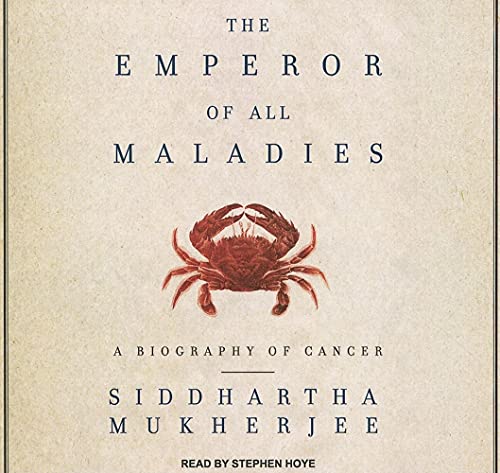
Find The Emperor of All Maladies: A Biography of Cancer Siddhartha Mukherjee in PDF, EPUB, ebook, audiobook, print, or library editions.
3 books in catalog
Illuminating the complex histories of human cellular biology, genetics, and oncology, popular science literature gained profound depth through The Emperor of All Maladies: A Biography of Cancer. Siddhartha Mukherjee, an oncologist and medical researcher, brought both clinical precision and literary narrative to the study of disease, transforming dense biomedical concepts into accessible accounts for general readers.
Born in New Delhi, India, in 1970, Mukherjee earned a Bachelor of Science in biology from Stanford University before attending the University of Oxford as a Rhodes Scholar, where he earned a DPhil in immunology. He went on to receive his MD from Harvard Medical School and completed his internal medicine residency and oncology fellowship at Massachusetts General Hospital. As a practicing hematologist, oncologist, and researcher, he serves as an assistant professor of medicine at Columbia University Medical Center in Manhattan, where he lives with his wife, artist Sarah Sze, and their two daughters. Beyond his book-length non-fiction, his scientific and medical writing has appeared in prominent journals and publications such as Nature, The New England Journal of Medicine, Cell, and The New York Times.
Mukherjee's work bridges clinical case studies, historical archival research, and personal reflections from his practice as a physician. By combining rigorous biological history with human stories of patients, researchers, and clinicians, his writing examines how cellular processes and genetic discoveries shape human identity, treatment paradigms, and medical ethics. He frequently incorporates firsthand observations from his laboratory and hospital rounds, rejecting detached detachment in favor of an engaged perspective that contextualizes fundamental scientific breakthroughs within human experience.
3 books in catalog
Illuminating the complex histories of human cellular biology, genetics, and oncology, popular science literature gained profound depth through The Emperor of All Maladies: A Biography of Cancer. Siddhartha Mukherjee, an oncologist and medical researcher, brought both clinical precision and literary narrative to the study of disease, transforming dense biomedical concepts into accessible accounts for general readers.
Born in New Delhi, India, in 1970, Mukherjee earned a Bachelor of Science in biology from Stanford University before attending the University of Oxford as a Rhodes Scholar, where he earned a DPhil in immunology. He went on to receive his MD from Harvard Medical School and completed his internal medicine residency and oncology fellowship at Massachusetts General Hospital. As a practicing hematologist, oncologist, and researcher, he serves as an assistant professor of medicine at Columbia University Medical Center in Manhattan, where he lives with his wife, artist Sarah Sze, and their two daughters. Beyond his book-length non-fiction, his scientific and medical writing has appeared in prominent journals and publications such as Nature, The New England Journal of Medicine, Cell, and The New York Times.
Mukherjee's work bridges clinical case studies, historical archival research, and personal reflections from his practice as a physician. By combining rigorous biological history with human stories of patients, researchers, and clinicians, his writing examines how cellular processes and genetic discoveries shape human identity, treatment paradigms, and medical ethics. He frequently incorporates firsthand observations from his laboratory and hospital rounds, rejecting detached detachment in favor of an engaged perspective that contextualizes fundamental scientific breakthroughs within human experience.