SSansFiction
The libraryCollectionsJournalStatsFor authors
Sign inJoin now
Sansfiction,

A digital library for books. Made by readers, for readers.

v 2.0 · 2026
The library
  • Discover
  • Collections
  • Book tracker
  • Journal
  • Stats
For authors
  • SF Links
  • Analytics
  • How it works
  • FAQ
Elsewhere
  • X / @sansfiction
  • Privacy
  • Terms
  • Contact
© 2026 SansFiction · Digital · GlobalA quiet room for your reading life.
The libraryCollectionsJournalStatsFor authors
Sign inJoin now →
Navigation
Library
Bookshelf
Journal
Discover
Collections
Tierlists
Stats
Profile
Author Page
Link Builder
Account
Sign in
S
G
BooksclassicsThe Dispossessed
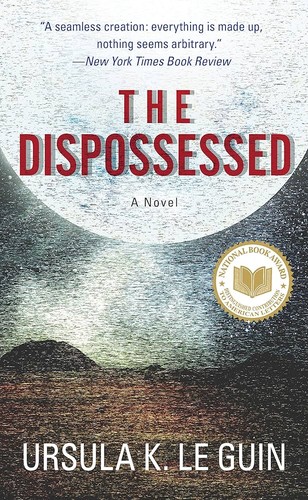
Cover of The Dispossessed by Ursula K. Le Guin
№ 6 · Hainish Cycle

The Dispossessed,

by Ursula K. Le Guin

Ask AI
Rating4.2/ 5
Ratings625
Pages400
Reading Hours8h
Published2019
LanguageEnglish

§Synopsis

01

The story takes place on the fictional planet Urras and its moon Anarres (since Anarres is massive enough to hold an atmosphere, this is often described as a double planet system). In order to forestall an anarcho-syndical workers' rebellion, the major Urrasti states gave the revolutionaries the right to live on Anarres, along with a guarantee of non-interference, approximately two hundred years before the events of The Dispossessed.[2] Before this, Anarres had had no permanent settlements apart from some mining.

The protagonist Shevek is a physicist attempting to develop a General Temporal Theory. The physics of the book describes time as having a much deeper, more complex structure than we understand it. It incorporates not only mathematics and physics, but also philosophy and ethics. The meaning of the theories in the book weaves nicely into the plot, not only describing abstract physical concepts, but the ups and downs of the characters' lives, and the transformation of the Anarresti society. An oft-quoted saying in the book is "true journey is return." [3].

Anarres is in theory a society without government or coercive authoritarian institutions. Yet in pursuing research that deviates from his society's current consensus understanding, Shevek begins to come up against very real obstacles. Shevek gradually develops an understanding that the revolution which brought his world into being is stagnating, and power structures are beginning to exist where there were none before. He therefore embarks on the risky journey to the original planet, Urras, seeking to open dialog between the worlds and to spread his theories freely outside of Anarres. The novel details his struggles on both Urras and his homeworld of Anarres.

The book also explores the Sapir-Whorf Hypothesis, that language shapes thinking, and thus, culture. The language spoken on the anarchist planet Anarres, Pravic, is a constructed language that reflects many aspects of the philosophical foundations of utopian anarchism. For instance, the use of the possessive case is strongly discouraged. In one scene, Shevek's daughter, meeting him for the first time, offers him "You can share the handkerchief I use,"[4] rather than "you may borrow my handkerchief", thus conveying the idea that the handkerchief is not owned by the girl, merely carried by her.[5] Cover of first paperback edition

The Dispossessed looks into the mechanisms that may be developed by an anarchist society, but also the dangers of centralization and bureaucracy that might easily take over such society without the continuation of revolutionary ideology. Part of its power is that it gives a spectrum of fairly well-developed characters, who illustrate many types of personalities, all educated in an environment that measures a person not by what he owns, but by what he can do, and how he relates to other human beings. Possibly the best example of this is the character of Takver, the hero's partner, who exemplifies many virtues: loyalty, love of life and living things, perseverance, and desire for a true partnership with another person.

The work is sometimes said to represent one of the few modern revivals of the utopian genre, [6] and there are certainly many characteristics of a utopian novel found in this book. Most obviously, Shevek is an outsider in Urras, following the "traveler" convention common in utopian literature. All of the characters portrayed in the novel have a certain spirituality or intelligence, there are no nondescript characters. It is also true to say that there are aspects of Anarres that are utopian: it is presented as a pure society that adheres to its own theories and ideals, which are starkly juxtaposed with Urras society.

However, the work is subtitled "An Ambiguous Utopia", and one of the major themes of the work is the ambiguity of different notions of utopia. Anarres is not presented as a perfect society, even within the constraints of what might define an anarchist utopia. Bureaucracy, stagnation, and power structures have problematized the revolution, as Shevek understands through the course of the novel. Moreover, Le Guin has painted a very stark picture of the natural and environmental constraints on society. Anarres citizens are forced to contend with a relatively sparse and unfruitful world. Hardship caused by lack of resources is a prominent theme, reflected in the title of the novel. Anarres citizens are dispossessed not just by political choice, but by the very lack of resources to possess. Here, again, Le Guin draws a contrast with the natural wealth of Urras, and the competitive behaviors this fosters. Le Guin's foreword to the novel notes that her anarchism is closely akin to that of Pyotr Kropotkin's, whose Mutual Aid closely assessed the influence of the natural world on competition and cooperation.[7] Le Guin's use of realism in this aspect of the work further problematizes — ambiguates — a simple utopian interpretation of the work. Anarres is not a perfect society, and Le Guin shows that no such thing is possible.

§Our take

Le Guin does not offer a blueprint for paradise; she builds two flawed societies and lets them accuse each other. Anarres is free from formal government but increasingly rigid, while Urras is wealthy, hierarchical, and repressive. That balance is the novel's real achievement, and its argument stays alive: a good society still has to survive conformity, scarcity, and the power that grows inside its own ideals.

The opening asks for patience. Its alternating timelines jump between Shevek's life on Anarres and Urras, and many readers find the prose dense and the first 100 to 150 pages slow. Push through if serious novels of ideas appeal; the payoff is a serious examination of freedom, property, language, and what happens when a revolution starts preserving itself. The science needs no equations, though its deliberate vagueness may test the scientifically minded.

§Themes

No government, no guarantee
Anarres begins without coercive institutions, yet bureaucracy, conformity, and new power structures take root anyway.
Freedom has a dry side
Scarcity and an unforgiving moon make Anarres austere, testing the ideals that sustain it.
Physics with a political purpose
Shevek's theory of time turns research, friendship, and his society's openness into one ethical problem.
Language bends thought
Pravic discourages possession even in ordinary speech, making property feel less natural.
The ambiguous utopia
Neither Anarres nor Urras is a paradise, and each exposes the compromises hidden inside its system.

§How it was received

Early critics were largely enthusiastic about the detailed society and the book's force as a thought experiment, though Lester del Rey's best-known objection was that the ending resolves too conveniently. The novel won the 1974 Nebula, the 1975 Hugo, and a Locus Award. Later readings split along political lines, while feminist criticism has praised the society's sexual freedom and also faulted its male-centered focus.

§Read it if

  • You want political fiction that argues through societies rather than speeches
  • You can tolerate a deliberate slow start and dense exposition
  • You want a standalone way into the Hainish Cycle and don't mind a demanding opening

§Skip it if

  • You need a plot-driven space opera. There are few action scenes, and the space travel is understated.
  • You want uncomplicated heroes or tidy ideology. Shevek can feel distant, and both societies have uncomfortable flaws.

§Before you start

Reading experience
The first 100 to 150 pages can feel slow because of alternating timelines, dense prose, and heavy exposition; the pace picks up, though it remains a cerebral, distanced read.
Reading order
The sixth Hainish novel by publication and the earliest in internal chronology. Le Guin said the Hainish novels need not be read in order, so it works as a standalone entry.
Content notes
Sexuality is discussed frankly, including a society with open sexual customs; Famine, suffering, and imprisonment recur; Social control and conformity pressure shape life on Anarres; A few violent scenes include physical injury.

§Common questions

Is The Dispossessed hard to get into?
It can be. The first 100 to 150 pages are often slow because of alternating timelines, dense prose, and heavy exposition; many readers say the book picks up after that.
Is The Dispossessed anti-anarchist?
Not simply. Le Guin treats Anarres as admirable but flawed and Urras as wealthy but repressive, leaving the political verdict deliberately open.
Do I need to read the other Hainish novels first?
No. It stands alone, and Le Guin said the Hainish novels can be read in any order.

§If you liked this

  • The Left Hand of Darkness by Ursula K. Le Guin — The usual pairing: another Hainish novel that can serve as an equally good entry point to Le Guin's imagined worlds.
  • The Word for World Is Forest by Ursula K. Le Guin — Le Guin named this with The Left Hand of Darkness as another way into the cycle; it looks at colonization and resistance rather than utopia.
  • Utopia by Thomas More — Le Guin lists More among her influences, and his 1516 vision offers an earlier example of an ideal society whose flaws remain visible.
  • The Player of Games (the Culture series) by Iain M. Banks — Banks's Culture is the other famous anarchist-leaning society in SF; one essayist argues Anarres is the more realistic of the two because it has to live with scarcity.
Sources
  • Wikipedia
  • Wikipedia
  • SFWA Nebula Awards
  • The Hugo Awards (official)
  • Nicholas Whyte (personal SF site)
  • Science Fiction Awards Database
  • Scientific American
  • The Anarchist Library (essay by Iain McKay, 2018)
  • Metaphorosis
  • Goodreads

Track this book

Add to your library to track progress and write reviews

§Genres
classics1classique1fantasy1fiction1juvenile fiction1literary1nonfiction1
§Content Warnings
§Moods
adventurous1challenging1emotional1hopeful1informative1inspiring1reflective1
§Tags
#diverse characters1#loveable characters1#not diverse characters1#read1#strong character development1

§About the Author

Ursula K. Le Guin
Ursula K. Le Guin

17 books in catalog

Speculative fiction gained profound depth through thoughtful worldbuilding that examined social structures, gender dynamics, and political philosophy across fantasy and science fiction settings such as the archipelago of Earthsea and the planetary systems of the Hainish Cycle. Ursula K. Le Guin was an American author who wrote more than 20 novels and 100 short stories, alongside poetry, children's books, essays, and translations during a literary career spanning nearly six decades.

Her extensive body of work includes 23 novels, 12 volumes of short stories, 11 volumes of poetry, 13 children's books, five essay collections, and four works of translation. Celebrated for her genre-bending speculative fiction, Le Guin earned six Nebula Awards, seven Hugo Awards, the SFWA Grand Master title, and the 2014 National Book Foundation Medal for Distinguished Contribution to American Letters.

Career & Background

Born Ursula Kroeber in 1929 in Berkeley, California, she was the daughter of anthropologist Alfred Louis Kroeber and writer Theodora Kroeber. Raised in an intellectual environment steeped in cultural anthropology, she developed a keen sensitivity to social structures and language that directly informed her detailed depictions of fictional societies. Le Guin published her first poem in 1959 and her first short story in 1961 before achieving widespread critical success.

Her early works, A Wizard of Earthsea (1968), The Left Hand of Darkness (1969), and The Dispossessed (1974), established her as a major figure in science fiction and fantasy. Over her long career, she expanded both the Earthsea series and her Hainish universe novels, receiving accolades such as the PEN/Malamud Award and being published in her lifetime by the Library of America in 2016 before her death in 2018.

Writing Style & Themes

At a time when American science fiction was largely centered on physical technology and hard-science tropes, Le Guin shifted focus toward anthropology, sociology, linguistics, and psychology. Her Hainish Cycle novels—which include Rocannon's World, Planet of Exile, City of Illusions, The Left Hand of Darkness, The Word for World Is Forest, The Dispossessed, and The Telling—explore alternative political systems such as anarchism, non-violent communication, anti-colonialism, and non-binary concepts of gender.

In her fantasy fiction, particularly the Earthsea cycle featuring A Wizard of Earthsea, The Tombs of Atuan, and Tehanu, Le Guin rejected conventional high-fantasy battle narratives in favor of themes concerning balance, ethical responsibility, self-discovery, and domestic authority. She was also an essayist on feminist issues and literary craft, publishing influential collections such as The Language of the Night and Dancing at the Edge of the World.

Major Works

  • A Wizard of Earthsea (1968)* — The opening novel of the Earthsea cycle, detailing the training and coming-of-age of the wizard Ged as he confronts his own shadow.
  • The Left Hand of Darkness (1969)* — A groundbreaking Hainish universe novel set on the winter planet Gethen, exploring human sexuality, social structures, and diplomacy in an ambisexual society.
  • The Dispossessed (1974)* — A Hugo and Nebula Award-winning novel contrasting an anarchist society on the moon Anarres with a capitalist state on the planet Urras.
  • The Tombs of Atuan — The second Earthsea novel, focusing on a young priestess trapped in an ancient labyrinth and her encounter with Ged.
  • The Lathe of Heaven — A speculative science fiction novel set in Portland about a man whose dreams alter reality and a psychiatrist who attempts to control them.
  • The Word for World Is Forest — A Hainish Cycle novella addressing military imperialism, environmental degradation, and indigenous resistance.
  • Tehanu — The fourth Earthsea novel, shifting focus toward everyday life, aging, and female empowerment within a fantasy world.
  • The Day Before the Revolution — An award-winning short story set in the Hainish universe that portrays the final day of Odo, the visionary philosopher behind the anarchist movement in The Dispossessed.
  • The Telling — A late Hainish Cycle novel following an observer sent to a planet where ancient cultural and oral traditions are suppressed by a technocratic regime.

§Featured Series

Hainish Cycle

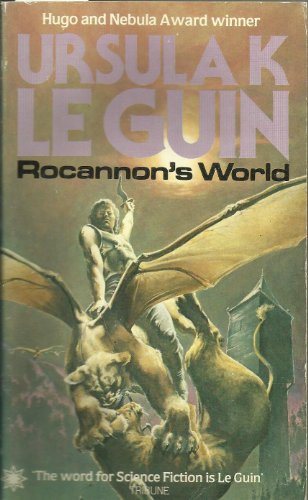
Cover of Rocannon's World by Ursula K. Le Guin

Rocannon's World

Ursula K. Le Guin, 1966
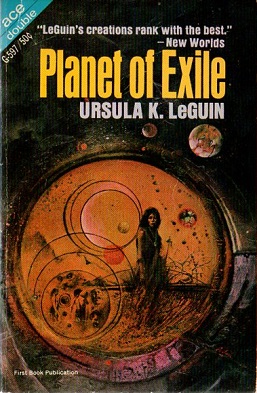
Cover of Planet of Exile by Ursula K. Le Guin

Planet of Exile

Ursula K. Le Guin, 1966
Cover of City of Illusions by Ursula K. Le Guin

City of Illusions

Ursula K. Le Guin, 1967
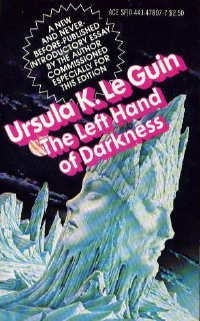
Cover of The Left Hand of Darkness by Ursula K. Le Guin

The Left Hand of Darkness

Ursula K. Le Guin, 1969
Cover of Winter's King by Ursula K. Le Guin

Winter's King

Ursula K. Le Guin, 2017
Cover of The Word for World Is Forest by Ursula K. Le Guin

The Word for World Is Forest

Ursula K. Le Guin, 1972
Cover of The Dispossessed by Ursula K. Le Guin

The Dispossessed

Ursula K. Le Guin, 1974
Cover of The Day Before the Revolution by Ursula K. Le Guin

The Day Before the Revolution

Ursula K. Le Guin, 1974
Cover of The Telling by Ursula K. Le Guin

The Telling

Ursula K. Le Guin, 2000
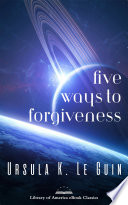
Cover of Five Ways to Forgiveness by Ursula K. Le Guin

Five Ways to Forgiveness

Ursula K. Le Guin, 2017

§Other Editions

Showing 2 of 75 editions
Cover of The Dispossessed

The Dispossessed

engHardcover
Turtleback Books19749780785764038
Cover of The Dispossessed

The Dispossessed

engPaperback
Argument- Verlag GmbH19749783886199433
§Genres
classics1classique1fantasy1fiction1juvenile fiction1literary1nonfiction1
§Content Warnings
§Moods
adventurous1challenging1emotional1hopeful1informative1inspiring1reflective1
§Tags
#diverse characters1#loveable characters1#not diverse characters1#read1#strong character development1

Metadata

ISBN-139781473229495
ISBN-100785764038
ASIN1473229499

Editions and availability

Find The Dispossessed Ursula K. Le Guin in PDF, EPUB, ebook, audiobook, print, or library editions.

View on Amazon
Bookshop.orgGoogle Play BooksBarnes & NobleOpen Library

Featured In Lists

Book cover from this collectionBook cover from this collectionBook cover from this collectionBook cover from this collection
Book cover from this collection

NPRs Top 100 Science-Fiction and Fantasy Books of All Time

100 books
Book cover from this collectionBook cover from this collectionBook cover from this collectionBook cover from this collection
Book cover from this collection

Hugo Award for Best Novel (1953 to 2025)

75 books
Book cover from this collectionBook cover from this collectionBook cover from this collectionBook cover from this collection
Book cover from this collection

Hugo Award Best Novel Nominees and Winners ( 1953 - present )

348 books
Book cover from this collectionBook cover from this collectionBook cover from this collectionBook cover from this collection
Book cover from this collection

Locus Award for Best Science Fiction Novel (1971 to 2025)

57 books
Book cover from this collectionBook cover from this collectionBook cover from this collectionBook cover from this collection
Book cover from this collection

Nebula Award for Best Novel (1965 to 2024)

61 books
Book cover from this collectionBook cover from this collectionBook cover from this collectionBook cover from this collection
Book cover from this collection

List 1001 Books Boxall

1000 books
Book cover from this collectionBook cover from this collectionBook cover from this collectionBook cover from this collection
Book cover from this collection

Sf Masterworks

71 books