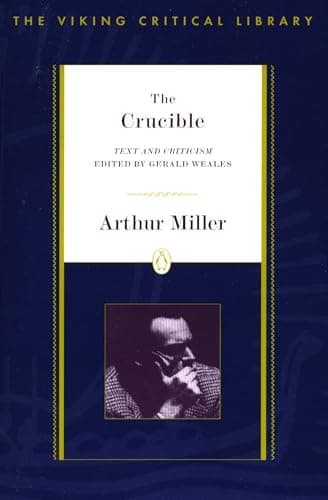
"I believe that the reader will discover here the essential nature of one of the strangest and most awful chapters in human history," Arthur Miller wrote of his classic play about the witch-hunts and trials in seventeenth-century Salem, Massachusetts. Based on historical people and real events, Miller's drama is a searing portrait of a community engulfed by hysteria. In the rigid theocracy of Salem, rumors that women are practicing witchcraft galvanize the town's most basic fears and suspicions; and when a young girl accuses Elizabeth Proctor of being a witch, self-righteous church leaders and townspeople insist that Elizabeth be brought to trial. The ruthlessness of the prosecutors and the eagerness of neighbor to testify against neighbor brilliantly illuminates the destructive power of socially sanctioned violence.
Written in 1953, The Crucible is a mirror Miller uses to reflect the anti-communist hysteria inspired by Senator Joseph McCarthy's "witch-hunts" in the United States. Within the text itself, Miller contemplates the parallels, writing, "Political opposition... is given an inhumane overlay, which then justifies the abrogation of all normally applied customs of civilized behavior. A political policy is equated with moral right, and opposition to it with diabolical malevolence." --back cover
"I believe that the reader will discover here the essential nature of one of the strangest and most awful chapters in human history," Arthur Miller wrote of his classic play about the witch-hunts and trials in seventeenth-century Salem, Massachusetts. Based on historical people and real events, Miller's drama is a searing portrait of a community engulfed by hysteria. In the rigid theocracy of Salem, rumors that women are practicing witchcraft galvanize the town's most basic fears and suspicions; and when a young girl accuses Elizabeth Proctor of being a witch, self-righteous church leaders and townspeople insist that Elizabeth be brought to trial. The ruthlessness of the prosecutors and the eagerness of neighbor to testify against neighbor brilliantly illuminates the destructive power of socially sanctioned violence.
Written in 1953, The Crucible is a mirror Miller uses to reflect the anti-communist hysteria inspired by Senator Joseph McCarthy's "witch-hunts" in the United States. Within the text itself, Miller contemplates the parallels, writing, "Political opposition... is given an inhumane overlay, which then justifies the abrogation of all normally applied customs of civilized behavior. A political policy is equated with moral right, and opposition to it with diabolical malevolence." --back cover
Add to your library to track progress and write reviews
Add to your library to track progress and write reviews
Find The Crucible: Text and Criticism Arthur Miller in PDF, EPUB, ebook, audiobook, print, or library editions.
Find The Crucible: Text and Criticism Arthur Miller in PDF, EPUB, ebook, audiobook, print, or library editions.

2 books in catalog
Postwar American drama was reshaped by stage works that examined the destructive pressure of social expectations on ordinary families, most notably through the Pulitzer Prize-winning drama Death of a Salesman. Playwright Arthur Miller authored mid-century theatrical classics that confronted the moral compromises of contemporary American life, combining intimate family tragedy with sharp societal critique.
Through plays such as The Crucible, Miller drew direct parallels between historical hysteria and contemporary political repression. His body of work spans six decades and includes classic stage dramas, radio plays, essays, and screenplays.
Arthur Asher Miller was born on October 17, 1915, in Harlem, New York, to Polish Jewish immigrants Isidore and Augusta Miller. His father owned a successful coat-manufacturing business, but the family suffered severe financial collapse following the 1929 Wall Street Crash, prompting a move to Brooklyn. After finishing high school and working various jobs to save money, Miller enrolled at the University of Michigan, where he began writing plays for the stage.
Miller achieved broad critical and commercial recognition with his 1947 play All My Sons, which was followed in 1949 by Death of a Salesman. The latter earned the Pulitzer Prize for Drama and multiple Tony Awards. During the 1950s, Miller's political convictions brought him before the House Un-American Activities Committee, where he refused to name former associates. Over his long career, he also published the 1945 novel Focus, wrote screenplays including The Misfits (1961), and collaborated with his wife, photographer Inge Morat, on travel books such as In Russia. Miller continued writing plays until his death on February 10, 2005, in Roxbury, Connecticut.
Miller's dramatic work frequently contrasts individual ethics with institutional pressure, examining how societal values drive characters into psychological and moral crises. His dialogue uses muscular, everyday speech to reveal the tragedy of common people pursuing flawed definitions of success, responsibility, or honor.
A recurring theme across his plays is personal accountability within a compromised community. Works like The Crucible employ historical allegory to interrogate mass paranoia, guilt, and political conformity, while plays such as A View from the Bridge and The Price dissect internal family conflicts and personal betrayal.
2 books in catalog
Postwar American drama was reshaped by stage works that examined the destructive pressure of social expectations on ordinary families, most notably through the Pulitzer Prize-winning drama Death of a Salesman. Playwright Arthur Miller authored mid-century theatrical classics that confronted the moral compromises of contemporary American life, combining intimate family tragedy with sharp societal critique.
Through plays such as The Crucible, Miller drew direct parallels between historical hysteria and contemporary political repression. His body of work spans six decades and includes classic stage dramas, radio plays, essays, and screenplays.
Arthur Asher Miller was born on October 17, 1915, in Harlem, New York, to Polish Jewish immigrants Isidore and Augusta Miller. His father owned a successful coat-manufacturing business, but the family suffered severe financial collapse following the 1929 Wall Street Crash, prompting a move to Brooklyn. After finishing high school and working various jobs to save money, Miller enrolled at the University of Michigan, where he began writing plays for the stage.
Miller achieved broad critical and commercial recognition with his 1947 play All My Sons, which was followed in 1949 by Death of a Salesman. The latter earned the Pulitzer Prize for Drama and multiple Tony Awards. During the 1950s, Miller's political convictions brought him before the House Un-American Activities Committee, where he refused to name former associates. Over his long career, he also published the 1945 novel Focus, wrote screenplays including The Misfits (1961), and collaborated with his wife, photographer Inge Morat, on travel books such as In Russia. Miller continued writing plays until his death on February 10, 2005, in Roxbury, Connecticut.
Miller's dramatic work frequently contrasts individual ethics with institutional pressure, examining how societal values drive characters into psychological and moral crises. His dialogue uses muscular, everyday speech to reveal the tragedy of common people pursuing flawed definitions of success, responsibility, or honor.
A recurring theme across his plays is personal accountability within a compromised community. Works like The Crucible employ historical allegory to interrogate mass paranoia, guilt, and political conformity, while plays such as A View from the Bridge and The Price dissect internal family conflicts and personal betrayal.