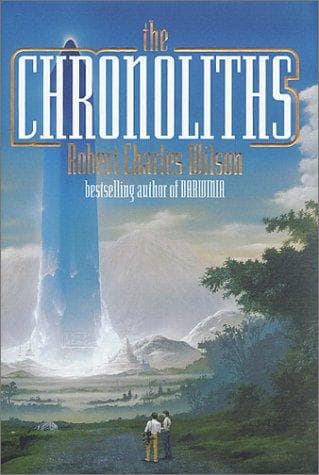
Scott Warden is a man haunted by the past--and soon to be haunted by the future. In early-twenty-first-century Thailand, Scott is an expatriate slacker. Then, one day, he inadvertently witnesses an impossible event: the violent appearance of a 200-foot stone pillar in the forested interior. Its arrival collapses trees for a quarter mile around its base, freezing ice out of the air and emitting a burst of ionizing radiation. It appears to be composed of an exotic form of matter. And the inscription chiseled into it commemorates a military victory--sixteen years in the future. Shortly afterwards, another, larger pillar arrives in the center of Bangkok--obliterating the city and killing thousands. Over the next several years, human society is transformed by these mysterious arrivals from, seemingly, our own near future. Who is the warlord "Kuin" whose victories they note? Scott wants only to rebuild his life. But some strange loop of causality keeps drawing him in, to the central mystery and a final battle with the future. The Chronoliths by Robert Charles Wilson is a 2002 Hugo Award Nominee for Best Novel and the winner of the 2002 John W. Campbell Memorial Award. At the Publisher's request, this title is being sold without Digital Rights Management Software (DRM) applied.
Scott Warden is a man haunted by the past--and soon to be haunted by the future. In early-twenty-first-century Thailand, Scott is an expatriate slacker. Then, one day, he inadvertently witnesses an impossible event: the violent appearance of a 200-foot stone pillar in the forested interior. Its arrival collapses trees for a quarter mile around its base, freezing ice out of the air and emitting a burst of ionizing radiation. It appears to be composed of an exotic form of matter. And the inscription chiseled into it commemorates a military victory--sixteen years in the future. Shortly afterwards, another, larger pillar arrives in the center of Bangkok--obliterating the city and killing thousands. Over the next several years, human society is transformed by these mysterious arrivals from, seemingly, our own near future. Who is the warlord "Kuin" whose victories they note? Scott wants only to rebuild his life. But some strange loop of causality keeps drawing him in, to the central mystery and a final battle with the future. The Chronoliths by Robert Charles Wilson is a 2002 Hugo Award Nominee for Best Novel and the winner of the 2002 John W. Campbell Memorial Award. At the Publisher's request, this title is being sold without Digital Rights Management Software (DRM) applied.
Add to your library to track progress and write reviews
Add to your library to track progress and write reviews
Find The Chronoliths Robert Charles Wilson in PDF, EPUB, ebook, audiobook, print, or library editions.
Find The Chronoliths Robert Charles Wilson in PDF, EPUB, ebook, audiobook, print, or library editions.

5 books in catalog
Speculative fiction featuring intimate character-driven narratives set against vast cosmological events defines a major strain of science fiction, exemplified by the award-winning novel Spin. Born in California and living in Canada, author Robert Charles Wilson has produced decades of acclaimed novels that blend high-concept cosmic premises with nuanced human emotion.
Robert Charles Wilson was born in Whittier, California, on December 15, 1953, and moved to Canada at age nine in 1962. His early publishing career began under the pen name Bob Chuck Wilson with the short story Equinocturne in Analog in 1975. After a decade-long hiatus from publishing fiction, he returned with short stories in 1985 and published his debut novel, A Hidden Place, in 1986, which became a Philip K. Dick Award finalist.
Over the following decades, Wilson published numerous celebrated novels, including Mysterium, which won the Philip K. Dick Award in 1994, and Darwinia, which won Canada's Aurora Award and received a Hugo Award nomination. His momentum continued with The Chronoliths, recipient of the John W. Campbell Memorial Award and a Hugo nominee, followed by Blind Lake. In 2006, his novel Spin achieved widespread critical acclaim, winning the Hugo Award for Best Novel.
A defining feature of Wilson's writing is the balance between cosmic scale and personal intimacy. His narratives frequently juxtapose extraordinary astronomical or dimension-altering phenomena—such as the sudden enclosure of Earth in Spin or the miraculous transformation of Europe in Darwinia—with grounded human drama and psychological depth. Rather than focusing solely on hard technical exposition, Wilson explores how ordinary individuals respond when confronted by unexplainable or overwhelming shifts in reality.
Philosophically, Wilson avoids rigid utopian or dystopian depictions, opting instead to examine human culture in complex intermediate states. He frequently explores themes of quarantine, alternate histories, temporal anomalies, and the psychological impact of contact with incomprehensible extraterrestrial or cosmic forces. By placing emotional realism at the core of high-concept speculative frameworks, Wilson creates science fiction grounded in human relationships.
5 books in catalog
Speculative fiction featuring intimate character-driven narratives set against vast cosmological events defines a major strain of science fiction, exemplified by the award-winning novel Spin. Born in California and living in Canada, author Robert Charles Wilson has produced decades of acclaimed novels that blend high-concept cosmic premises with nuanced human emotion.
Robert Charles Wilson was born in Whittier, California, on December 15, 1953, and moved to Canada at age nine in 1962. His early publishing career began under the pen name Bob Chuck Wilson with the short story Equinocturne in Analog in 1975. After a decade-long hiatus from publishing fiction, he returned with short stories in 1985 and published his debut novel, A Hidden Place, in 1986, which became a Philip K. Dick Award finalist.
Over the following decades, Wilson published numerous celebrated novels, including Mysterium, which won the Philip K. Dick Award in 1994, and Darwinia, which won Canada's Aurora Award and received a Hugo Award nomination. His momentum continued with The Chronoliths, recipient of the John W. Campbell Memorial Award and a Hugo nominee, followed by Blind Lake. In 2006, his novel Spin achieved widespread critical acclaim, winning the Hugo Award for Best Novel.
A defining feature of Wilson's writing is the balance between cosmic scale and personal intimacy. His narratives frequently juxtapose extraordinary astronomical or dimension-altering phenomena—such as the sudden enclosure of Earth in Spin or the miraculous transformation of Europe in Darwinia—with grounded human drama and psychological depth. Rather than focusing solely on hard technical exposition, Wilson explores how ordinary individuals respond when confronted by unexplainable or overwhelming shifts in reality.
Philosophically, Wilson avoids rigid utopian or dystopian depictions, opting instead to examine human culture in complex intermediate states. He frequently explores themes of quarantine, alternate histories, temporal anomalies, and the psychological impact of contact with incomprehensible extraterrestrial or cosmic forces. By placing emotional realism at the core of high-concept speculative frameworks, Wilson creates science fiction grounded in human relationships.