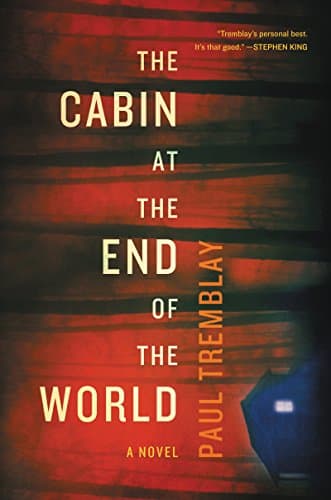
Seven-year-old Wen and her parents, Eric and Andrew, are vacationing at a remote cabin on a quiet New Hampshire lake. Their closest neighbors are more than two miles in either direction along a rutted dirt road.
One afternoon, as Wen catches grasshoppers in the front yard, a stranger unexpectedly appears in the driveway. Leonard is the largest man Wen has ever seen but he is young, friendly, and he wins her over almost instantly. Leonard and Wen talk and play until Leonard abruptly apologizes and tells Wen, "None of what’s going to happen is your fault". Three more strangers then arrive at the cabin carrying unidentifiable, menacing objects. As Wen sprints inside to warn her parents, Leonard calls out: "Your dads won’t want to let us in, Wen. But they have to. We need your help to save the world."
Add to your library to track progress and write reviews
Find The Cabin at the End of the World Paul Tremblay in PDF, EPUB, ebook, audiobook, print, or library editions.

8 books in catalog
Blending psychological suspense, horror, and dark fantasy, the novel A Head Full of Ghosts brought widespread attention to modern possession narratives by exploring family trauma, media exploitation, and narrative ambiguity. Author Paul Tremblay is a New York Times bestselling writer whose fiction spans horror, dark fantasy, mystery, and science fiction.
Born on June 30, 1971, in Aurora, Colorado, Paul Gaetan Tremblay grew up in New England. He attended Providence College for his undergraduate studies and earned a master's degree in mathematics from the University of Vermont. Before writing full-time, Tremblay established a long-time career as a high school mathematics teacher outside of Boston, Massachusetts, where he continues to live with his family. He began publishing short fiction in 2000 and launched his novel-length career with the hardboiled crime novels The Little Sleep and No Sleep Till Wonderland.
Over his career, Tremblay has received the Bram Stoker, British Fantasy, Sheridan Le Fanu, and Massachusetts Book awards, and has served as a juror for the Shirley Jackson Awards. His major standalone novels include A Head Full of Ghosts, Disappearance at Devil's Rock, The Cabin at the End of the World, Survivor Song, The Pallbearers Club, The Beast You Are, Horror Movie: A Novel, and Another. His 2018 thriller The Cabin at the End of the World was adapted by Universal Pictures into the feature film Knock at the Cabin. Tremblay has also published short fiction collections including Growing Things and Other Stories and She Said Destroy, alongside standalone short fiction such as the Amazon Original stories "The Last Conversation" and "In Bloom," and works like Dead but Dreaming of Electric Sheep. His essays and short stories have appeared in The New York Times, Boston Globe, Los Angeles Times, Entertainment Weekly online, and numerous year's best anthologies.
Tremblay's writing is defined by grounded characterization, psychological realism, and a deliberate destabilization of classic horror tropes. Rather than relying solely on supernatural monsters, his narratives frequently utilize unreliable narrators, metafictional frameworks, and ambiguous occurrences that leave supernatural interpretations open to debate. His work explores modern anxieties, pandemic crises, working-class realities, domestic vulnerability, and the emotional complexities of friendship and family.