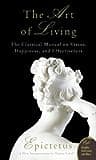
Epictetus was born into slavery about 55 ce in the eastern outreaches of the Roman Empire. Once freed, he established an influential school of Stoic philosophy, stressing that human beings cannot control life, only their responses to it. By putting into practice the ninety-three witty, wise, and razor-sharp instructions that make up The Art of Living, readers learn to meet the challenges of everyday life successfully and to face life's inevitable losses and disappointments with grace.
Epictetus was born into slavery about 55 ce in the eastern outreaches of the Roman Empire. Once freed, he established an influential school of Stoic philosophy, stressing that human beings cannot control life, only their responses to it. By putting into practice the ninety-three witty, wise, and razor-sharp instructions that make up The Art of Living, readers learn to meet the challenges of everyday life successfully and to face life's inevitable losses and disappointments with grace.
Add to your library to track progress and write reviews
Add to your library to track progress and write reviews
Find The Art of Living: The Classical Manual on Virtue, Happiness, and Effectiveness Epictetus in PDF, EPUB, ebook, audiobook, print, or library editions.
Find The Art of Living: The Classical Manual on Virtue, Happiness, and Effectiveness Epictetus in PDF, EPUB, ebook, audiobook, print, or library editions.

6 books in catalog
Ancient Stoic philosophy offers practical guidance for personal freedom, self-management, and resilience against life's external uncertainties, most famously collected in The Discourses and The Enchiridion. Epictetus, a former slave who became one of antiquity's most influential ethical teachers, did not leave written texts of his own; instead, his spoken lectures were preserved by his student Arrian. Through modern compilations like Discourses and Selected Writings, his practical philosophy continues to serve as an accessible guide for navigating adversity and personal ethics.
Born into slavery around 50–55 AD in Hierapolis, Phrygia (present-day Pamukkale, Turkey), Epictetus was originally known by a descriptive Greek name meaning 'acquired' rather than a personal birth name. He was brought to Rome as a slave belonging to Epaphroditus, an influential freedman and administrative secretary to Emperor Nero. While still in servitude, Epictetus was permitted to study under the prominent Stoic philosopher Musonius Rufus, gaining a deep foundation in classical ethical theory despite suffering from physical disability and lameness. After obtaining his freedom following the death of Nero, he began teaching philosophy in Rome. However, around 89–90 AD, Emperor Domitian banished all philosophers from Rome, prompting Epictetus to relocate to Nicopolis in northwestern Greece. In Nicopolis, he established a thriving philosophical school where he taught students until his death around 130–135 AD.
Because Epictetus taught entirely through oral lectures and informal dialogues, his philosophical style is direct, conversational, heartfelt, and occasionally satirical. His teaching concentrated heavily on practical ethics rather than abstract physics or logic, emphasizing two foundational concepts: 'prohairesis' (volition or moral character) and the correct use of 'impressions' (chrēsis tōn phantasiōn). He maintained a strict division between things within human control—such as opinions, desires, and moral choices—and things outside human control, such as external events, health, reputation, and wealth. By focusing strictly on self-management and personal integrity, his teachings aim to help individuals achieve inner freedom and tranquility regardless of external circumstances.
6 books in catalog
Ancient Stoic philosophy offers practical guidance for personal freedom, self-management, and resilience against life's external uncertainties, most famously collected in The Discourses and The Enchiridion. Epictetus, a former slave who became one of antiquity's most influential ethical teachers, did not leave written texts of his own; instead, his spoken lectures were preserved by his student Arrian. Through modern compilations like Discourses and Selected Writings, his practical philosophy continues to serve as an accessible guide for navigating adversity and personal ethics.
Born into slavery around 50–55 AD in Hierapolis, Phrygia (present-day Pamukkale, Turkey), Epictetus was originally known by a descriptive Greek name meaning 'acquired' rather than a personal birth name. He was brought to Rome as a slave belonging to Epaphroditus, an influential freedman and administrative secretary to Emperor Nero. While still in servitude, Epictetus was permitted to study under the prominent Stoic philosopher Musonius Rufus, gaining a deep foundation in classical ethical theory despite suffering from physical disability and lameness. After obtaining his freedom following the death of Nero, he began teaching philosophy in Rome. However, around 89–90 AD, Emperor Domitian banished all philosophers from Rome, prompting Epictetus to relocate to Nicopolis in northwestern Greece. In Nicopolis, he established a thriving philosophical school where he taught students until his death around 130–135 AD.
Because Epictetus taught entirely through oral lectures and informal dialogues, his philosophical style is direct, conversational, heartfelt, and occasionally satirical. His teaching concentrated heavily on practical ethics rather than abstract physics or logic, emphasizing two foundational concepts: 'prohairesis' (volition or moral character) and the correct use of 'impressions' (chrēsis tōn phantasiōn). He maintained a strict division between things within human control—such as opinions, desires, and moral choices—and things outside human control, such as external events, health, reputation, and wealth. By focusing strictly on self-management and personal integrity, his teachings aim to help individuals achieve inner freedom and tranquility regardless of external circumstances.