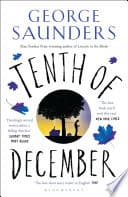
One of the most important and blazingly original writers of his generation, George Saunders is an undisputed master of the short story, and Tenth of December is his most honest, accessible, and moving collection yet.
In the taut opener, “Victory Lap,” a boy witnesses the attempted abduction of the girl next door and is faced with a harrowing choice: Does he ignore what he sees, or override years of smothering advice from his parents and act? In “Home,” a combat-damaged soldier moves back in with his mother and struggles to reconcile the world he left with the one to which he has returned. And in the title story, a stunning meditation on imagination, memory, and loss, a middle-aged cancer patient walks into the woods to commit suicide, only to encounter a troubled young boy who, over the course of a fateful morning, gives the dying man a final chance to recall who he really is.
A hapless, deluded owner of an antiques store; two mothers struggling to do the right thing; a teenage girl whose idealism is challenged by a brutal brush with reality; a man tormented by a series of pharmaceutical experiments that force him to lust, to love, to kill—the unforgettable characters that populate the pages of Tenth of December are vividly and lovingly infused with Saunders’s signature blend of exuberant prose, deep humanity, and stylistic innovation.
Writing brilliantly and profoundly about class, sex, love, loss, work, despair, and war, Saunders cuts to the core of the contemporary experience. These stories take on the big questions and explore the fault lines of our own morality, delving into the questions of what makes us good and what makes us human.
Unsettling, insightful, and hilarious, the stories in Tenth of December—through their manic energy, their focus on what is redeemable in human beings, and their generosity of spirit—not only entertain and delight; they fulfill Chekhov’s dictum that art should “prepare us for tenderness.” (source)
Add to your library to track progress and write reviews
Find Tenth of December George Saunders in PDF, EPUB, ebook, audiobook, print, or library editions.

4 books in catalog
Blending social satire, speculative fiction, and emotional resonance, short story collections and experimental novels have reshaped modern fiction through distinct tragicomic voices and surreal settings. The novel Lincoln in the Bardo received the 2017 Man Booker Prize for its innovative construction of historical excerpts and theatrical ghost monologues surrounding Abraham Lincoln's mourning of his son.
George Saunders gained broad literary recognition through acclaimed collections such as Tenth of December and Pastoralia, establishing a distinct approach to exploring corporate bureaucracy, human vulnerability, and moral choices.
Born on December 2, 1958, in Amarillo, Texas, George Saunders was raised in a working-class community in south Chicago. He earned a Bachelor of Science degree in geophysical engineering from the Colorado School of Mines before working in diverse environments, including the oil fields of Sumatra, Indonesia, a Texas slaughterhouse, and an environmental engineering firm in Rochester, New York.
Saunders went on to complete a Master of Fine Arts in creative writing at Syracuse University, studying under author Tobias Wolff. He joined the faculty of Syracuse University's creative writing program, where he continues to teach. His fiction began appearing regularly in The New Yorker in 1992, leading to his debut story collection, CivilWarLand in Bad Decline, in 1996. Over his career, he has earned fellowships from the Guggenheim Foundation, the Lannan Foundation, and a MacArthur Fellowship in 2006, alongside induction into the American Academy of Arts and Letters in 2018.
Saunders's fiction consistently examines the absurdities of contemporary labor, consumer culture, and institutional pressure placed upon everyday working-class figures. His narratives frequently take place in themed environments, simulated historical reenactments, and near-future corporate landscapes, using dark humor to highlight underlying human grief and desire for connection.
Stylistically, his work relies on fragmented narrative perspectives, invented corporate dialects, colloquial speech, and rapid shifts between comedy and tragedy. In Lincoln in the Bardo, this style expanded into a multi-voiced narrative structure, while stories like Vigil and Pastoralia maintain a focused examination of character integrity, regret, and empathy under systemic constraint.