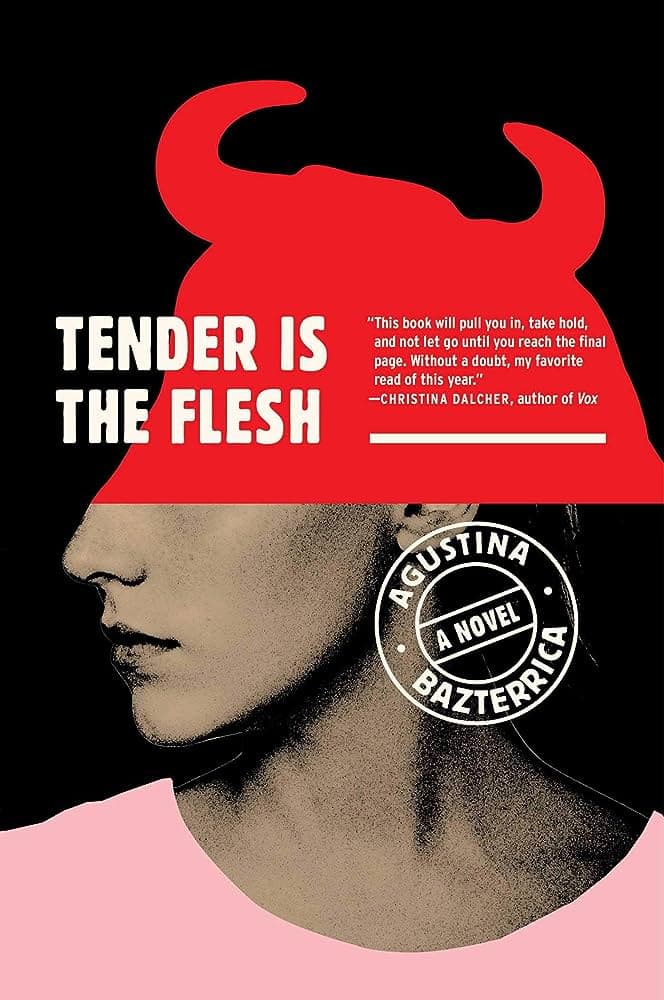
"His wife has left him, his father is sinking into dementia, and Marcos tries not to think too hard about how he makes a living. After all, it happened so quickly. First, it was reported that an infectious virus has made all animal meat poisonous to humans. Then governments initiated the “Transition.” Now, eating human meat—“special meat”—is legal. Marcos tries to stick to numbers, consignments, processing.
Then one day he’s given a gift: a live specimen of the finest quality. Though he’s aware that any form of personal contact is forbidden on pain of death, little by little he starts to treat her like a human being. And soon, he becomes tortured by what has been lost—and what might still be saved."-- Provided by Amazon
Add to your library to track progress and write reviews
Find Tender Is the Flesh Agustina Bazterrica in PDF, EPUB, ebook, audiobook, print, or library editions.

2 books in catalog
In speculative horror and dystopian fiction, few contemporary narratives match the unsettling impact of Tender Is the Flesh, a novel depicting a world where a sudden virus makes animal meat lethal and human consumption becomes institutionalized. Argentine writer Agustina Bazterrica gained widespread international attention with this award-winning work, establishing a powerful body of fiction that spans short story collections and dystopian novels.
Born in Buenos Aires in 1974, Agustina Bazterrica studied fine arts at the University of Buenos Aires before establishing herself within the regional and international literary scene. Her early recognition came through short fiction, winning First Prize in the Municipality of Buenos Aires Competition for an Unpublished Short Story in 2004/2005 and First Prize in the 38th Edmundo Valadés Latin American Short Story Contest in Puebla, Mexico, in 2009. Alongside her creative writing, she has actively shaped cultural programming in Buenos Aires as a cultural manager, workshop curator, and judge for literary competitions such as the National Arts Fund Prize and the Itaú Digital Short Story Prize.
Bazterrica published her debut novel Matar al niña and the short story collection Antes del encuentro voraz before achieving international critical acclaim with her 2017 novel Cadáver exquisito, published in English as Tender Is the Flesh. The novel won Argentina's Premio Clarín de Novela in 2017 and received the 2020 Ladies of Horror Fiction Award for Best Novel, making her the first author awarded the honor for a work originally written in Spanish. Her translated works, including the story collection Nineteen Claws and a Black Bird and her novel The Unworthy, have further expanded her reach across global publishing markets.
Bazterrica's fiction frequently examines systemic violence, institutional cruelty, consumerism, and the ethical decay inherent in modern societies. Her writing employs stark realism alongside dystopian and horror elements to interrogate how language, political rhetoric, and societal apathy normalize horrific practices. Whether depicting extreme social hierarchies or psychological vulnerability, her prose maintains a precise, unsparing tone that forces readers to confront uncomfortable moral dilemmas and the mechanisms of human rationalization.