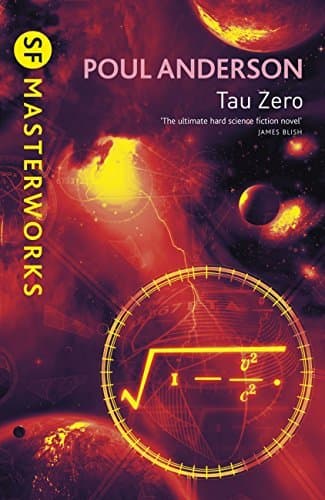
Poul Anderson's Tau Zero is an outstanding work of science fiction, in part because it combines two qualities that are often at odds in this genre: an interest in the emotional lives of its characters and a fascination with all things technological and scientific. In Tau Zero these components are not merely fused; they work together with a remarkable synergy that makes the novel much more than just a deep space adventure story.The novel centers on a ten-year interstellar voyage aboard the spaceship Leonora Christine, and it opens with members of the crew preparing for their departure from earth. It is an especially moving departure because they know that while they are aboard the ship and traveling close to the speed of light, time will be passing much more quickly back home. As a result, by the time they return everyone they know will have long since died. From practically the very first page, therefore, Tau Zero sets the scientific realities of space travel in dramatic tension with the no-less-real emotional and psychological states of the travelers. This is a dynamic Anderson explores with great success over the course of the novel as fifty crewmembers settle in for the long journey together. They are a highly-trained team of scientists and researchers, but they are also a community of individuals, each trying to make a life for him or herself in space.This is the background within which the action of the novel takes place. Anderson carefully depicts the network of relationships linking these people before the real plot begins to unfold. The voyage soon takes a unexpected and disastrous turn for the worse. The ship passes through a small, uncharted, cloudlike nebula that makes it impossible for the crew to decelerate the ship. The only hope, in fact, is for the ship to speed up. But acceleration towards the speed of light means that time outside the spaceship passes even more quickly, and the crew finds itself hurtling deeper into space and further into the future. Anderson's experience as a physicist is evidenced in the knowledgeable way he discusses the technical details of space and time travel, although his explanations never become burdensome or tedious. More to the point, the painstaking care with which he has drawn the characters ensures that the action is both imaginatively compelling and emotionally meaningful. It is a combination that is unfortunately all too rare in science fiction.
Poul Anderson's Tau Zero is an outstanding work of science fiction, in part because it combines two qualities that are often at odds in this genre: an interest in the emotional lives of its characters and a fascination with all things technological and scientific. In Tau Zero these components are not merely fused; they work together with a remarkable synergy that makes the novel much more than just a deep space adventure story.The novel centers on a ten-year interstellar voyage aboard the spaceship Leonora Christine, and it opens with members of the crew preparing for their departure from earth. It is an especially moving departure because they know that while they are aboard the ship and traveling close to the speed of light, time will be passing much more quickly back home. As a result, by the time they return everyone they know will have long since died. From practically the very first page, therefore, Tau Zero sets the scientific realities of space travel in dramatic tension with the no-less-real emotional and psychological states of the travelers. This is a dynamic Anderson explores with great success over the course of the novel as fifty crewmembers settle in for the long journey together. They are a highly-trained team of scientists and researchers, but they are also a community of individuals, each trying to make a life for him or herself in space.This is the background within which the action of the novel takes place. Anderson carefully depicts the network of relationships linking these people before the real plot begins to unfold. The voyage soon takes a unexpected and disastrous turn for the worse. The ship passes through a small, uncharted, cloudlike nebula that makes it impossible for the crew to decelerate the ship. The only hope, in fact, is for the ship to speed up. But acceleration towards the speed of light means that time outside the spaceship passes even more quickly, and the crew finds itself hurtling deeper into space and further into the future. Anderson's experience as a physicist is evidenced in the knowledgeable way he discusses the technical details of space and time travel, although his explanations never become burdensome or tedious. More to the point, the painstaking care with which he has drawn the characters ensures that the action is both imaginatively compelling and emotionally meaningful. It is a combination that is unfortunately all too rare in science fiction.
Add to your library to track progress and write reviews
Add to your library to track progress and write reviews
Find Tau Zero Poul Anderson in PDF, EPUB, ebook, audiobook, print, or library editions.
Find Tau Zero Poul Anderson in PDF, EPUB, ebook, audiobook, print, or library editions.

7 books in catalog
Rigorous physics principles and deep historical lore shaped hard science fiction and speculative fantasy across six decades of publishing, producing celebrated novels such as Tau Zero and The High Crusade. Poul William Anderson entered the field during the Golden Age of science fiction and maintained an active publishing career into the twenty-first century, earning seven Hugo Awards and three Nebula Awards alongside the SFWA Grand Master Award.
His vast bibliography spans hard science fiction, space opera, alternate history, historical fantasy, and short stories, demonstrating a rare combination of scientific literacy and mythic storytelling.
Born to Danish parents in Pennsylvania in 1926, Anderson spent parts of his childhood in Texas and Denmark before returning to the United States around the onset of World War II. He earned a degree in physics from the University of Minnesota in 1948, publishing his first science fiction story while still an undergraduate and becoming a full-time freelance writer upon graduation. In 1953, he married Karen Kruse, with whom he shared a lifelong literary partnership; their daughter, Astrid, later married science fiction author Greg Bear. Anderson took on leadership roles within the speculative fiction community, serving as the sixth president of the Science Fiction and Fantasy Writers of America in 1972. He was also a founding member of the Society for Creative Anachronism and belonged to the Swordsmen and Sorcerers' Guild of America, a loose-knit group of heroic fantasy authors founded in the 1960s whose works featured in Lin Carter's Flashing Swords! anthologies. Additionally, his advocacy for space exploration led Robert A. Heinlein to dedicate his 1985 novel The Cat Who Walks Through Walls to Anderson and eight other members of the Citizens' Advisory Council on National Space Policy. Anderson continued writing until his death from cancer on July 31, 2001, after a month in the hospital, with several of his novels published posthumously.
Anderson's fiction is distinguished by scrupulous attention to physical details and astronomical logic, informed by his degree in physics and his deep knowledge of Scandinavian history and languages. He frequently explored complex political systems, long-term societal changes, and galactic expansion, while simultaneously contributing foundational works to high fantasy and heroic fantasy. His novels and short stories frequently examined individual liberty versus organizational power, as reflected in his contributions to shared universes like Foundation's Friends and standalone science fiction novels including The Enemy Stars, There Will Be Time, Fire Time, and The People of the Wind.
7 books in catalog
Rigorous physics principles and deep historical lore shaped hard science fiction and speculative fantasy across six decades of publishing, producing celebrated novels such as Tau Zero and The High Crusade. Poul William Anderson entered the field during the Golden Age of science fiction and maintained an active publishing career into the twenty-first century, earning seven Hugo Awards and three Nebula Awards alongside the SFWA Grand Master Award.
His vast bibliography spans hard science fiction, space opera, alternate history, historical fantasy, and short stories, demonstrating a rare combination of scientific literacy and mythic storytelling.
Born to Danish parents in Pennsylvania in 1926, Anderson spent parts of his childhood in Texas and Denmark before returning to the United States around the onset of World War II. He earned a degree in physics from the University of Minnesota in 1948, publishing his first science fiction story while still an undergraduate and becoming a full-time freelance writer upon graduation. In 1953, he married Karen Kruse, with whom he shared a lifelong literary partnership; their daughter, Astrid, later married science fiction author Greg Bear. Anderson took on leadership roles within the speculative fiction community, serving as the sixth president of the Science Fiction and Fantasy Writers of America in 1972. He was also a founding member of the Society for Creative Anachronism and belonged to the Swordsmen and Sorcerers' Guild of America, a loose-knit group of heroic fantasy authors founded in the 1960s whose works featured in Lin Carter's Flashing Swords! anthologies. Additionally, his advocacy for space exploration led Robert A. Heinlein to dedicate his 1985 novel The Cat Who Walks Through Walls to Anderson and eight other members of the Citizens' Advisory Council on National Space Policy. Anderson continued writing until his death from cancer on July 31, 2001, after a month in the hospital, with several of his novels published posthumously.
Anderson's fiction is distinguished by scrupulous attention to physical details and astronomical logic, informed by his degree in physics and his deep knowledge of Scandinavian history and languages. He frequently explored complex political systems, long-term societal changes, and galactic expansion, while simultaneously contributing foundational works to high fantasy and heroic fantasy. His novels and short stories frequently examined individual liberty versus organizational power, as reflected in his contributions to shared universes like Foundation's Friends and standalone science fiction novels including The Enemy Stars, There Will Be Time, Fire Time, and The People of the Wind.