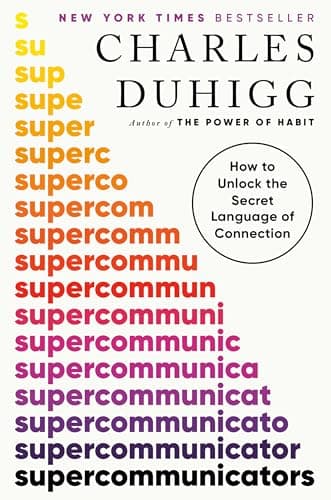
Come inside a jury room as one juror leads a starkly divided room to consensus. Join a young CIA officer as he recruits a reluctant foreign agent. And sit with an accomplished surgeon as he tries, and fails, to convince yet another cancer patient to opt for the less risky course of treatment. In Supercommunicators, Charles Duhigg blends deep research and his trademark storytelling skills to show how we can all learn to identify and leverage the hidden layers that lurk beneath every conversation.
Communication is a superpower and the best communicators understand that whenever we speak, we’re actually participating in one of three conversations: practical (What’s this really about?), emotional (How do we feel?), and social (Who are we?). If you don’t know what kind of conversation you’re having, you’re unlikely to connect.
Supercommunicators know the importance of recognizing—and then matching—each kind of conversation, and how to hear the complex emotions, subtle negotiations, and deeply held beliefs that color so much of what we say and how we listen. Our experiences, our values, our emotional lives—and how we see ourselves, and others—shape every discussion, from who will pick up the kids to how we want to be treated at work. In this book, you will learn why some people are able to make themselves heard, and to hear others, so clearly.
With his storytelling that takes us from the writers’ room of The Big Bang Theory to the couches of leading marriage counselors, Duhigg shows readers how to recognize these three conversations—and teaches us the tips and skills we need to navigate them more successfully.
In the end, he delivers a simple but powerful lesson: With the right tools, we can connect with anyone.
Add to your library to track progress and write reviews
Find Supercommunicators: How to Unlock the Secret Language of Connection Charles Duhigg in PDF, EPUB, ebook, audiobook, print, or library editions.

3 books in catalog
Investigative journalism and social science research meet in non-fiction works that examine human psychology, habit formation, productivity, and interpersonal dynamics. Charles Duhigg has authored several high-profile books in this space, most notably The Power of Habit: Why We Do What We Do in Life and Business, which spent over three years on bestseller lists and was translated into 40 languages.
Through deep reporting and concrete case studies of individuals and organizations, his work translates behavioral research into practical insights about how people work, communicate, and change daily routines.
Born in New Mexico in 1974, Charles Duhigg completed his undergraduate studies at Yale University before earning a Master of Business Administration from Harvard Business School in 2003. He began his journalism career as a staff writer for the Los Angeles Times before joining The New York Times in 2006, where he worked as a reporter and senior editor until 2017. Later in his career, he became a staff writer and contributor for The New Yorker magazine.
In 2013, Duhigg was part of a reporting team at The New York Times that was awarded the Pulitzer Prize for Explanatory Reporting for 'The iEconomy,' a ten-part series detailing the business practices of Apple and other technology companies. His investigative journalism has also earned the George Polk Award, the Gerald Loeb Award, the Investigative Reporters and Editors Medal, the Scripps Howard National Journalism Award, and recognition from the National Academies of Sciences. In addition to print reporting, he has appeared on broadcast outlets including NPR, PBS's NewsHour, Frontline, This American Life, and The Colbert Report.
Combining the analytical rigor of an investigative journalist with insights informed by business education, Duhigg connects scientific research with real-world narratives. His writing frequently pairs behavioral psychology, neuroscience, and organizational science with memorable real-life case studies. Rather than offering abstract self-help techniques, he focuses on how systems, routines, and environmental structures shape human behavior.
A central theme across his books is the mechanics of behavioral change and effective communication. He explores how habit loops operate in individuals and corporations, how high-performing groups structure their decision-making processes, and how conversations can be navigated by recognizing underlying emotional, practical, and social layers.