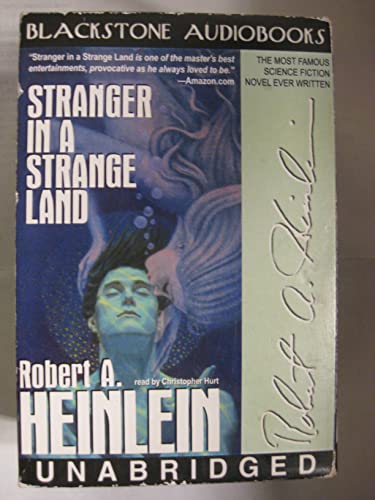
№ 1 · Stranger in a Strange Land
Stranger In A Strange Land,
§Synopsis
01Valentine Michael Smith, born and raised on Mars, arrives on Earth stunning Western culture with his superhuman abilities
§Our take
This is two books under one title: a sharp fish-out-of-water comedy that spends its second half turning into a pulpit. Valentine Michael Smith's view of religion, money, monogamy and death is funny and strange until the novel settles into long debates about sex, free love and the church Smith develops. Even readers allergic to the sermons tend to admit the opening has snap.
It even helped inspire a real religion, the Church of All Worlds. Edition matters too: the 1961 text lost tens of thousands of words, and accounts differ over whether Heinlein or the publisher drove the cuts. Kirkus preferred the shorter book. Reason preferred the restored text, and the Heinlein Society favors the uncut version for voice. The restored edition adds fuller descriptions and dialogue, not new scenes.
§Themes
- The outsider eye
- Smith treats religion, money, monogamy and fear of death as bizarre human customs rather than natural facts.
- Religion as counterculture
- The novel's church makes open sexuality, communal living and Martian ideas its most sustained experiment.
- Freedom's blind spots
- The book's expansive sexual ideal collides with demeaning views of women, narrow gender roles and homophobic passages.
- The talkative advocate
- Jubal Harshaw is vivid, witty and a great talker, though critics often read him as Heinlein's mouthpiece.
- Two texts, one novel
- The shorter 1961 edition and the posthumous restored text change the balance between brisk satire, discussion and sermon.
§How it was received
The book was divisive from the start: Orville Prescott dismissed it as a botched mixture of science fiction, humor, satire and eroticism, yet it won the 1962 Hugo Award for Best Novel and sold strongly. Kirkus preferred the 1961 text, while Reason preferred the restored version and said the book still worked as social criticism and science fiction thirty years later. Annalee Newitz later called its portrayal of women the sexist model of hippie life, a criticism that remains central to reading it now.
§Read it if
- You enjoy a genuinely sharp outsider's-eye satire of religion, money, monogamy and death
- You can sit through long conversations about sex, spirituality and communal living
- You want a formative counterculture classic read with its dated attitudes plainly in view
§Skip it if
- You need consistently progressive portrayals of women and gay characters. This novel draws heavy criticism for both.
- Talk-heavy chapters and long sermons sound like a seminar. The second half is where many readers lose patience.
§Before you start
- Reading experience
- The opening moves briskly through Smith's return and adjustment; the second half slows into long, discussion-heavy sections on religion and sex that can test patience.
- Reading order
- Standalone novel. It is not part of Heinlein's Future History or another series. The 1961 cut edition and the posthumous restored edition are two versions of the same novel, not consecutive installments.
- Content notes
- Open treatment of sex, polyamory and free love; Demeaning treatment of women, including a line widely read as blaming rape victims; Homophobic passages and narrow portrayals of gay characters; Religious satire and cult-like church material that some readers find offensive or creepy; Violence and killing.
§Common questions
- Which version should I read?
- Choose the 1961 text for a tighter, faster read. The restored text offers fuller descriptions and dialogue, and serious critical opinion remains divided.
- Is it part of Heinlein's Future History?
- No. It is a standalone novel; the cut and restored editions are versions, not separate books in a sequence.
- Did this book really inspire a religion?
- Yes. The Church of All Worlds was inspired by the novel, founded by readers in 1967 and chartered in 1968. Heinlein was not a member.
§If you liked this
- Starship Troopers by Robert A. Heinlein — Another Heinlein novel in which his political and social views drive the story, set in a very different, military key.
- The Harrad Experiment by Robert H. Rimmer — A same-era novel of free-love communities, often linked with Heinlein's religious ideas even though Heinlein objected to being grouped with it.
- Atlas Shrugged by Ayn Rand — Often grouped with Heinlein as an ideas-first novel of the period, but Heinlein objected to the comparison, so it works better as a contrast than a close match.
Track this book
Add to your library to track progress and write reviews