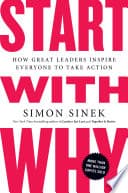
Why do you do what you do?
Why are some people and organizations more innovative, more influential, and more profitable than others? Why do some command greater loyalty from customers and employees alike? Even among the successful, why are so few able to repeat their success over and over?
People like Martin Luther King Jr., Steve Jobs, and the Wright Brothers might have little in common, but they all started with why. It was their natural ability to start with why that enabled them to inspire those around them and to achieve remarkable things.
In studying the leaders who've had the greatest influence in the world, Simon Sinek discovered that they all think, act, and communicate in the exact same way—and it's the complete opposite of what everyone else does. Sinek calls this powerful idea The Golden Circle, and it provides a framework upon which organizations can be built, movements can be lead, and people can be inspired. And it all starts with WHY.
Any organization can explain what it does; some can explain how they do it; but very few can clearly articulate why. WHY is not money or profit—those are always results. WHY does your organization exist? WHY does it do the things it does? WHY do customers really buy from one company or another? WHY are people loyal to some leaders, but not others?
Starting with WHY works in big business and small business, in the nonprofit world and in politics. Those who start with WHY never manipulate, they inspire. And the people who follow them don't do so because they have to; they follow because they want to.
Drawing on a wide range of real-life stories, Sinek weaves together a clear vision of what it truly takes to lead and inspire. This book is for anyone who wants to inspire others or who wants to find someone to inspire them.
Add to your library to track progress and write reviews
Find Start With Why: How Great Leaders Inspire Everyone To Take Action Simon Sinek in PDF, EPUB, ebook, audiobook, print, or library editions.

1 books in catalog
Modern business leadership literature heavily emphasizes the underlying purpose driving organizational success, a movement popularized by leadership books examining how inspired teams operate. Simon Sinek brought this concept to international prominence by analyzing patterns in how influential leaders think, act, and communicate, arguing that long-term trust and loyalty stem from clearly defined core motivations.
Through his writing and public speaking, Sinek offers readers actionable frameworks for organizational management and personal growth. His best-known book, Start With Why: How Great Leaders Inspire Everyone To Take Action, explores how sustainable leadership begins with understanding an organization's fundamental purpose rather than merely focusing on what it produces.
Simon Oliver Sinek was born in Wimbledon, London, England, on October 9, 1973. During his childhood, his family lived in Johannesburg, London, and Hong Kong before settling in the United States. Sinek studied law at City, University of London, and received a Bachelor of Arts degree in cultural anthropology from Brandeis University. His academic training in anthropology deeply influenced his approach to analyzing human behavior, group dynamics, and institutional cultures.
Sinek began his career in advertising before transitioning into organizational consulting, ethnography, and public speaking. In 2009, he presented a popular TED Talk on the concept of 'Why,' which became one of the most-watched talks on TED.com with over 60 million views. He subsequently established himself as a leading author and corporate consultant on leadership and workplace culture, later founding The Optimism Company to promote environments where individuals feel inspired, safe, and fulfilled.
Sinek's writing bridges cultural anthropology and practical business management, translating ethnographic observations into straightforward principles for leadership and collaboration. Drawing on his background studying human societies, he focuses on how enduring organizations foster trust, psychological safety, and cooperation among team members. A recurring theme across his work is the distinction between short-term transactional strategies and purpose-driven, long-term leadership.