№ 4 · The Hitchhiker's Guide to the Galaxy
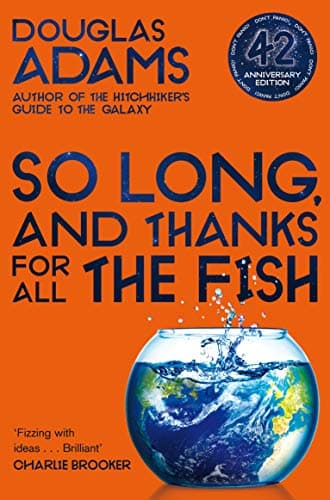
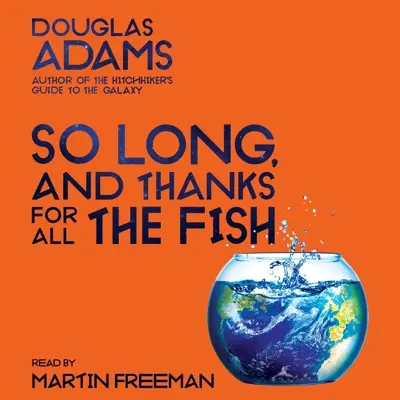
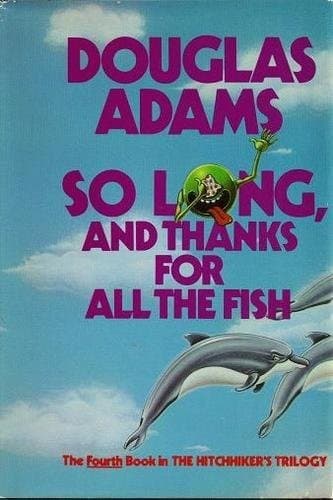
After years of traversing the galaxy in a dressing gown, Arthur Dent achieves the impossible: he returns to Earth. This should be a logistical miracle, considering he personally witnessed the planet's destruction at the hands of a Vogon Constructor Fleet. Yet, here he is, standing in the British rain, finding his house exactly where he left it. The world seems to have collectively forgotten its brush with oblivion, treating the "apocalypse" as a mass hallucination, leaving Arthur to grapple with the isolating reality of being one of the few who remembers the truth.
Amidst this unsettling normalcy, Arthur discovers a mysterious glass bowl inscribed with the words "So Long, and Thanks for All the Fish." His search for answers leads him to Fenchurch, a woman who experienced a profound revelation at the exact moment the world was supposed to end—only to have the secret slip through her fingers. Their connection is forged in the shared trauma of a universe that doesn't add up, shifting the narrative focus from the vast, cold expanses of space to the intimate, messy complexities of human attachment and the search for meaning in a restored world.
The world-building in this installment takes a sharp turn from the surrealist space opera of previous volumes toward a "heightened mundane" atmosphere. Earth is back, but it is an Earth defined by absences—most notably the total disappearance of the planet's dolphins. The setting operates on a logic of collective denial; the atmosphere is thick with British rain and the quiet absurdity of a civilization that has been "reset" without its consent. The rules of this world are dictated by a lingering sense of wrongness that only those who left the planet can perceive, creating a suburban landscape that feels more alien than a lunar colony.
The character development marks a significant departure from the earlier "bumbling protagonist" archetype. Arthur Dent is no longer merely a victim of cosmic coincidence; he is an active participant in his own life, seeking emotional stability and romantic connection. The relationship between Arthur and Fenchurch serves as the narrative anchor, moving the series from satirical sketches toward a grounded exploration of how two people find solace in one another when the universe proves itself to be fundamentally unreliable.
The novel expertly subverts several common science fiction and literary tropes:
Add to your library to track progress and write reviews
Find So Long, and Thanks for All the Fish Douglas Adams in PDF, EPUB, ebook, audiobook, print, or library editions.

10 books in catalog
Combining cosmic absurdity with British existential satire, the speculative comedy subgenre gained its defining masterwork through a multimedia phenomenon that transformed the cold vacuum of space into a stage for philosophical inquiry, technological skepticism, and bureaucratic farce. Author Douglas Adams introduced audiences to a surreal universe where an eccentric alien travel guide, a depressed robot, and a displaced Englishman navigate space-time following the destruction of Earth to make way for a hyperspace bypass. By introducing a universe where the answer to life’s ultimate question of life, the universe, and everything is a simple integer, he established a permanent bridge between speculative fiction and high-concept comedy, influencing generations of science fiction writers, software designers, and digital pioneers.
Recognition for this literary output included becoming the youngest author to receive a Golden Pan Award—an honor he would win twice more—and posthumous induction into the Radio Academy’s Hall of Fame. Beyond the five-volume "trilogy" that sold over 15 million copies worldwide during his lifetime, his portfolio expanded into the "holistic" detective fiction of the Dirk Gently series, satirical dictionaries, and influential environmental advocacy in Last Chance to See. As a visionary thinker who early on predicted the rise of e-books, hyperlinked multimedia, and the ultimate interconnectedness of all things, Douglas Adams created a lasting body of work that continues to frame how readers perceive the intersection of human fallibility, environmental responsibility, and rapid technological progress.
Born Douglas Noël Adams in Cambridge in 1952, the author was educated at Brentwood School in Essex before entering St John’s College, Cambridge, where he earned a BA in English literature in 1974 and later an MA. During his time at university, he joined the famous Footlights comedy troupe, which launched his passion for scriptwriting and satirical performance. His early post-graduation career was defined by a difficult struggle to secure a stable footing in the British television and comedy circuit. Despite writing sketches for BBC radio and television programs and forming a brief writing collaboration with Monty Python’s Graham Chapman—earning a rare non-Python writing credit on Monty Python's Flying Circus—financial instability forced him to take on various odd jobs, working as a hospital porter, barn builder, chicken shed cleaner, and bodyguard for a Qatar royal family.
The conceptual seed for his most famous creation was planted in 1971 while hitchhiking across Europe as a teenager. Lying in a field in Innsbruck, Austria, while gazing up at the stars with a copy of Ken Welsh's Hitchhiker’s Guide to Europe, he envisioned a galactic equivalent designed for weary space travelers. In 1978, this premise materialized when the first series of The Hitchhiker’s Guide to the Galaxy aired on BBC Radio 4. The radio comedy's unprecedented popularity propelled the story across multiple media formats, leading to a record album, stage adaptations, a 1981 BBC television series, and a best-selling 1979 novelization, The Hitchhiker's Guide to the Galaxy. By 1984, Douglas Adams had become the youngest writer to receive the Golden Pan Award, which commemorated one million copies sold.
Throughout the late 1970s and 1980s, Adams expanded his creative scope into television script editing and prospective multimedia projects. He served as a script editor for the seventeenth season of the iconic BBC science fiction series Doctor Who in 1979, writing the celebrated serial "City of Death" under the pseudonym David Agnew (co-written with Graham Williams) as well as the serials "The Pirate Planet" and the unfinished "Shada". His passion for computing and emerging technologies led him to embrace personal computers early, becoming one of the first prominent British authors to adopt Apple Macintosh hardware for literary composition. In the 1990s, he co-founded The Digital Village (later known as h2g2), an internet media company through which he created the BAFTA-nominated interactive graphic adventure computer game Starship Titanic in 1998, accompanied by a tie-in novel written by Terry Jones.
In his later years, Adams moved with his family to Santa Barbara, California. At the time of his unexpected death from a heart attack in May 2001 at the age of 49, he was actively working on the screenplay for The Hitchhiker's feature film adaptation, which was eventually released posthumously in 2005. Following his passing, a collection of his unpublished essays, speeches, short fiction, and uncompleted novel chapters was edited and released as The Salmon of Doubt in 2002. His archive of papers and digital files remains a vital resource for scholars of comedy, science fiction, and digital media, while annual international celebrations such as Towel Day honor his creative contribution to global culture.
The core of Douglas Adams's writing style is rooted in a "holistic" worldview, where seemingly disparate, trivial, or chaotic events are revealed to be intricately linked through subterranean logic and absurdity. His prose relies heavily on the "reductio ad absurdum" technique, taking mundane human frustrations—such as poor quality tea, digital wristwatches, middle-management bureaucracy, or missing paperwork—and projecting them onto a galactic scale. Through this satirical mechanism, he lampooned complex socio-political issues including municipal urban planning, social engineering, the futility of military conflicts, and the fundamental limitations of human intellectual hubris when confronted with a vast, uncaring cosmos.
Recurring thematic threads across his bibliography include the search for meaning in an indifferent universe, the environmental consequences of technological expansion, and the "fundamental interconnectedness of all things." As a staunch atheist and passionate environmentalist, Adams used his public profile to campaign for endangered species, serving as a patron for the Dian Fossey Gorilla Fund and Save The Rhino International. His non-fiction travel book Last Chance to See, co-authored with zoologist Mark Carwardine after expeditions to locate critically endangered animals like the Kakapo and Northern White Rhino, reflects his deep commitment to wildlife preservation. His work balances sharp satirical observations regarding political and corporate institutions with a curious, optimistic wonder regarding scientific discovery and natural phenomena.
Adams's narrative technique is distinguished by witty linguistic subversion, humorous footnotes, non-sequiturs, and structural irony. In both The Hitchhiker's saga and the Dirk Gently novels, narrative resolution rarely comes from traditional heroic action; instead, plot points turn on coincidence, philosophical paradoxes, and chaotic misunderstandings. His comedic rhythm heavily influenced modern science fiction, audio drama, and narrative game design, demonstrating that speculative literature could serve as a vehicle for profound philosophical skepticism while remaining accessible and entertaining.
The Hitchhiker's Guide to the Galaxy