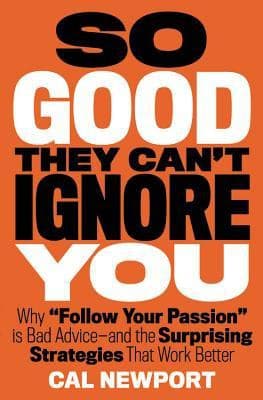
So Good They Can't Ignore You: Why Skills Trump Passion in the Quest for Work You Love,
by Cal Newport
by Cal Newport
In this eye-opening account, Cal Newport debunks the long-held belief that "follow your passion" is good advice. Not only is the cliché flawed-preexisting passions are rare and have little to do with how most people end up loving their work-but it can also be dangerous, leading to anxiety and chronic job hopping.
After making his case against passion, Newport sets out on a quest to discover the reality of how people end up loving what they do. Spending time with organic farmers, venture capitalists, screenwriters, freelance computer programmers, and others who admitted to deriving great satisfaction from their work, Newport uncovers the strategies they used and the pitfalls they avoided in developing their compelling careers.
Matching your job to a preexisting passion does not matter, he reveals. Passion comes after you put in the hard work to become excellent at something valuable, not before. In other words, what you do for a living is much less important than how you do it.
With a title taken from the comedian Steve Martin, who once said his advice for aspiring entertainers was to "be so good they can't ignore you," Cal Newport's clearly written manifesto is mandatory reading for anyone fretting about what to do with their life, or frustrated by their current job situation and eager to find a fresh new way to take control of their livelihood. He provides an evidence-based blueprint for creating work you love.
SO GOOD THEY CAN'T IGNORE YOU will change the way we think about our careers, happiness, and the crafting of a remarkable life.
Add to your library to track progress and write reviews
Find So Good They Can't Ignore You: Why Skills Trump Passion in the Quest for Work You Love Cal Newport in PDF, EPUB, ebook, audiobook, print, or library editions.
4 books in catalog
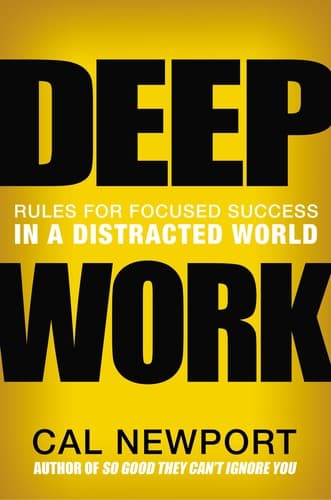
Analyzing attention management, workplace culture, and modern productivity, nonfiction research and writings have challenged conventional assumptions about technology and career growth. The bestselling book Deep Work: Rules for Focused Success in a Distracted World established a compelling framework for cultivating intense concentration in an era dominated by constant digital interruptions. Cal Newport has emerged as a prominent voice advocating for deliberate, high-value cognitive effort over reactive busyness.
Through his bestselling books, essays, and public commentary, Newport offers readers structured, evidence-based alternatives to digital burnout and fragmented focus. His books have sold over two million copies worldwide and have been translated into more than forty languages.
Calvin C. Newport was born on June 23, 1982, and grew up in Pennington, New Jersey. He completed his secondary education at Hopewell Valley Central High School in 2000 before attending Dartmouth College, where he graduated Phi Beta Kappa with a bachelor's degree in computer science in 2004. He earned his master's degree in 2006 and a Ph.D. in computer science in 2009 from the Massachusetts Institute of Technology, where his doctoral dissertation focused on distributed computing systems under advisor Nancy Lynch. Following a postdoctoral fellowship at MIT from 2009 to 2011, he joined the computer science faculty at Georgetown University.
Alongside his academic research in computer science, Newport established a parallel career writing about study methods, professional development, and digital technology. In addition to authoring eight books, he serves as a contributing writer for The New Yorker, hosts the Deep Questions podcast, and publishes long-form essays on his Study Hacks website.
Newport's writing combines academic analytical precision with practical strategies for managing cognitive focus, personal habits, and workplace communication. Rather than treating productivity as a matter of raw effort, his works examine how organizational structures and digital tools shape human behavior, decision-making, and professional satisfaction.
A central focus of his work is the critique of constant connectivity and the common assumption that passion alone determines career fulfillment. In books addressing personal organization and technology, Newport champions practices such as time-block planning, corporate office hours modeled on academic schedules, and the intentional reduction of shallow digital distractions.