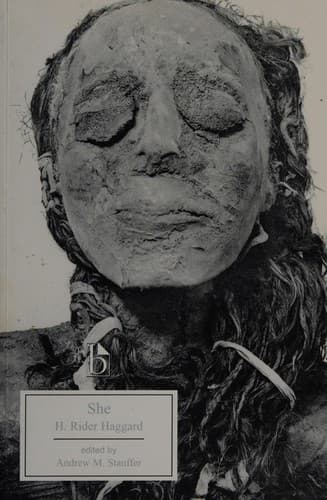
An enduring adventure yarn set in pre colonial Africa, culminating in the discovery of a lost civilization ruled by a beautiful eternally youthful queen. "She is generally considered to be one of the classics of imaginative literature and with 83 million copies sold by 1965, it is one of the best-selling books of all time." See more at: http://en.wikipedia.org/wiki/She_(novel)

An enduring adventure yarn set in pre colonial Africa, culminating in the discovery of a lost civilization ruled by a beautiful eternally youthful queen. "She is generally considered to be one of the classics of imaginative literature and with 83 million copies sold by 1965, it is one of the best-selling books of all time." See more at: http://en.wikipedia.org/wiki/She_(novel)
Add to your library to track progress and write reviews
Find She: A History of Adventure H. Rider Haggard in PDF, EPUB, ebook, audiobook, print, or library editions.
Ayesha
Ayesha
2 books in catalog
Victorian adventure fiction gained a foundational narrative model with stories set in unexplored regions that established the lost world literary genre. H. Rider Haggard became a central figure in popular late-nineteenth-century literature through his tales of African exploration, ancient civilizations, and dramatic expeditions, including the famous 1885 novel King Solomon's Mines.
Born in Norfolk, England, in 1856, Henry Rider Haggard was sent to South Africa in 1875 to serve as secretary to Sir Henry Bulwer, the lieutenant-governor of Natal. During his six years in southern Africa, Haggard held official colonial posts, including Master of the High Court of the Transvaal and an adjutant of the Pretoria Horse. His direct observations of African landscapes, cultures, and regional politics deeply informed his subsequent writing. Upon returning to England, he turned these experiences into popular fiction alongside non-fiction works and imperial agricultural studies, eventually receiving a knighthood for his public service and land reform efforts prior to his death in 1925.
Haggard's narrative style combined Victorian romance with detailed descriptions of African topography, history, and folklore. His adventure stories frequently explore themes of ancient lost civilizations, supernatural longevity, colonial anxiety, and heroic voyages through uncharted wilderness. By pairing realistic observational details from his time in southern Africa with imaginative archaeological mysteries, Haggard established a durable template for lost-world adventure narrative that influenced generations of adventure literature.
2 books in catalog
Victorian adventure fiction gained a foundational narrative model with stories set in unexplored regions that established the lost world literary genre. H. Rider Haggard became a central figure in popular late-nineteenth-century literature through his tales of African exploration, ancient civilizations, and dramatic expeditions, including the famous 1885 novel King Solomon's Mines.
Born in Norfolk, England, in 1856, Henry Rider Haggard was sent to South Africa in 1875 to serve as secretary to Sir Henry Bulwer, the lieutenant-governor of Natal. During his six years in southern Africa, Haggard held official colonial posts, including Master of the High Court of the Transvaal and an adjutant of the Pretoria Horse. His direct observations of African landscapes, cultures, and regional politics deeply informed his subsequent writing. Upon returning to England, he turned these experiences into popular fiction alongside non-fiction works and imperial agricultural studies, eventually receiving a knighthood for his public service and land reform efforts prior to his death in 1925.
Haggard's narrative style combined Victorian romance with detailed descriptions of African topography, history, and folklore. His adventure stories frequently explore themes of ancient lost civilizations, supernatural longevity, colonial anxiety, and heroic voyages through uncharted wilderness. By pairing realistic observational details from his time in southern Africa with imaginative archaeological mysteries, Haggard established a durable template for lost-world adventure narrative that influenced generations of adventure literature.