BooksSeiobo There Below
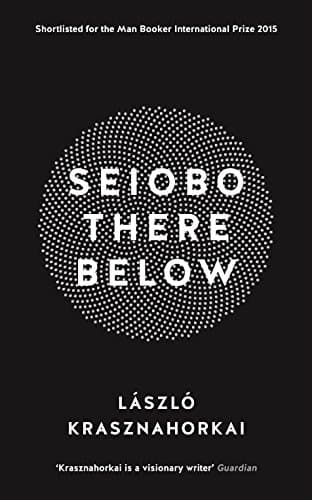
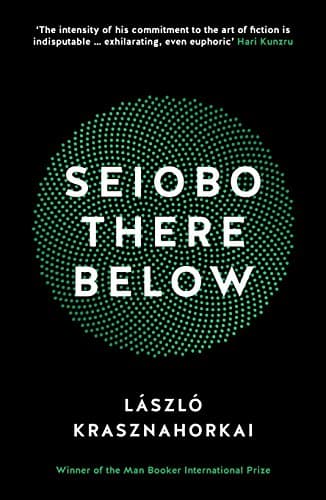
From the winner of the 2015 Man Booker International Prize The latest novel from “the contemporary Hungarian master of the apocalypse” (Susan Sontag) Seiobo — a Japanese goddess — has a peach tree in her garden that blossoms once every three thousand years: its fruit brings immortality. In Seiobo There Below, we see her returning again and again to mortal realms, searching for a glimpse of perfection. Beauty, in Krasznahorkai’s new novel, reflects, however fleetingly, the sacred — even if we are mostly unable to bear it. Seiobo shows us an ancient Buddha being restored; Perugino managing his workshop; a Japanese Noh actor rehearsing; a fanatic of Baroque music lecturing a handful of old villagers; tourists intruding into the rituals of Japan’s most sacred shrine; a heron hunting.… Over these scenes and more — structured by the Fibonacci sequence — Seiobo hovers, watching it all.
From the winner of the 2015 Man Booker International Prize The latest novel from “the contemporary Hungarian master of the apocalypse” (Susan Sontag) Seiobo — a Japanese goddess — has a peach tree in her garden that blossoms once every three thousand years: its fruit brings immortality. In Seiobo There Below, we see her returning again and again to mortal realms, searching for a glimpse of perfection. Beauty, in Krasznahorkai’s new novel, reflects, however fleetingly, the sacred — even if we are mostly unable to bear it. Seiobo shows us an ancient Buddha being restored; Perugino managing his workshop; a Japanese Noh actor rehearsing; a fanatic of Baroque music lecturing a handful of old villagers; tourists intruding into the rituals of Japan’s most sacred shrine; a heron hunting.… Over these scenes and more — structured by the Fibonacci sequence — Seiobo hovers, watching it all.
Add to your library to track progress and write reviews
Add to your library to track progress and write reviews
Find Seiobo There Below László Krasznahorkai in PDF, EPUB, ebook, audiobook, print, or library editions.
Find Seiobo There Below László Krasznahorkai in PDF, EPUB, ebook, audiobook, print, or library editions.
2 books in catalog
László Krasznahorkai (Hungarian: [ˈlaːsloː ˈkrɒsnɒɦorkɒi]; born 5 January 1954) is a Hungarian writer, novelist and screenwriter. Krasznahorkai is known for his difficult and demanding novels, often labelled postmodern, which explore dystopian and melancholic themes. Several of his works, including his novels Satantango (1985) and The Melancholy of Resistance (1989), have been adapted into feature films by the director Béla Tarr.
In 2025, he was awarded the Nobel Prize in Literature "for his compelling and visionary oeuvre that, in the midst of apocalyptic terror, reaffirms the power of art".
His novel The Melancholy of Resistance (1989) received the German Bestenliste-Prize for the best literary work of the year in 1993. In 1996, he was a fellow at the Wissenschaftskolleg in Berlin.
Beginning with Sátántangó (1994), filmmaker Béla Tarr, a close friend, adapted several of Krasznahorkai's works into films, including Werckmeister Harmonies (2000), which adapts The Melancholy of Resistance. Krasznahorkai stated that their 2011 film, The Turin Horse, would be their final collaboration. He has also collaborated with artist Max Neumann on illustrated works, including the novella Chasing Homer (2021), released with an original score by jazz musician Szilveszter Miklós.
His novel Seiobo There Below won the Best Translated Book Award in 2014. In 2015, he became the first Hungarian author to receive the Man Booker International Prize.
Krasznahorkai's work has received significant critical acclaim. Susan Sontag described him as "the contemporary Hungarian master of apocalypse who inspires comparison with Gogol and Melville", while W. G. Sebald wrote that "the universality of Krasznahorkai's vision rivals that of Gogol's Dead Souls and far surpasses all the lesser concerns of contemporary writing".
In 2024, the Austrian National Library in Vienna acquired Krasznahorkai’s literary archive (Vorlass), which is now preserved in its Literature Archives.
2 books in catalog
László Krasznahorkai (Hungarian: [ˈlaːsloː ˈkrɒsnɒɦorkɒi]; born 5 January 1954) is a Hungarian writer, novelist and screenwriter. Krasznahorkai is known for his difficult and demanding novels, often labelled postmodern, which explore dystopian and melancholic themes. Several of his works, including his novels Satantango (1985) and The Melancholy of Resistance (1989), have been adapted into feature films by the director Béla Tarr.
In 2025, he was awarded the Nobel Prize in Literature "for his compelling and visionary oeuvre that, in the midst of apocalyptic terror, reaffirms the power of art".
His novel The Melancholy of Resistance (1989) received the German Bestenliste-Prize for the best literary work of the year in 1993. In 1996, he was a fellow at the Wissenschaftskolleg in Berlin.
Beginning with Sátántangó (1994), filmmaker Béla Tarr, a close friend, adapted several of Krasznahorkai's works into films, including Werckmeister Harmonies (2000), which adapts The Melancholy of Resistance. Krasznahorkai stated that their 2011 film, The Turin Horse, would be their final collaboration. He has also collaborated with artist Max Neumann on illustrated works, including the novella Chasing Homer (2021), released with an original score by jazz musician Szilveszter Miklós.
His novel Seiobo There Below won the Best Translated Book Award in 2014. In 2015, he became the first Hungarian author to receive the Man Booker International Prize.
Krasznahorkai's work has received significant critical acclaim. Susan Sontag described him as "the contemporary Hungarian master of apocalypse who inspires comparison with Gogol and Melville", while W. G. Sebald wrote that "the universality of Krasznahorkai's vision rivals that of Gogol's Dead Souls and far surpasses all the lesser concerns of contemporary writing".
In 2024, the Austrian National Library in Vienna acquired Krasznahorkai’s literary archive (Vorlass), which is now preserved in its Literature Archives.