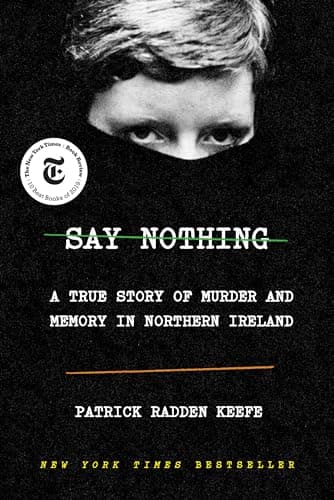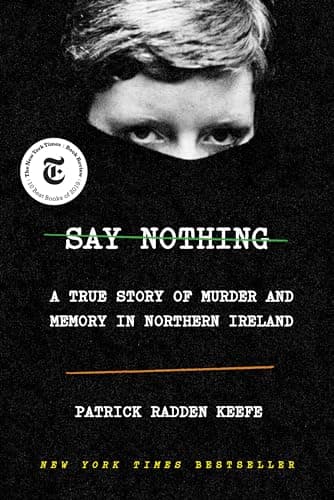
“Masked intruders dragged Jean McConville, a 38-year-old widow and mother of 10, from her Belfast home in 1972. In this meticulously reported book — as finely paced as a novel — Keefe uses McConville’s murder as a prism to tell the history of the Troubles in Northern Ireland. Interviewing people on both sides of the conflict, he transforms the tragic damage and waste of the era into a searing, utterly gripping saga.” – New York Times Book Review, Ten Best Books of the Year
From award-winning New Yorker staff writer Patrick Radden Keefe, a stunning, intricate narrative about a notorious killing in Northern Ireland and its devastating repercussions
In December 1972, Jean McConville, a thirty-eight-year-old mother of ten, was dragged from her Belfast home by masked intruders, her children clinging to her legs. They never saw her again. Her abduction was one of the most notorious episodes of the vicious conflict known as The Troubles. Everyone in the neighborhood knew the I.R.A. was responsible. But in a climate of fear and paranoia, no one would speak of it. In 2003, five years after an accord brought an uneasy peace to Northern Ireland, a set of human bones was discovered on a beach. McConville’s children knew it was their mother when they were told a blue safety pin was attached to the dress–with so many kids, she had always kept it handy for diapers or ripped clothes.
Patrick Radden Keefe’s mesmerizing book on the bitter conflict in Northern Ireland and its aftermath uses the McConville case as a starting point for the tale of a society wracked by a violent guerrilla war, a war whose consequences have never been reckoned with. The brutal violence seared not only people like the McConville children, but also I.R.A. members embittered by a peace that fell far short of the goal of a united Ireland, and left them wondering whether the killings they committed were not justified acts of war, but simple murders. From radical and impetuous I.R.A. terrorists such as Dolours Price, who, when she was barely out of her teens, was already planting bombs in London and targeting informers for execution, to the ferocious I.R.A. mastermind known as The Dark, to the spy games and dirty schemes of the British Army, to Gerry Adams, who negotiated the peace but betrayed his hardcore comrades by denying his I.R.A. past–Say Nothing conjures a world of passion, betrayal, vengeance, and anguish.
Add to your library to track progress and write reviews
Find Say Nothing: A True Story of Murder and Memory in Northern Ireland Patrick Radden Keefe in PDF, EPUB, ebook, audiobook, print, or library editions.

2 books in catalog
Investigative narrative nonfiction examining corporate corruption, political violence, systemic secrecy, and organized crime has been defined by deeply reported accounts that read with the pacing of thrillers, such as the acclaimed history Say Nothing: A True Story of Murder and Memory in Northern Ireland. Patrick Radden Keefe has established a major body of work as both an investigative journalist and an author, uncovering hidden power structures and human tragedies behind high-profile global scandals. As a long-time staff writer for The New Yorker, his comprehensive investigations explore complex networks ranging from international espionage and drug cartels to corporate dynasties and unsolved homicides.
Patrick Radden Keefe grew up in the Dorchester neighborhood of Boston, Massachusetts, as the son of urban planner Frank Keefe and philosophy professor Jennifer Radden. He earned his undergraduate degree at Columbia University before continuing his education abroad and domestically, receiving master's degrees from Cambridge University and the London School of Economics, followed by a JD from Yale Law School. Keefe began contributing investigative reporting to The New Yorker in 2006 and subsequently became a staff writer. Over his career, his writing has also appeared in The New York Review of Books, The New York Times Magazine, and Slate. His investigative journalism has earned significant industry recognition, including the National Magazine Award for Feature Writing in 2014, as well as being named a finalist for the National Magazine Award for Reporting in 2015 and 2016. In addition to his journalism, he has received research fellowships from the Guggenheim Foundation, the Rockefeller Foundation, the New America Foundation, the Woodrow Wilson International Center for Scholars, and the Cullman Center for Scholars and Writers at the New York Public Library.
Keefe's investigative approach focuses on institutional complicity, high-level corruption, secrets held by powerful figures, and the human consequences of covert actions. A signature aspect of his reporting technique is constructing detailed, vivid portraits of evasive or uncooperative subjects by piecing together extensive documentary records, court filings, and interviews with peripheral associates, as demonstrated in his profiles of drug lord Joaquín "El Chapo" Guzmán, mass shooter Amy Bishop, and the Sackler family behind Purdue Pharma. His books combine rigorous archival research with propulsive narrative structure, transforming dense legal and corporate histories into accessible narrative accounts. Beyond written reportage, Keefe has expanded his storytelling into audio and television, serving as creator and host of the espionage podcast Wind of Change and as an executive producer on the FX television adaptation of Say Nothing: A True Story of Murder and Memory in Northern Ireland.