Jerusalem’s Lot is a town where everyone knows your name, yet no one truly knows what happens behind closed doors. When writer Ben Mears returns to his childhood home to confront the trauma of a decades-old memory involving the derelict Marsten House, he finds a community defined by its mundane secrets and slow, rhythmic decay. The arrival of an enigmatic pair of antique dealers signals a shift in the local ecosystem, turning a quiet New England retreat into a landscape of unexplained disappearances and a creeping, nocturnal dread.
As the sun dips below the horizon, the social fabric of the "Lot" begins to unravel, not through a single catastrophic event, but through a series of quiet, domestic tragedies that the town’s inherent skepticism refuses to acknowledge. The conflict lies in the friction between modern rationalism and a primordial evil that finds perfect camouflage in the shadows of rural apathy. Ben Mears must navigate his own grief and the disbelief of his neighbors to understand why the house on the hill—a place that has always felt "hungry"—has suddenly found a new, terrifyingly silent tenant.
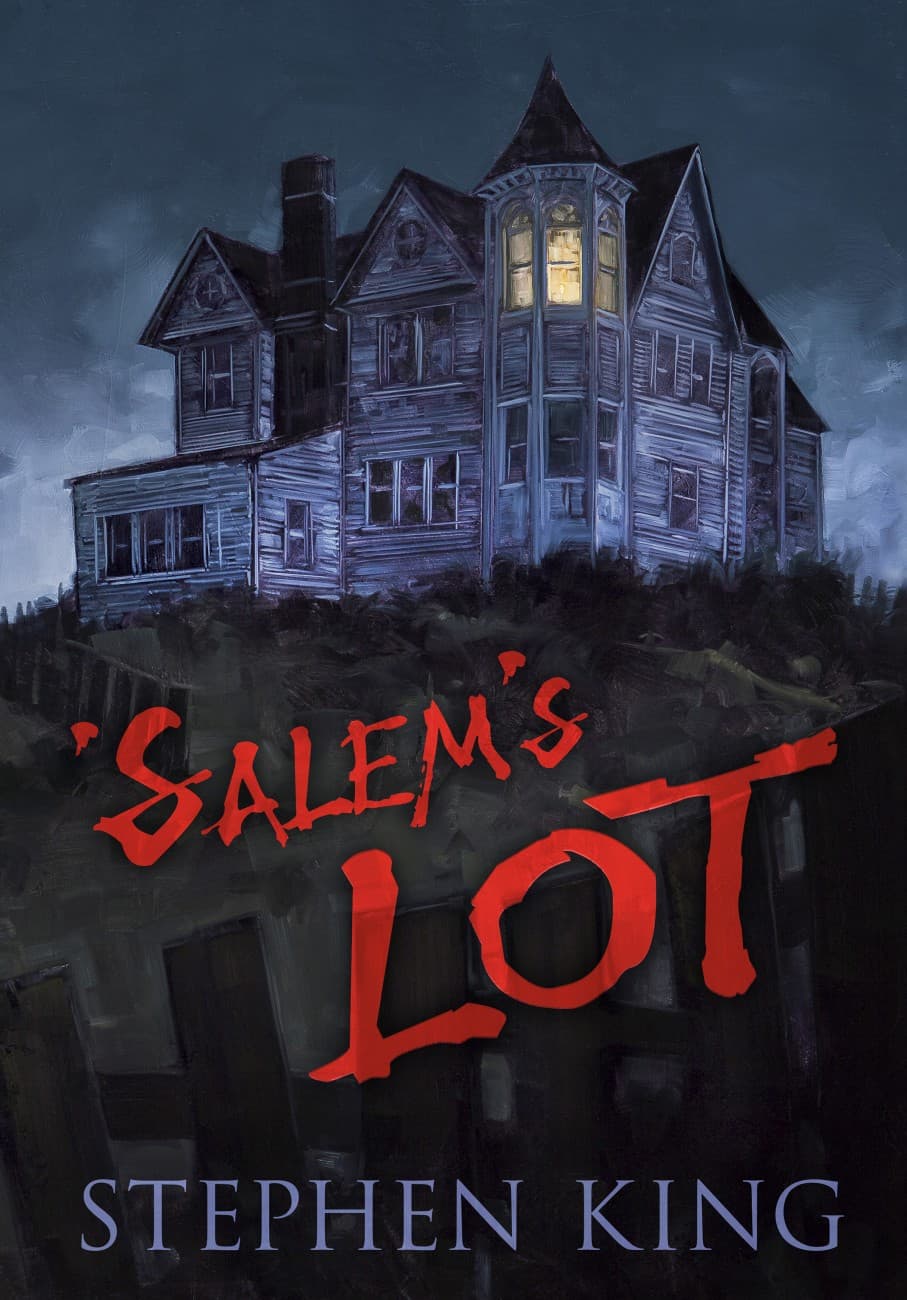
In 'Salem’s Lot, the setting is far more than a backdrop; it is a malevolent participant in the narrative. The Marsten House sits atop a hill, overlooking the town like a physical manifestation of a dark past. King establishes a world-building rule where evil requires a "sink" or a conduit to enter a community, and the house serves as that psychic anchor. The atmosphere is thick with New England Gothic sensibilities—crisp autumn air, the smell of woodsmoke, and the claustrophobia of a town that is geographically isolated and socially insular. The horror functions on the principle of permission: the town's own corruption and habit of looking the other way allow a new, predatory force to take root in the shadows of the Marsten House’s history.
Ben Mears serves as the lens through which we view the town’s decline. His initial arc is one of professional curiosity and personal exorcism; as a widower and a writer, he returns to the Lot seeking a way to translate his childhood fears into a novel. His relationship with Susan Norton, a local woman seeking her own escape from the stagnation of small-town life, provides a grounded, human contrast to the supernatural unease. However, Ben’s primary struggle is the "Status Quo" dilemma. He is an outsider who was once an insider, making him uniquely capable of seeing the subtle changes in the town’s behavior that the locals ignore out of habit or stubbornness.
The novel utilizes the "Invasion" trope, but subverts it by making the invaders savvy businessmen who understand the mechanics of capitalism and property law. By setting the story in a modern (1970s) context, King highlights a specific moral dilemma: the vulnerability of a society that has traded its folklore and spiritual vigilance for scientific rationalism. In this world, the greatest weapon of the antagonist is not brute strength, but the fact that modern people simply do not believe in the "old ways." This creates a high-stakes environment where the protagonists must not only fight a physical threat but also overcome the paralyzing social stigma of being perceived as "insane" for acknowledging the reality of the darkness.
The stakes in the first half of the book are centered on the erosion of the community. As children go missing and unexplainable illnesses begin to spread, the narrative focuses on the breakdown of the town’s social institutions—the medical examiner, the local sheriff, and the clergy. Each character is forced to choose between the safety of denial and the terror of the truth. The moral weight of the story rests on these early observations: how much of our neighbor's safety are we willing to sacrifice for the sake of our own comfortable reality? The horror in 'Salem's Lot is not just what comes out of the basement, but the silence that follows it.
Add to your library to track progress and write reviews
Find 'Salem's Lot Stephen King in PDF, EPUB, ebook, audiobook, print, or library editions.

38 books in catalog
Stephen Edwin King was born the second son of Donald and Nellie Ruth Pillsbury King. After his father left them when Stephen was two, he and his older brother, David, were raised by his mother.
He is widely known for his horror novels, he has been crowned the "King of Horror". He has also explored other genres, among them suspense, crime, science-fiction, fantasy and mystery.